Market analysis
Avocado imports in Argentina: Brazil gains ground
Imports grew 10% through July. Brazil led the transition between Peru's decline and the return of Chilean supply.
September 23, 2026
The Argentine avocado market is undergoing a transition. Although Chile remains its main supplier, during 2026 the market showed a more active presence from Brazil and Peru, particularly during the middle months of the year.
The restructuring reached its clearest point in July. While Peruvian shipments were losing momentum and the new Chilean season had not yet fully entered the market, Brazil accounted for nearly 70% of monthly imports. A month later, the scenario began to shift again: Brazilian supply remained strong, Chile regained market share, and Peru continued to retreat.
This succession of origins not only helps sustain year-round supply. It also changes the competitive landscape in areas such as price, quality, size, and arrival condition.
Avocado imports in Argentina: three years of growth
The evolution over the past three years shows a significant expansion in the volume of avocados imported by Argentina.
Between January and July 2024, the country received approximately 505 containers. During the same period in 2025, the figure increased to 1,346, while in 2026 it reached 1,481 containers.
This means that volume nearly tripled between 2024 and 2025. During the first seven months of 2026, it grew again, this time by 10% compared with the same period of the previous year.
Avobook data confirms greater availability of imported fruit in the Argentine market, although the increase in arrivals should not automatically be interpreted as equivalent growth in final consumption. Establishing that relationship would require incorporating information on sales, inventories, losses, and movement through wholesale and retail channels.
Miguel Bauzá, manager of Don Jaime, notes that avocado consumption has increased in recent seasons, but warns that the country is currently facing a general contraction in demand, which he estimates at around 30% across different product categories.
This context makes the balance between price and quality particularly relevant.
“Product quality at a reasonable price; if the price is not reasonable, consumers will choose the cheaper option,” Bauzá summarizes regarding the priorities of Argentine buyers.
Seasonality and the shift between suppliers
The composition of the Argentine market follows a relatively recognizable calendar, although the expansion of Brazilian supply is beginning to create longer periods of overlap.
Chile has a particularly strong presence at the beginning and end of the year. Peru gains market share during the middle months, while Brazil finds opportunities as its harvest progresses and the Peruvian season approaches its end.
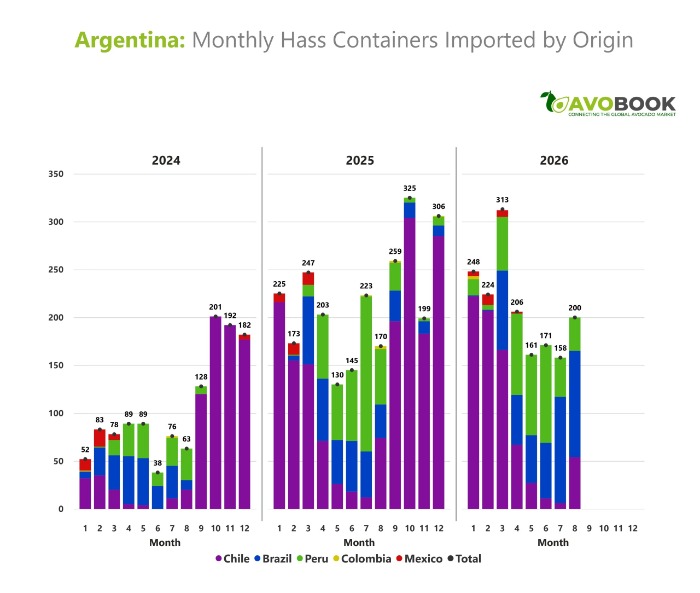
In January 2026, Chile supplied approximately 220 of the 248 containers received by Argentina. Although it was not the only supplier, it accounted for the vast majority of supply.
The composition began to diversify in March. That month, when imports reached their highest level of the year to date at 313 containers, Chile supplied approximately 166, Brazil 83, and Peru 56. A smaller volume from Mexico was also recorded.
From April onward, Peru gained prominence as a source. Its shipments reached approximately 85 containers that month, remained at 84 in May, and increased to 102 in June. At the same time, Chilean participation declined and Brazil began to gain ground.
The result was a gradual transition from a market dominated by Chile toward a more evenly distributed composition among the three main suppliers.
In July, Brazilian avocados took the lead
In July, Argentina imported 158 containers of avocados. Brazil supplied 111, equivalent to just over 70% of the total. Peru accounted for 41 containers, approximately 26%, while Chile recorded around six.
The figure made Brazil the leading origin for the month and clearly reflected the window that opens between the decline in Peruvian supply and the arrival of the new Chilean season.
Tiago Falange Carvalho, Commercial Director of Avocado Jaguacy Agroindustria LTDA, explains that Brazil’s performance was not uniform throughout the season. In February and March, some shipments arrived with dry matter levels below 23%, a situation that affected fruit acceptance and temporarily slowed purchases.
According to Falange Carvalho, the market began moving larger volumes again from May onward. Subsequently, the availability of fruit with better condition and larger sizes allowed Brazil to regain space during June, July, and August.
Bauzá agrees that Brazilian quality improved over the course of the season. In his view, late-season fruit has more favorable commercial attributes and can compete through a combination of larger sizes and lower prices than Chilean supply.
Therefore, the Brazilian opportunity does not depend solely on the existence of a gap in the seasonal calendar. It is also conditioned by its ability to meet the dry matter, quality, and condition standards required by the Argentine market.
August points to the return of Chilean fruit
The Brazilian window did not end immediately with Chile’s reappearance.
In August, Argentine imports increased to 200 containers. Brazil maintained exactly the 111 containers recorded in July, while Chile reappeared with 54 and Peru reduced its shipments to 35.
Brazil still accounted for 55.5% of supply, but Chile’s share increased to 27%. Peru, meanwhile, declined to 17.5%.
The August composition represents the beginning of a new shift: Brazil retained the lead, Chile began to regain ground, and Peru moved closer to the end of its commercial window.
The experience of previous seasons shows that Chile can gain significant presence during the final months of the year. In 2025, for example, the Argentine market received 259 containers in September, 325 in October, and 306 in December, with Chile clearly dominating during much of that period.
In this scenario, the challenge for Brazil will be determining how long it can extend its exports without losing competitiveness against Chilean fruit, which Argentine buyers recognize for its quality.
Price, quality, and size: The dynamics of competition
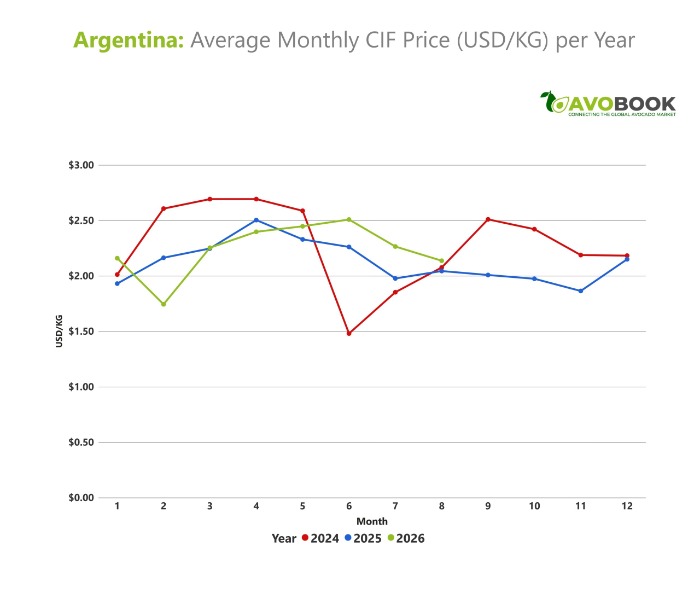
The average CIF price also reflects the changes recorded during the season.
In 2026, it began at approximately US$2.16 per kilogram and declined to US$1.74 in February. It subsequently began to recover, reaching an average of US$2.50 in June, before moderating to US$2.27 in July and around US$2.13 in August.
The trajectory shows that Brazil’s increased prominence in July did not coincide with the lowest price of the year. Its advance coincided with the gradual exit of Peru, lower Chilean presence, and an improvement in the condition of Brazilian fruit.
Falange Carvalho believes that larger sizes could become an advantage for Brazil. According to his analysis, Argentine buyers have begun to become familiar with larger Brazilian fruit toward the end of the season, which could increase competition when it overlaps with new Chilean supply.
Chile retains an advantage in perceived quality, according to Bauzá. However, in a price-sensitive market, that perception alone does not guarantee a purchasing decision. The difference between the two origins will need to remain sufficiently narrow for consumers to prioritize quality over the lower-priced alternative.
Outlook: Brazil seeks to extend its commercial window
Competition could intensify in the coming years due to the growth of Brazil’s planted area.
Falange Carvalho estimates that Brazil currently has around 10,000 hectares planted with avocados, of which approximately 6,000 are in production. For the next season, he projects 11,000 hectares planted and 7,000 hectares in production.
With greater availability, he considers it possible to extend regular shipments to Argentina through the end of October. Production from out-of-season flowering could even allow Brazilian fruit to be present during November, although its volume and continuity will depend on the conditions of each season.
If this expansion materializes, Brazil would no longer participate solely as a transitional supplier. Its calendar would begin to overlap directly with a larger portion of the Chilean season.
A supply landscape that is becoming less linear
The Argentine market is no longer limited to a simple sequence in which one origin disappears before the next one enters. The 2026 data shows increasingly clear periods of overlap and competition.
Chile dominated the beginning of the year. Peru accounted for a significant share of supply between April and June. Brazil took the lead in July and maintained it through August, even as Chilean supply began to return.
The window between Peru and Chile remains strategic for Brazil, but taking advantage of it depends on more than availability. The experience at the beginning of the season demonstrates that entering the market with fruit that has not yet reached the appropriate condition can quickly close commercial opportunities.
Dry matter, arrival condition, size, and price will determine how far Brazilian supply can advance. If production continues to grow and Brazil manages to maintain quality toward the end of the season, competition with Chile will become more direct and the Argentine market calendar will have increasingly less-defined boundaries.
For buyers, this greater overlap expands sourcing alternatives. For suppliers, however, it makes Argentina a more contested market, where taking advantage of a commercial window no longer simply means arriving on time, but arriving with the right fruit.