Market evolution
Argentina will surpass the rate of avocado imports in 2026.
The country received 1,680 trucks of Hass avocados between January and August, nearly 150 more than in the same period of 2025. Chile leads the supply, while Brazil and Peru maintain similar volumes.
October 1, 2026
Argentina continues to increase its imports of Hass avocados after a significant jump in 2025. According to Avobook figures, the country went from receiving 1,271 trucks in 2024 to 2,605 in 2025, an increase of 105%. Between January and August 2026, the cumulative total reached 1,680 trucks.
According to Avobook’s analysis, this latest volume exceeds by approximately 150 trucks the figure recorded during the same months of 2025. The trend points to the possibility of further annual growth, although the final result will depend on arrivals during the remainder of 2026.
Brazil and Peru Close the Gap in Volume
Between January and August 2026, Chile remained the leading supplier, with 760 trucks and approximately 45% of the imported volume.
Brazil ranked second, with 467 trucks, followed by Peru, with 425. Together, both origins accounted for approximately 53% of arrivals, with a difference of 42 trucks in favor of Brazil.
Brazil’s cumulative total through August had already surpassed its 395 trucks for all of 2025. This comparison helps put its progress into perspective, although it involves periods of different durations. Mexico also appears among the suppliers, with a reduced share compared with the three leading origins.
Chile Drove the 2025 Jump
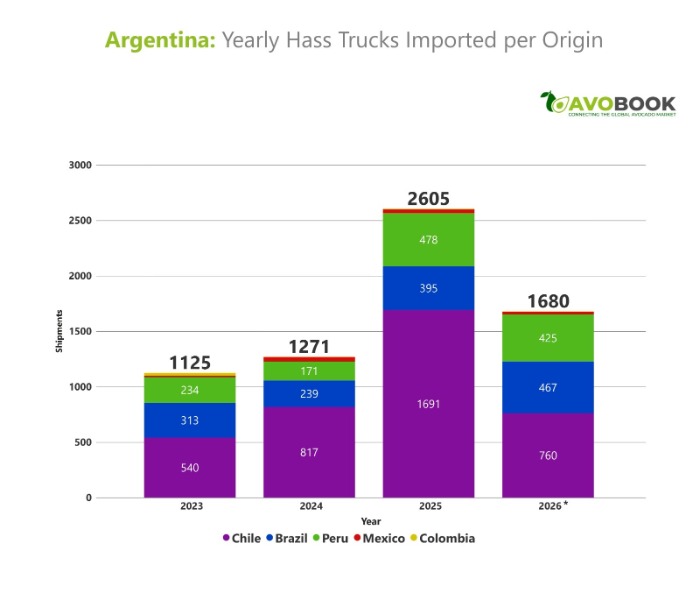
The series shows a change in the scale of Argentina’s supply. In 2023, 1,125 trucks entered the country, while in 2024 there were 1,271. One year later, the volume had more than doubled.
Chile made the largest contribution to the increase between 2024 and 2025. Its shipments rose from 817 to 1,691 trucks. The additional 874 trucks represented approximately 66% of the total increase in Argentina’s avocado imports.
Peru also expanded its presence, increasing from 171 trucks in 2024 to 478 in 2025. Brazil, meanwhile, increased its shipments from 239 to 395 trucks during that period.
More Volume, with Attention to Consumption Capacity
The increase in imports raises a question for exporters: How much volume can the market absorb and at what prices?
In statements collected by Avobook in 2025, Miguel Bauza, from Don Jaime, warned that consumption growth did not have a precise projection. “The increase in avocado consumption in Argentina does not have a certain or measured projection,” he noted.
Bauza identified demand concentrated in Buenos Aires and other urban markets, including Rosario, Córdoba and Mendoza. He also linked the incorporation of avocado into diets to interest in healthy food and recommendations from nutritionists.
His observations provide context for current growth, although they correspond to 2025. Import figures show an expansion in supply; on their own, they do not make it possible to measure how much consumption increased or how profitability evolved.
With 1,680 trucks received through August, Argentina is moving above the volume recorded during the same period of the previous year. The end of 2026 will determine whether this trajectory translates into a new annual high.