Expanding market with strong concentration of origin
Argentina experiences sustained growth with Chilean dominance
The Argentine avocado market is expected to increase its import volume between 2023 and 2026, reinforcing its high dependence on Chilean supply.
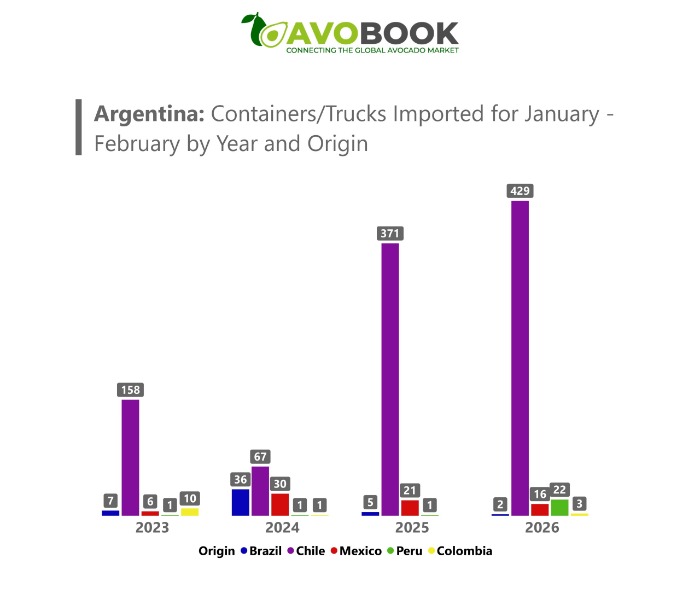
The Argentine avocado market continues to show sustained growth in recent years, accompanied by a marked concentration in its source of supply. According to data from the Avobook team, imports during the January-February period increased from approximately 182 shipments in 2023 to 472 in 2026, representing a 159% increase.
This growth not only reflects increased market demand but also an acceleration in the pace of expansion. Shipments are projected to increase by 19% between 2025 and 2026 alone, consolidating an upward trend that has been intensifying since the previous year.
In this scenario, Chile stands out as the dominant player. In 2026, the country accounted for 429 shipments in the first two months of the year, far exceeding any other origin. This figure represents a significant jump compared to the 67 shipments recorded in 2024, demonstrating sustained growth that explains virtually all of the expansion of the Argentine market.
Chile's participation is also reflected in the market structure. During January–February 2026, Chilean products accounted for 90.89% of total imports, creating a scenario of high dependence. Far behind are Peru, with 4.66%, Mexico with 3.39%, Colombia with 0.64%, and Brazil with 0.42%.
While some origins show signs of recovery, their presence remains marginal. Peru, for example, is increasing its shipments from just 1 in 2024 to 22 in 2026, while Mexico reaches 16 shipments in the same period. However, these advances do not significantly alter the market structure.
Brazil, meanwhile, is experiencing a decline in its relative share, dropping from 36 shipments in 2024 to just 2 in 2026, further reinforcing the concentration on a single origin. Colombia also maintains a limited presence, with volumes not exceeding 3 shipments in 2026.
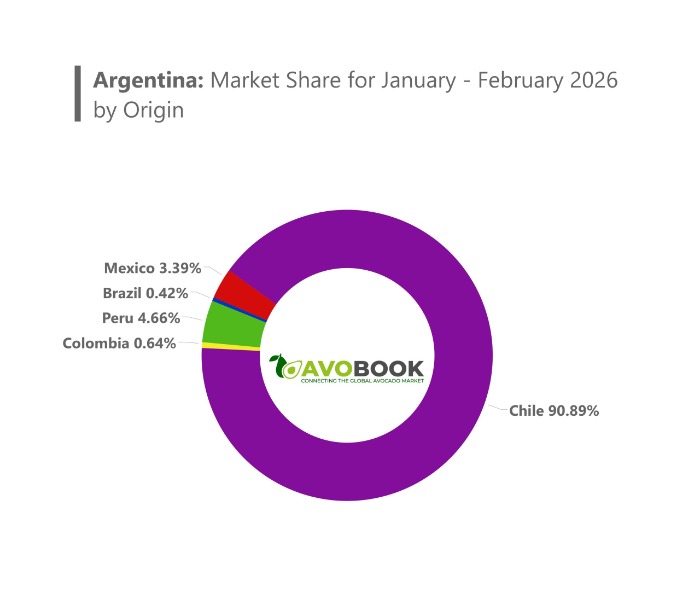
Thus, Argentina is currently configured as an expanding market, but one highly dependent on Chilean supply. The growth observed in recent years is explained almost entirely by this origin, while the other supplier countries continue to play a secondary role in the supply dynamics.