Asian Survey
Hass avocado imports are growing in China, Japan, and South Korea
China leads growth in Asia, Japan consolidates stability, and South Korea maintains steady expansion in the first half of the year.
During the first half of 2026, Asian markets maintained a positive trajectory in their Hass avocado imports, although with very different behaviors among themselves.
While China saw a strong increase in volumes driven mainly by Peru , Japan maintained a more stable and diversified supply, and South Korea continued to consolidate gradual growth that reflects the sustained expansion of its domestic consumption.
Asia continues to strengthen its position as a leading destination for Hass avocados . While it still accounts for a smaller volume of shipments than Europe or the United States , the first half of 2026 confirms the region's growing importance for exporting countries. China, Japan, and South Korea all increased their imports during the first half of the year, responding differently to the increased supply.
China consolidates the strongest growth of the semester
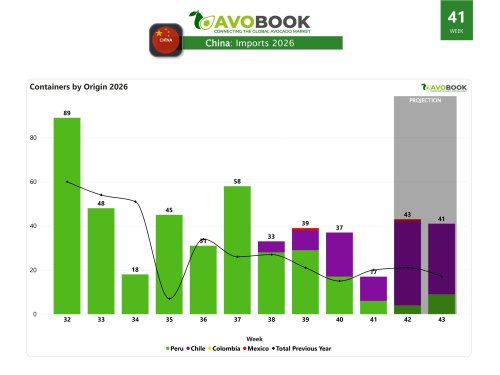
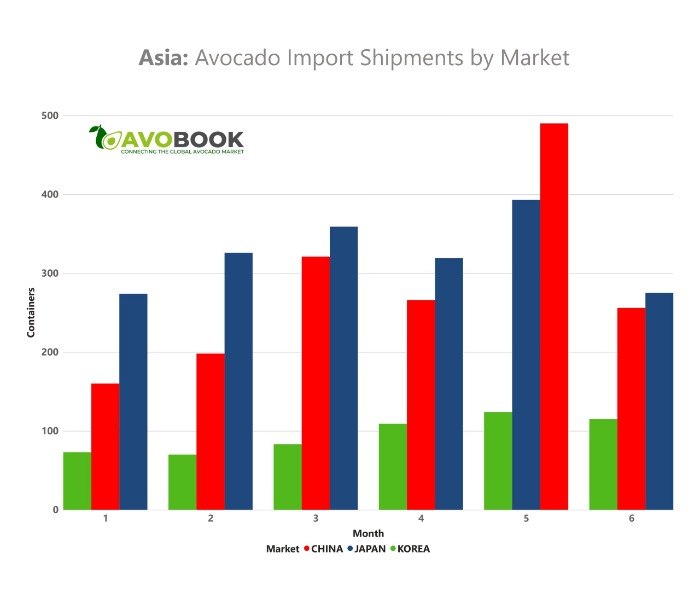
Among the three markets analyzed, China registered the most significant expansion in the region. Fruit imports began the year at approximately 160 containers in January, gradually increasing to over 300 containers in March. Growth continued throughout the second quarter, reaching its peak volume in May at 490 containers, before experiencing a moderate downward correction in June.
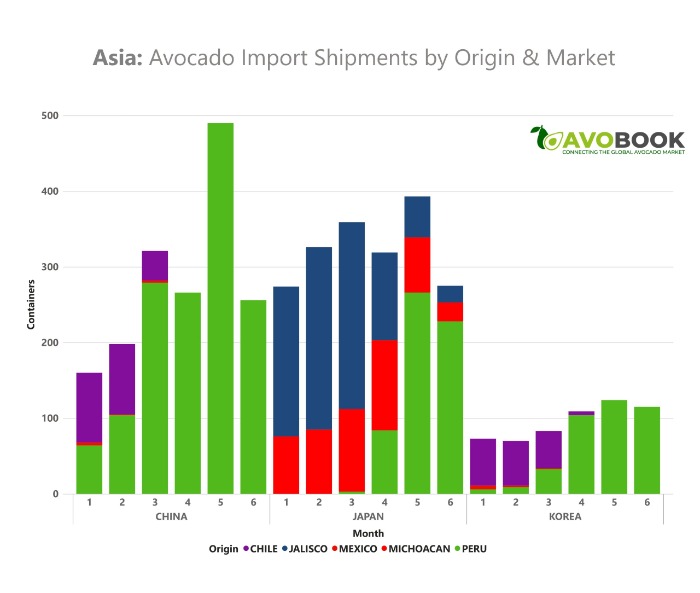
This increase was primarily driven by Peru, which went from sharing the supply with Chile during the first months of the year to becoming the overwhelmingly dominant supplier from March onward. Chile, on the other hand, gradually reduced its share as the Peruvian season progressed, reflecting the typical seasonal shift in supply to the Chinese market.
More supply meant lower prices
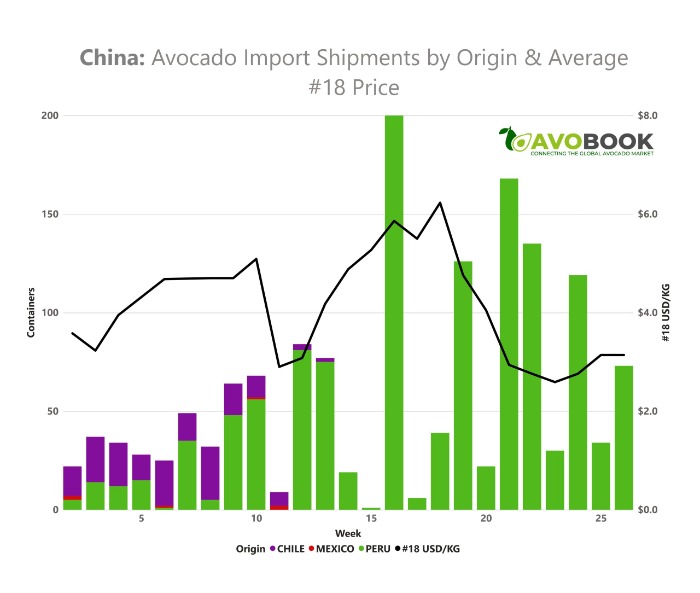
The growth in imports also had a direct effect on prices in China. During the first weeks of the year, when arrivals were still limited, the average price of size 18 remained stable between US$4 and US$5 per kilogram at distribution centers.
However, the situation began to change from week 16 onwards, coinciding with a significant increase in shipments from Peru. As supply grew at the Asian port terminals, the market began to show increasing pressure on trade prices.
Between weeks 16 and 22, some of the largest volumes of the semester were concentrated, and at the same time, the average price fell from US$ 6.23/kg to approximately US$ 3.14/kg, showing an inverse relationship between fruit availability and valuation.
This behavior demonstrates that, despite the growth in local consumption, China continues to be a particularly sensitive market to sudden increases in supply, where rapid variations in volumes generate profound impacts on sales values.
Japan maintains a stable and diversified market
Unlike China, Japan exhibited considerably more stable trade behavior throughout the semester, maintaining more homogeneous monthly volumes in its import records.
Imports began with approximately 275 containers, gradually increased until March, registered a slight decrease in April, and subsequently grew again in May before moderating towards the end of June.
One of the most interesting aspects of the Japanese market was the composition of its supply. During the first months of the year, Jalisco led shipments, while from the second quarter onward, Peru began to gain prominence. At the same time, Michoacán and other Mexican origins also increased their share, resulting in a Hass avocado supply that is considerably more diversified than that of its Chinese counterpart.
This stability in volumes and the diversity of suppliers suggest a consolidated demand capable of absorbing supply variations without major imbalances.
Key aspects of supply and trade behavior in Asia
Peru consolidated its position as the dominant supplier in China and South Korea from April onwards, displacing the initial share held by Chile at the beginning of the season.
Furthermore, the abrupt increase in containers generated strong downward pressure in the Chinese market, causing the average price of 18 gauge to retreat significantly from its initial peak.
For its part, Japan demonstrated a commercial structure capable of absorbing supply variations without imbalances thanks to a balanced supply among multiple providers such as Jalisco, Michoacán and Peru.
If the trend observed during the first six months of the year continues, Asia will continue to increase its importance in the global avocado trade. Understanding these specific patterns will become increasingly relevant for defining the trade strategies of exporting countries in the coming cycle.