Security and logistics
Michoacán strengthens security in avocado cultivation
The deployment of 1,500 troops in Michoacán seeks to safeguard production, transportation, and certifications after temporary pauses in shipments.
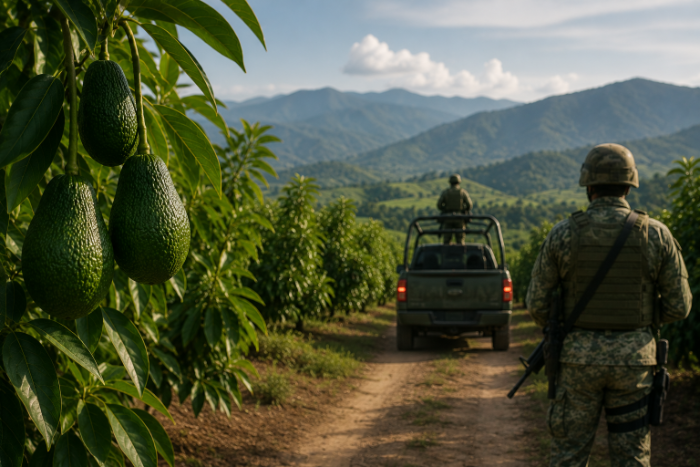
In recent days, the Mexican avocado sector has once again become the focus of international attention following the strengthening of security measures implemented by the Federal Government in Michoacán, the country's main avocado producing and exporting state.
The decision comes in response to a series of security incidents in some production areas that led to a reinforced police presence and the coordination of new measures to protect the operation of the agricultural export chain. Meanwhile, activity is gradually returning to normal, as authorities work to ensure the continuity of trade and the confidence of international markets.
An operation focused on production and logistics
As part of the new deployment, the Mexican government added 1,500 new members of the Army and the National Guard, joining the approximately 8,000 troops already operating in Michoacán.
The strategy includes the protection of 17 packing plants, the installation of 29 operational bases in the main producing areas, and permanent surveillance on strategic roads used for avocado transport.
The operation also includes accompanying the staff of the National Service for Agrifood Health, Safety and Quality (Senasica) at various phytosanitary inspection points, as well as creating a Regional Intelligence Fusion Center in Uruapan, from where security actions will be coordinated.
The measures will focus especially on municipalities such as Los Reyes, Peribán, Tingüindín, Tocumbo and Cotija, considered relevant areas for avocado production.
A challenge that transcends production
The strengthening of security occurs in a context where extortion against producers, transporters and packers has been recognized by the Mexican authorities themselves as one of the main challenges facing the agri-food chain of Michoacán.
During the presentation of the results of the so-called Michoacán Plan, the Secretary of Security and Citizen Protection, Omar García Harfuch, reported that since the strategy's inception, nearly 950 arrests have been made in the region related to various crimes, including those involving extortion rackets that affect diverse agricultural activities. Recent actions also include the capture of new members of groups linked to these practices, reinforcing the government's strategy aimed at reducing the risks faced by the productive sector.
Impact on international trade
The situation took on special significance after the United States temporarily suspended the processing of exports from the region, a measure adopted as a result of the security situation that affected phytosanitary supervision efforts.
This type of disruption is not entirely unprecedented for the industry. Similar situations occurred in 2022 and again in 2024, when security-related incidents also led to temporary pauses in exports before both governments agreed on new protective measures and activity could resume.
Given that Michoacán concentrates about 88% of Mexican production destined for the US market, any alteration in its operation generates immediate follow-up by international importers, exporters and distributors.
The priority: to restore normal operations
Beyond recent events, both authorities and industry have focused their efforts on ensuring the continuity of supply. The deployment of personnel aims to protect the entire logistics chain, from production areas to packing plants, transport routes, and sanitary inspection points, with the goal of providing safer conditions for producers, workers, and certification bodies.
In parallel, the gradual resumption of activities allows for a projected gradual recovery of trade flows, while the measures announced by the Mexican government continue to be implemented.
A key factor for one of the world's leading suppliers
Michoacán maintains a strategic role in the global avocado market. Its production capacity and close trade relationship with the United States make the region's operational stability a key factor for the entire industry.
In this context, the announced measures aim not only to strengthen security in production areas but also to preserve the continuity of a supply chain that serves one of the world's most important markets. The progress of the operation and the consolidation of the return to normalcy will be closely monitored by various industry stakeholders in the coming weeks.