Francisco González Valdés
Salt washing as part of the production strategy in Hass avocado
Chili
A key aspect of increasing the efficiency of fertilization programs is the design of irrigation programs under salt-free soil conditions, despite the growing difficulty of applying leaching irrigations during increasingly dry winters.
Scientific models, historical statistical data, glacier retreat, and the progressive decline of the sclerophyllous forest (espino, peumo, quillay, and boldo trees) all demonstrate that rainfall has decreased significantly over the past 15 years. As a reference, in the Maipo River basin, at the elevation of the Olivares River glaciers—one of the sub-basins that contributes most to the Maipo River flow—a glacier mass covering 110 km² existed 150 years ago. Today, these glaciers cover only 54 km² due to rising atmospheric temperatures at higher elevations.
In the future, water resources for agriculture will become increasingly scarce, making irrigation programs ever more efficient. One factor inherently associated with irrigation management is salinity.
Most cultivated plants are sensitive to salinity and may show reductions in productivity even at relatively low salinity levels in irrigation water. In the case of avocado trees, it has been reported that an electrical conductivity (EC) level of 0.8 dS/m in irrigation water can already affect yield potential, while production losses may reach as much as 65% at an EC level of 1.8 dS/m (Figure 2).
An increase in salt concentration in irrigation water, and the subsequent accumulation of salts in the soil solution, inhibits growth and alters water relations within the plant, creating osmotic drought conditions (Figure 1). Stomatal opening, which governs transpiration and gas exchange between the plant and the atmosphere, is dramatically affected. The entire plant experiences reduced transpiration as a consequence of the osmotic effect generated by high salt concentrations in the rhizosphere.
Chloride and sodium ions accumulate in leaves and damage the photosynthetic machinery within chloroplasts. Sodium, in particular, also affects cytoplasmic pH regulation. All these effects are expressed as partial leaf burn and a significant reduction in the photosynthetic capacity of the entire plant.
As a result, leaf area decreases, sudden defoliation may occur during flowering, recently set fruit may drop, fruit drop may intensify during mid-season, and fruit size may be adversely affected. Depending on salinity levels at the beginning of the season and the characteristics of the accumulated ions in the soil, the productive capacity of the plant can be reduced by up to 50%.
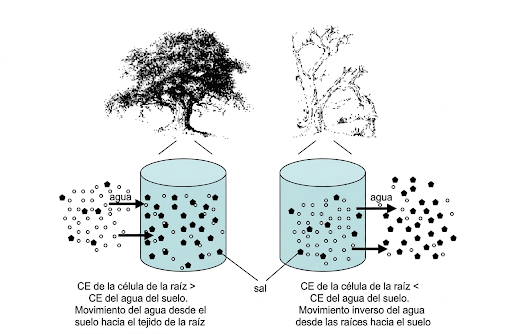
Figure 1. Water movement within the plant as a consequence of salt concentration (EC) gradients between the soil solution and plant cell tissues.
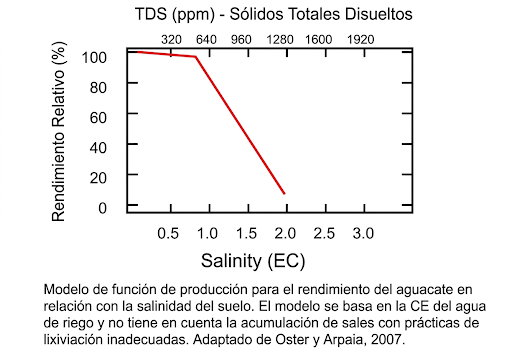
Figure 2. Productivity affected by salt levels in irrigation water, assuming that irrigation water EC is similar to soil solution EC (saturated paste). Salt leaching practices are not considered.
Rainfall Events and Salt Leaching
Until a few years ago, rainfall levels considered normal (above 350 mm) were sufficient to provide natural salt leaching during the autumn-winter period, when plants are either dormant (deciduous species) or undergoing fruit maturation and floral induction (evergreen species).
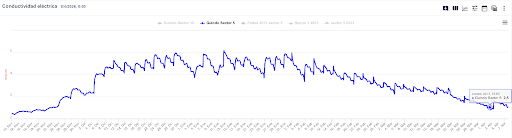
The decline in rainfall across central Chile has resulted in accumulated salts from irrigation water not being adequately leached. Effective salinity management begins with understanding irrigation water quality and how both salt concentration and composition change throughout the year. In rivers of central Chile, increased flows caused by winter rains or summer snowmelt produce a noticeable dilution of salts.
On the other hand, it is not possible to leach salts from the soil when the salt concentration in irrigation water is higher than the salt concentration already present in the soil.
Rainwater, which is virtually salt-free, can partially improve the effectiveness of leaching irrigations, provided that the post-rain wetting front is followed by an early leaching irrigation event.
Conversely, a low-intensity rainfall event may actually intensify the damage caused by accumulated salts if no leaching irrigation is applied afterward.
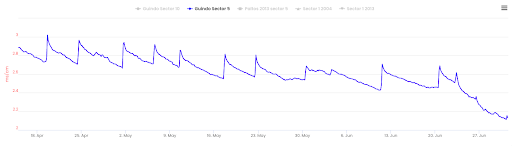
Salt movement within the soil follows concentration gradients. Therefore, if a rainfall event of approximately 30 mm penetrates about 25 cm into the soil profile, the salt concentration in the upper layer (0–30 cm) would be expected to be lower than in the deeper layer (30–60 cm). Since most fruit trees concentrate their fine absorbing roots in the upper soil layer, the absence of a subsequent leaching irrigation will inevitably cause salts from deeper layers to move upward toward the root zone.
Within three to four weeks, this process may become evident through severe foliage burn caused by salts, characterized by necrotic leaf tips and an overall wilted appearance of the orchard.
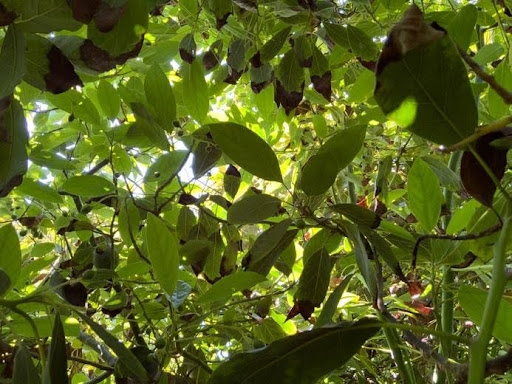
Figure 3. Fruit set developing under saline conditions. The apparent good fruit set will be severely affected by the lack of photoassimilates and nutrients resulting from the progressive damage caused by salinity to the foliage.
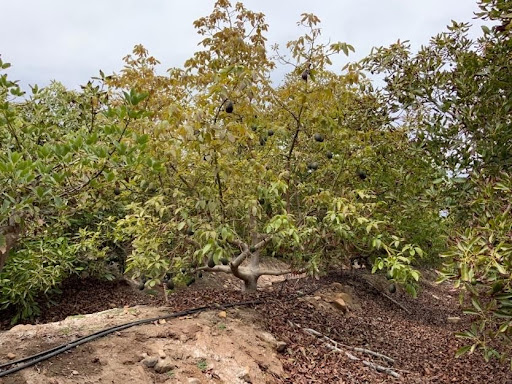
Figure 4. Severe defoliation that leaves mature fruit susceptible to abortion due to extreme tree weakness. 10/02/2022.
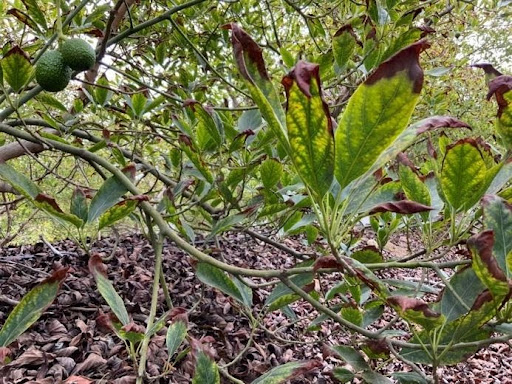
Figure 5. Severe leaf damage in an orchard affected by salinity. Note that although chloride burn affects only about 10% of the leaf surface, toxicity has destroyed chloroplasts throughout most of the leaf, leaving less than 10% of the leaf photosynthetically active. Developing fruit remains exposed and susceptible to abortion. 10/02/2022.
Francisco González Valdés
Avocado and citrus consultant - Bellotoagro
+56 97478 7535 -
fgonzalez@bellotoagro.cl
Learn more about us at bellotoagro.cl