Wood-decay fungi in Hass avocado: origin and impact on fruit production and quality (part 1)
Chili
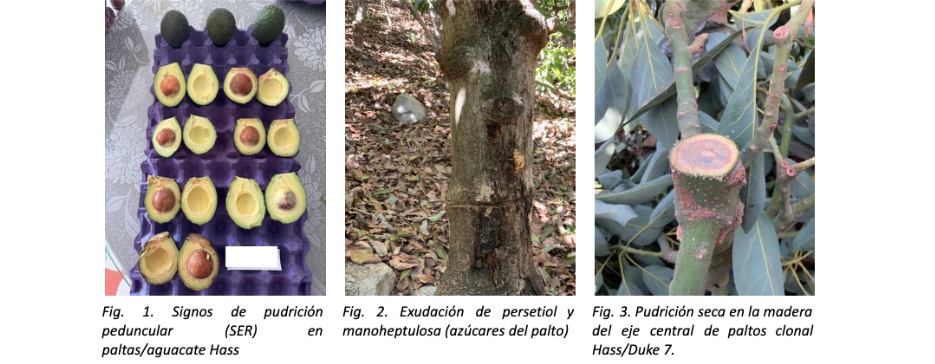
In July, a seminar on wood-decay fungi in Hass avocados was held in Chile, due to the increasing incidence and severity of the disease in Chile, Peru, and certainly Colombia. The seminar included testimony from Dr. Luis Álvarez of Peru, academic studies by Professor Ximena Besoain (PUCV), and the technical perspective of the author of this column. In the previous column, we discussed the difficulty of marketing fruit that does not guarantee quality, specifically observing fruit affected by stem end rot (SER) on a supermarket shelf. The implications of this disease affect both the production and marketing chains, highlighting the complexity of selling a green fruit that appears healthy but develops stem end rot and black vascular bundles as it ripens (Figure 1).
Situation in Chile
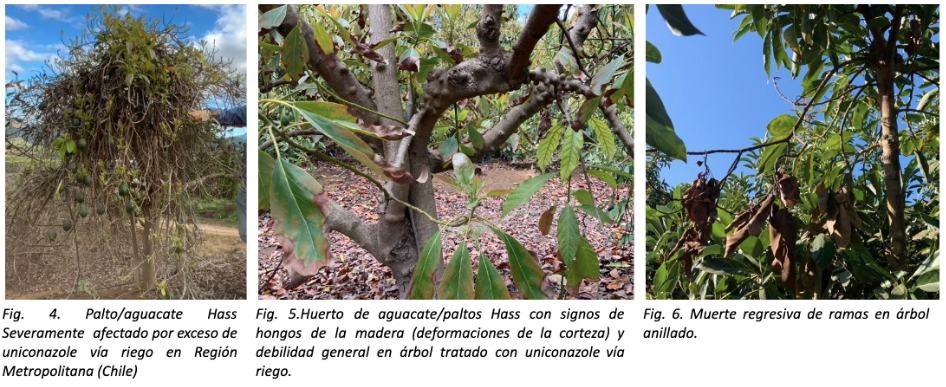
In this context, I studied the work of Valencia et al. (2019), who, in collaboration with various industry stakeholders, including consultants, producers, and exporters, surveyed orchards throughout Central Chile affected by this group of fungi. The evident signs of these fungi in the wood are dieback of branches, exudation of sugars (persetiol and mannoheptulose), and dry wood rot, all of which reduce production (Figures 2, 3, and 6). In the study, 6 of the 16 orchards surveyed were affected by wood-decay fungi, while 11 of the 16 presented species that produce SER (Symbiotic Reactivity) in fruit. In addition to the above, Valencia (2019) observed a high degree of genetic diversity, making it possible to associate more virulent species that affect the fruit, causing fruit rot (SER), in warmer climates in geographical areas with low coastal influence (e.g., San Felipe). These species, such as Lasiodiplodia theobromae, reach their maximum growth rate at temperatures between 20 and 35°C. Conversely, orchards with greater coastal influence and more moderate temperatures exhibit species with lower growth rates, such as Neofusicoccum nonquaesitum, associated with wood damage, whose maximum growth rate occurs between 20 and 30°C. Both species are also the most severe, capable of forming larger lesions in less time, both on post-harvest fruit (L. theobromae) and on trees (Neofusicoccum nonquaesitum), severely impacting productivity. They are also present in other countries such as Colombia and Peru. Other species of fungi associated with wood and fruit were surveyed by Valencia (2019) in this work, and this high diversity of species was also attributed to the climatic and geographical diversity of Chile. Thus, these species are now considered endophytes, meaning that orchards that appear healthy may already contain some of these fungi, and their origin could, in many cases, come from nurseries whose plants are propagated from material originating from already infected orchards.
Dispersal of Conidia (Spores) and Orchard Infection: Like all diseases, wood-decay fungi require three concurrent factors to manifest: 1) favorable environmental conditions, 2) the presence of the causal agent, and 3) a susceptible host. These three factors are not always present, but assuming that the causal agent is present in most cases (endophytic disease), the analysis of disease control should focus on the susceptible host or, alternatively, understanding when environmental conditions are favorable. Thus, if the fungus is already present in the orchard, favorable weather conditions are sufficient for its development to cause disease, that is, economic damage, when the orchard is most susceptible. In Chile, we have observed that stressed orchards express the disease at the wood level between midsummer (February) and autumn (May), precisely when water stress occurs due to either a deficit or excessive ambient heat. The latter can be the case in orchards on north-facing slopes. Conidia dispersal begins with the first rains between April and May, and if there are open wounds from summer pruning or girdling, there is a greater likelihood of infection in healthy trees. Studies conducted in California (Avenot et al. 2023) have shown that the highest incidence occurs in orchards planted at high densities (3x3), not by chance, but due to the high intensity of formative pruning since establishment. Furthermore, in Chile, severely affected high-density orchards exhibit symptoms of the disease when girdling and the use of growth regulators applied via irrigation coincide. This management practice could also be a predisposing factor, since in new orchards treated with growth regulators, vigor is reduced precisely due to the effect of uniconazole, which reduces the diameters of the xylem vessels, generating a slowdown in water conduction (similar to resistance), at least in the xylem formed in the cambium zone, located just under the bark, very close to the phloem, which is the food source for wood-decay fungi. In young trees, high doses of uniconazole maintain this effect throughout the season and even for several seasons, depending on the soil type and organic matter content, leading to situations of extreme decline (Figures 4 and 5). Cultural practices such as reducing pruning material or removing it from the orchard also contribute to disease control.
Fig. 4. Hass avocado severely affected by excess uniconazole via irrigation in the Metropolitan Region (Chile)
Fig. 5.Hass avocado orchard with signs of wood-decay fungi (bark deformations) and general weakness in a tree treated with uniconazole via irrigation.
Several agronomic techniques and positive experiences are being studied, and some promising results have already been obtained for effective disease control at both the orchard and fruit levels. These aspects will be discussed in the next column. Additional seminar material can be found at bellotoagro.cl
References
Avenot, Herve Fabrice, Dee Vega, Mary Lu Arpaia, and Themis J. Michailides. 2023. “Prevalence, Identity, Pathogenicity, and Infection Dynamics of Botryosphaeriaceae Causing Avocado Branch Canker in California.” Phytopathology® X (X): 1–14. https://doi.org/10.1094/phyto-11-21-0459-r. Valencia, Ana L., Pilar M. Gil, Bernardo A. Latorre, and I. Marlene Rosales. 2019. “Characterization and Pathogenicity of Botryosphaeriaceae Species Obtained from Avocado Trees with Branch Canker and Dieback and from Avocado Fruit with Stem End Rot in Chile.” Plant Disease 103 (5): 996–1005. https://doi.org/10.1094/PDIS-07-18-1131-RE.
Francisco González Valdés, Avocado and Citrus Consultant - Bellotoagro +56 97478 7535 - fgonzalez@bellotoagro.cl