Regional market
Chilean avocado gains ground in the Argentine market
Economic openness, exchange rate stability, and consumption growth position Argentina as a structural opportunity for Chile with room to continue expanding trade volume and value, according to Antonio Lante, manager of Exportadora Baika Chile and Peru.
Argentina has ceased to be merely a complementary market and has become one of the most important strategic destinations for Chilean avocados. The combination of economic openness, greater exchange rate stability, growth in domestic consumption, and a favorable trade window has allowed Chile to strengthen its presence and reach nearly 60% market share in that country.
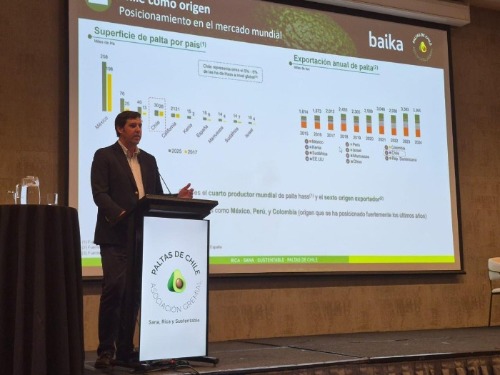
This was explained by Antonio Lante Della Rovere, manager of Exportadora Baika Chile and Peru, who during his analysis highlighted that Argentina today represents a true “strategic lung” for the Chilean industry, both for its growth potential and for its logistical advantages compared to traditional destinations such as Europe.
One of the main factors behind this consolidation has been the change in the Argentine economic context. According to Lante, the liberalization of imports, which were previously heavily restricted, along with greater dollar stability and a growing economy, have fostered a more dynamic market with better conditions for international trade.
Added to this is a consumer who has matured year after year in their relationship with avocados, progressively increasing their consumption and consolidating a more stable demand.
A business opportunity with less risk and greater value
Chile has also managed to consolidate its position thanks to a key structural advantage: its trade window faces virtually no direct competition from other major regional origins.
Brazil and Peru, the main competitors in South America, do not significantly overlap with the Chilean season, functioning more as complements than competitors. Furthermore, Argentine production does not overlap with Chilean supply, allowing for greater commercial stability.
According to the Baika executive, this condition allows Chilean fruit to be sold at even higher FOB values compared to other origins, reflecting a clear price differentiation on the part of the Argentine consumer.
Traditionally, Europe has been the main destination for Chilean avocados. However, the growth of Argentina as a structural market is changing some of that export logic.
Geographical proximity significantly reduces transit times, minimizes travel risks, and improves logistical efficiency. This results in fruit with less exposure to transportation problems and greater commercial security.
Furthermore, Lante points out that Argentine consumers are willing to pay high and competitive prices compared to Europe for Chilean fruit, making the neighboring market an increasingly attractive alternative for exporters.
Another concept that is gaining strength in the Chilean export strategy is that of so-called "global supply blackouts", commercial windows that open when other origins face extraordinary climatic problems.
Phenomena such as heavy rains, heat waves, frosts, or El Niño events can significantly disrupt production in countries like Peru, Morocco, Spain, or even Chile. These disruptions create specific demand opportunities that Chile can capitalize on thanks to a key advantage: the ability to keep fruit on the tree and strategically decide when to harvest.
“Chile has the advantage, it has the fruit and the conditions to be able to travel long transits,” explained Lante, emphasizing the need for the industry to be attentive to react quickly when a source loses supply and a commercial opportunity arises in specific markets.
The challenge now is to grow strategically.
Despite these opportunities, the international growth of Chilean avocados also faces significant constraints.
The main challenge lies in the limited availability of suitable land for new avocado plantations. Unlike other crops or countries like Peru, where territorial expansion has been much more aggressive, Chile has a more restrictive geography for avocado cultivation.
Added to this is a robust domestic market, which competes directly with exports and often offers equally attractive returns. According to Lante, Argentina even functions almost as a second domestic market today due to its proximity and sustained growth.
From Baika's perspective, the Argentine market is still far from reaching its peak.
Per capita consumption remains low, although it maintains a steady upward trend. The main challenge will be the country's economic stability, especially regarding variables such as the exchange rate, the strength of domestic consumption, and potential future import restrictions.
However, even during challenging years for the Argentine economy, avocado consumption continued to grow, albeit at a slower pace. Today, with greater economic openness, the market offers an even more significant opportunity to further expand volume.
For Lante, the next step is not just about selling more fruit, but about refining the offering and building greater commercial value.
One of the major challenges lies in further professionalizing the ripening of avocados at their destination. The Chilean experience demonstrates that when consumers have access to ripe, ready-to-eat fruit, the market can grow significantly.
In terms of quality, he assures that Chile has already made significant progress and today sends good fruit to Argentina, so the main challenge is to consolidate that consumption experience and strengthen the Chile origin brand.
“It’s not about changing varieties, but about being strategic in harvesting decisions and carefully reading the opportunities offered by both the domestic and international markets,” he concluded.
According to the executive, competing solely for commercial opportunities will not be enough. While Chile has managed to position itself with good quality and a consistent supply, he considers it essential to continue strengthening the country brand with promotional activities that will allow it to maintain and expand that leadership in markets like Argentina.