European market
Europe receives 14.6% more avocados so far in 2026
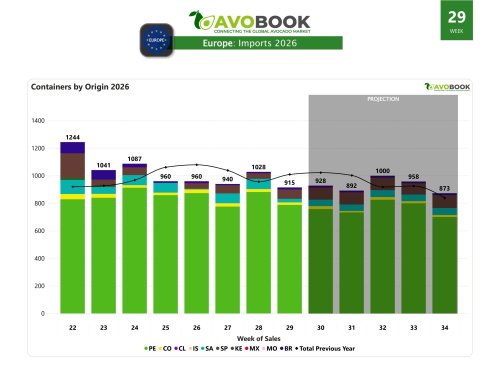
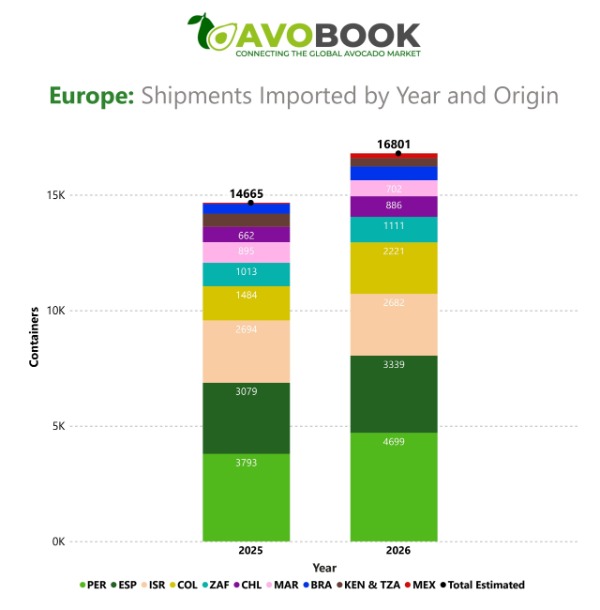
Between weeks 1 and 19, arrivals reached 16,799 units. Peru, Colombia, and Chile are gaining ground, while Morocco and Kenya are losing ground.
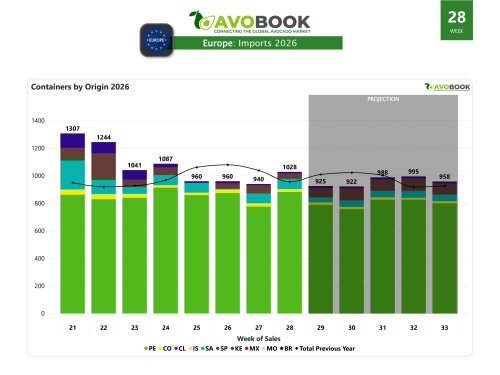
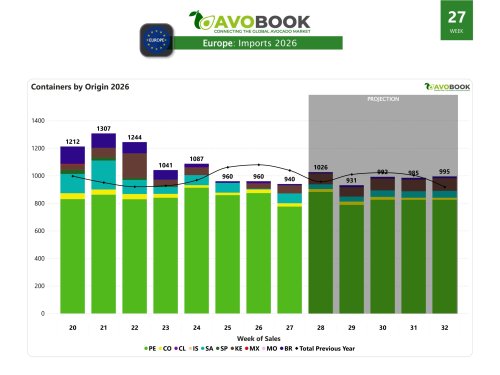
Europe continues to solidify its position as the leading destination for international avocados, and so far in 2026, the market shows greater fruit availability compared to the previous year. According to estimates from the Avobook data team, between weeks 1 and 19, total arrivals reached 16,799 units, representing a 14.6% increase compared to the same period in 2025, when 14,663 units were recorded.
The increase reflects greater supply pressure in the European market, driven mainly by the advance of shipments from Peru, which remains the main origin and also leads growth in absolute terms.
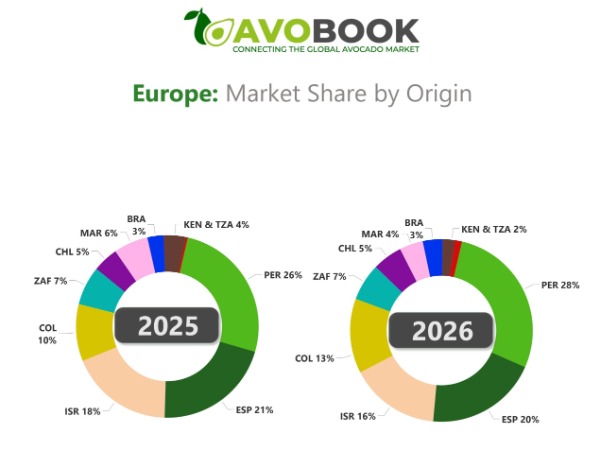
During this period, shipments from Peru increased from 3,793 to 4,699, representing a 23.9% rise. This increase reaffirms Peru's position as the continent's main supplier and explains a large part of the overall growth observed in Europe during the first 19 weeks of the year.
Colombia, Chile and Brazil expand their presence
Colombia also showed significant expansion within the European market. Its shipments grew by 49.7%, from 1,484 to 2,221 units, consolidating an increasingly relevant share of the international market.
Chile also registered significant progress, with a growth of 33.8%, strengthening its presence in Europe and gaining more space within the trade window.
Brazil, for its part, showed a significant expansion of 40.2%, while South Africa presented a more moderate increase of 9.7%, remaining a stable player within the European supply.
In the case of Spain, growth was 8.4%, which allowed it to remain one of the main regional suppliers, especially due to its strategic role within the European market itself.
Mexico is accelerating, while Morocco and Kenya are falling behind
One of the most striking data points of the period was the performance of Mexico. Although it still maintains a smaller share of the total, it registered the largest relative growth among all the origins analyzed, going from 53 to 207 arrivals, equivalent to an increase of 290.6%.
This progress reflects a greater Mexican presence in Europe, although still far from the volumes handled by the continent's main exporters.
In contrast, some origins showed a reduction in their shipments. Morocco registered a drop of 21.7%, while Kenya decreased by 35.9%, reflecting a smaller share compared to the same period of the previous year.
Israel, meanwhile, practically maintained its shipments without major variations, showing stability within its usual presence in the European market.
The balance of the first 19 weeks confirms that Europe continues to concentrate high international supply pressure, with Peru leading the supply and several Latin American origins gaining prominence in an increasingly competitive scenario.