Francisco González Valdés
Climate trend for Chile 2026 to 2027
Chili
On May 19, 2026, in its latest climate trend report, the Climate Research Institute (CRI) at Columbia University published projections indicating that the arrival of El Niño is imminent. Based on the sea surface temperature anomaly, which was +0.1°C between February and April, this anomaly reached +0.4°C in May. This means the threshold for the development of El Niño has already been reached, considering that an anomaly in sea surface temperature exceeding 0.5°C is considered an El Niño event.
Regarding the expected trends for Chile in the coming months, based on observations of the subsurface water temperature profile in the east-central equatorial Pacific, a notable warming signal has emerged. Temperatures at depths between 50 and 150 meters have increased substantially, with anomalies exceeding 6°C. This represents a significant reservoir of subsurface heat that could act as critical surface energy for the development and intensification of El Niño conditions later on, contributing to atmospheric-marine coupling. This is expected to continue until the summer of 2027. These indicators are twice the magnitude of those observed during the 2023 El Niño event.
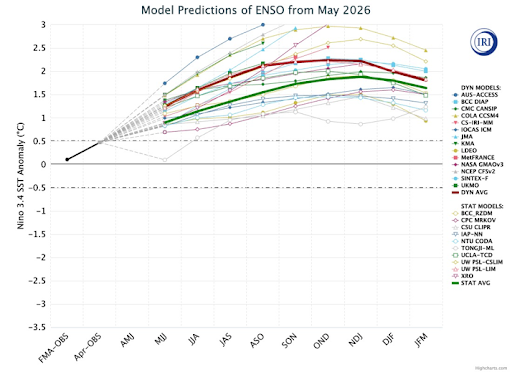
Fig. 1. Prediction of sea surface temperature anomalies in the period May 2026 to March 2027.
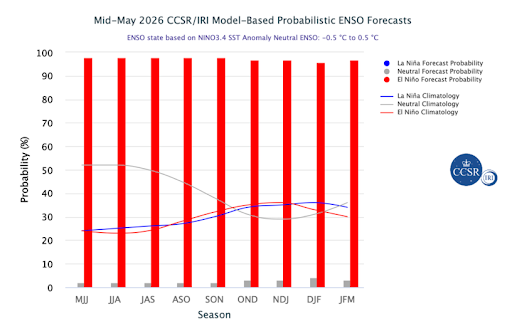
Fig. 2. Probabilities of the El Niño phenomenon occurring in the months of May 2026 to March 2027
We can expect heavy rainfall possibly extending into the spring period, along with above-normal minimum and maximum temperatures. This makes the incidence of diseases associated with free-flowing fruit rot (brown rot in citrus), stem or neck rot caused by Phytophthora sp., and blossom-end rot in the spring of 2026, as well as increased weed pressure within orchards and greater forest biomass on the surrounding hills, perfectly predictable, with the consequent increased risk of wildfires. The period from spring 2026 to summer 2027 is expected to be exceptionally hot, which would lead to a greater incidence of sun damage affecting both fruit and plants.
At the moment, there is still no atmospheric and marine coupling, so there are no near-term forecasts of rain.
In summary, the biotic and abiotic factors whose pressure will progressively increase from June onwards are:
- Brown rot of fruit (June to September)
- Flower remains rot (September to November)
- Neck rot (November to March)
- High weed pressure.
- Heat damage to fruit and trees (November to March)
These forecasts are in line with previous projections, so all that remains is for farmers to be prepared, and that of everything that is coming, rainwater will always be the best news.
Additionally, it is recommended to attend the seminar “MEGA-NIÑO? risks for agriculture in central and southern Chile” organized by Minagri.
https://www.agromet.cl/%C2%BFmega-ni%C3%B1o-riesgos-para-la-agricultura-del-centro-y-sur-de-chile
References
https://iri.columbia.edu/our-expertise/climate/forecasts/enso/current
Francisco González Valdés
Avocado and citrus consultant - Bellotoagro
+56 97478 7535 -
fgonzalez@bellotoagro.cl
Learn more about us at bellotoagro.cl