Argentine market
Argentina faces supply pressure due to Peruvian boom
The sustained growth of imports and the increase in Peruvian, Brazilian and Chilean fruit are putting pressure on avocado prices in Argentina.
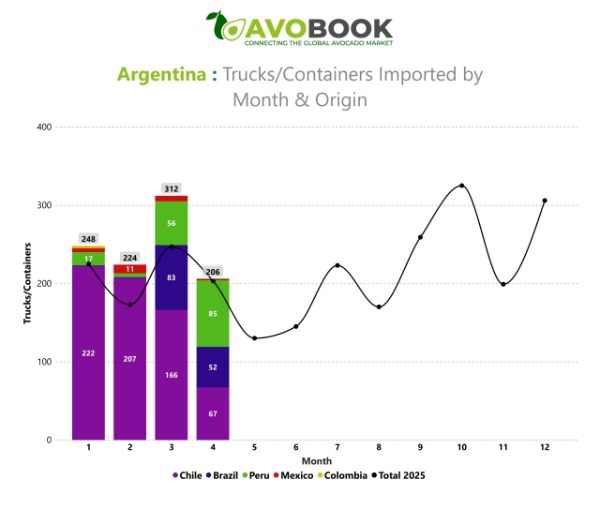
Argentina continues to solidify its position as one of the fastest-growing avocado markets in South America, but the sharp increase in import volumes this season has also begun to raise signs of trade tension. According to data analyzed by Avobook's data team, the Argentine market has been surpassing last year's volumes month after month, driven primarily by a greater presence of Peruvian fruit between March and July.
This scenario unfolds against a backdrop of Peru projecting to close the season with significantly higher volumes than in 2025, while Chile is nearing the end of its export window and Brazil is also increasing its market presence. The combination of these three origins intensified competition and exerted strong downward pressure on prices during the second quarter of the season.
According to the information gathered, the period of greatest supply pressure was concentrated between March and May, reaching a peak of nearly 312 containers or truckloads imported during March. This increase created a scenario of fruit abundance in the Argentine market, directly impacting the product's value and reducing commercial returns for several operators.
According to the Argentine importer consulted for this analysis, the current scenario is complex due to the strong growth in available supply. The simultaneous presence of Peru, Chile, and Brazil has considerably increased commercial competition and led to a rapid drop in prices, even affecting the profitability of some shipments that are currently arriving with negative returns.
Supply pressure mainly affects medium and small sizes
The price drop is not affecting all market segments equally. Meanwhile, medium and small sizes appear to be the most vulnerable in oversupply scenarios, mainly because they account for a larger proportion of the volume traded and face more intense competition among suppliers.
In contrast, larger sizes and premium fruit have shown greater resilience to market pressure. The relatively lower availability of these sizes and more stable demand in specific market segments helped to partially offset the price decline observed during peak volume weeks.
The trends observed this season are also beginning to raise questions about the future structure of the regional market. Current behavior doesn't appear to be solely due to a temporary oversupply, but rather shows signs of a deeper shift in the balance between production, demand, and returns.
The sustained growth of Peruvian production, coupled with the convergence of marketing windows across different origins, is creating increasingly competitive markets. In this new scenario, factors such as fruit quality, market differentiation, and diversification of export destinations are becoming more crucial for maintaining positive profit margins.
A growing market, but with increasingly tight margins
Despite the price pressure observed this season, Argentina continues to show signs of expansion as an import market. The sustained increase in volumes reflects continued growth in consumption and the growing importance of avocados within the country's fruit and vegetable offerings.
However, demand growth appears to be outpacing the increase in regional supply. This imbalance is likely leading to sharper price adjustments whenever high volumes from different origins coincide with similar supply windows.
For the Peruvian industry, the future challenge will not only involve continuing to increase production, but also better managing destinations, segmenting markets, and developing commercial strategies capable of absorbing an ever-increasing supply without deteriorating the returns of the entire chain.