In 2025 alone, 67% of European imports came from the Mediterranean, but the season is winding down. What will happen now?
As the 2024-2025 season enters its final phase, the main Mediterranean avocado suppliers, Israel, Spain and Morocco, conclude their participation in supplying Europe.
With a season marked by intense fluctuations in supply and demand, the avocado trade in Europe underwent a significant reconfiguration in 2024-2025. Mediterranean countries played a crucial role in sourcing, ensuring product availability during a key consumption period. Israel, Spain, and Morocco led shipments to the continent, consolidating their presence in an increasingly competitive market.
During the first months of 2025, these countries competed with other players such as Colombia and Chile, which also had a presence in the European market. However, the Mediterranean campaign is drawing to a close, and Peru is expected to take the market lead in the coming weeks, gradually displacing the current suppliers.
Participation of Mediterranean countries in the 2024/2025 season
According to Tomás de la Cuadra, data analyst at Avobook, Israel, Spain, and Morocco have played a crucial role in supplying the European market throughout the season. Israel shipped a total of 3,300 containers, while Spain registered 2,000 and Morocco 1,800. During the first 11 weeks of 2025, these three countries accounted for 67.42% of European imports, totaling 4,637 containers. A highlight of this season has been the significant increase in shipments from Morocco compared to the previous year, solidifying its presence in the European market.
During this stage, these countries have competed with Colombia and Chile. To begin with, Chile, which generally starts and finishes its season earlier, has seen its participation reduced in this phase. On the other hand, Colombia is in the final stages of its main harvest, while simultaneously beginning its off-season harvest.
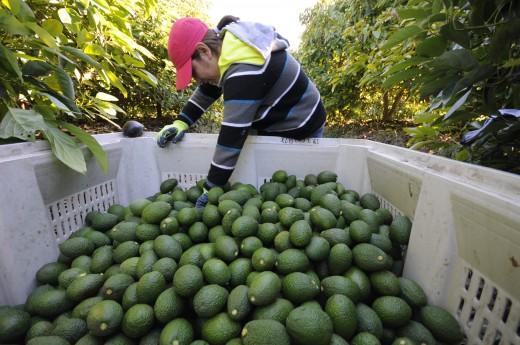
As the Mediterranean season draws to a close, Peru is expected to take the lead in the European market by the end of March, gradually displacing current suppliers. Morocco is anticipated to be the first to reduce its shipments, followed by Israel, while Spain will continue exporting until approximately Week 20, when its campaign concludes.
This scenario reflects the constant evolution of the avocado trade, in a context where climatic, logistical and commercial factors are redefining the global map of the production and export of this fruit.
The challenge of avocados in the Mediterranean basin
Gonzalo Vargas, a columnist for Avobook and representative of Goliat Agrícola, warns that while the Mediterranean region has enormous potential for fruit cultivation, avocado development faces significant challenges. "Some areas are seeing their productive potential reduced due to water scarcity, soil salinization, and the high cost of water, while others have managed to expand their crops," Vargas points out.
Currently, Morocco, Spain, and Portugal are leading the growth of avocado cultivation in the region, incorporating areas where this fruit was not previously grown. However, these countries face considerable climate challenges. "Heat waves, with temperatures that can reach up to 50 degrees Celsius, represent a serious threat to the stability of the crop," explains Vargas. These extreme temperatures, combined with winds from the Sahara and the west, stress the plants, causing defoliation, fruit abortion, and a weakened immune system, which favors the proliferation of diseases such as wood-decay fungi.
To mitigate these effects, high-altitude micro-sprinkler irrigation systems have been implemented, a strategy also used in frost-prone areas in Chile and California. However, Vargas warns that "these efforts don't always guarantee stable production. Last season, extreme temperatures delayed the harvest, affecting fruit quality and creating uncertainty in the markets." Furthermore, although prices were high in previous months, producers who decided to store fruit did not achieve the same profits this season.
The future challenge for the avocado industry in the Mediterranean basin lies in improving harvest planning to distribute production more evenly throughout the season, avoiding dependence on late harvests. "Selecting varieties that are more resistant to cold and heat, such as Ardith in Israel or certain adapted hybrids, will be key to the sustainability of the crop in the region," says Vargas. In this context, regions with less extreme summers could consolidate their position as those with the greatest production potential in the future. "Just as heat kills more humans than cold, in agriculture, the damage caused by extreme temperatures can determine the viability of a crop," Vargas concludes.
The future of avocados in the Mediterranean basin will depend on the ability of producers to adapt to an increasingly challenging climate and on the implementation of agronomic strategies that guarantee the quality and stability of supply in international markets.