Avocado growing areas grow by 17% in five years in Ecuador
Ecuador, a land of diverse ecological zones and agricultural diversity, has historically been an avocado producer, with records dating back to pre-Columbian times. As such, avocado production in Ecuador has shown sustained growth over the last five years, establishing itself as one of the emerging crops within the national agricultural sector.
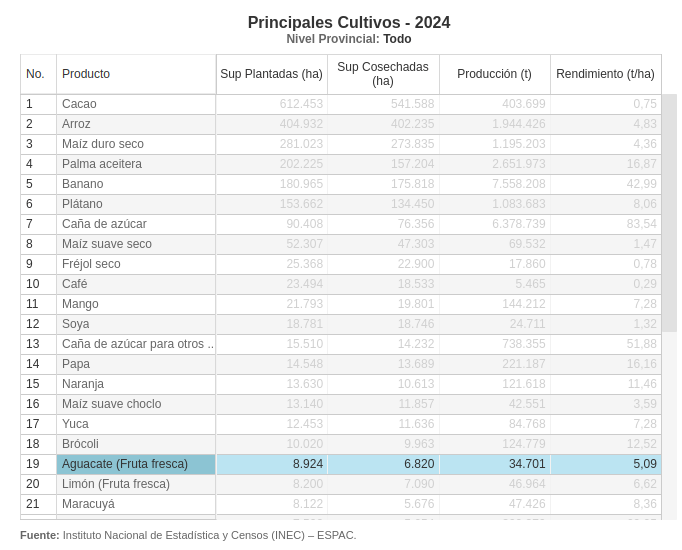
According to updated data from the Public Agricultural Information System (SIPA), in 2024 avocado ranked 19th among the country's main agricultural products, with a total of 8,924 hectares planted and 6,820 harvested, generating a total production of 34,701 tons.
This growth represents an improvement compared to 2020, when the crop ranked 21st with 7,630 hectares planted, reflecting an increase of between 10% and 15% in five years, both in area and volume. The national average yield was 5.09 tons per hectare. Regarding the destination of the production, according to information from stakeholders in the avocado value chain, the domestic market absorbed most of the 34,000 tons produced, while between 10% and 15% was destined for export, mainly of the Hass variety, which represents approximately 90% of total exports.
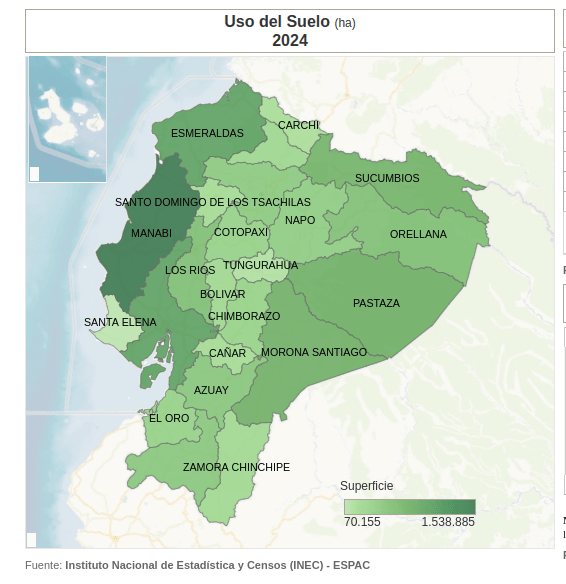
Geographic distribution: predominance of the Sierra and new expanding centers
Avocado production in Ecuador is concentrated primarily in the Sierra region, where several provinces have established themselves as national leaders in the crop. In the north of the country, the province of Carchi, bordering Colombia, stands out as one of the areas with the largest planted area, with 2,564 hectares. This figure represents more than 20% of the national total, reaching a production of 9,306 tons and an average yield of 4.57 tons per hectare. In fact, avocados are the second most important crop in this Andean province.
Nearby, in the northern province of Imbabura, the crop is showing interesting growth. Of the 1,348 hectares planted, only 691 have reached the harvest stage, indicating strong potential for expansion in the coming years. With a productivity of 7.33 tons per hectare—one of the highest in the country—Imbabura contributes more than 5,000 tons to national production, equivalent to 10% of the total. Part of this higher yield is due to the growth of Hass variety cultivation, geared toward the export market.
The province of Pichincha, whose capital is Quito, combines tradition and modernization in avocado cultivation. With 1,436 hectares planted and 1,274 harvested, it achieves a total production of 12,774 tons and a remarkable productivity of 10.02 tons per hectare, the highest in the country. In areas like Guayllabamba, historically associated with the Fuerte avocado, production is still destined for domestic consumption; however, in other nearby areas, Hass avocado plantations have been developed, increasing harvest efficiency.
The coastal region also contributes to the production map, albeit with a different approach. In the province of Guayas, 2,545 hectares have been planted and 2,361 harvested, generating a production of 6,149 tons. However, the average yield is only 2.60 tons per hectare. This low productivity is largely due to the predominance of tropical varieties, primarily destined for the local market. Only a minimal fraction—less than 50 hectares—is dedicated to Hass avocado cultivation for export.
Overall, the data reflect a heterogeneous geographical distribution but with a clear pattern: productive leadership is in the Sierra, particularly in the north, while in other areas of the country new centers with high potential are beginning to emerge if appropriate technology and marketing strategies are applied.
For Santiago Pinto, president of Interanza, this growth is not by chance, but the result of unique agroecological conditions: “Ecuador is a country that, thanks to its geographical location, its climate, its land and the hours of sunlight, has significant agricultural production,” he states.
Pinto also highlights the historical value of the avocado in the national agricultural identity: “Ecuador is a centuries-old, if not millennia-old, producer of avocados. There are records of this fruit from long before colonization and it is very prominent in various cultures both on the coast and in the highlands.”
The expert also confirms that most of the expansion is concentrated in the Sierra region, but acknowledges the emergence of new hotspots in provinces such as Bolívar, Tungurahua, and Santa Elena, in the central Sierra and the Coast. However, he warns that challenges remain, especially regarding technological advancements.
“There is still no adequate technological process in place that has allowed for higher production outputs. We are working with members of the value chain to change this.”
The projections are optimistic. A FAO study within the framework of the Hand in Hand project (2021–2022) identified a potential growth of at least 20,000 hectares of avocado cultivation in Ecuador. Currently, the effective area under cultivation is approximately between 3,500 and 3,900 hectares for the Hass variety, suggesting ample room for expansion.
“The goal is to reach an average production of between 25 and 30 tons per hectare with technologically advanced crops of between 8 and 10 years,” Pinto concludes.
Ecuador is making steady progress toward consolidating its avocado production chain, combining tradition, territorial diversification, and export prospects. If current technical challenges are overcome, the country could position itself as a key player in the international avocado market in the coming years.