Trump imposes tariffs on Mexican avocados: What will happen to the market?
President Donald Trump has announced the imposition of 25% tariffs on imports from Mexico, Canada, and China, a measure that will take effect on February 1, 2025. This protectionist policy seeks to address concerns related to illegal immigration and drug trafficking, especially fentanyl. According to information published by Reuters and The Wall Street Journal, this decision could have significant economic consequences, particularly for the Mexican agri-food industry, where avocados are among the most affected products.
The Mexican government has also responded to this measure with various actions and official statements. President Claudia Sheinbaum spoke with President Trump, after which they agreed to a one-month pause in the implementation of these tariffs. During this dialogue, Sheinbaum pledged to deploy 10,000 National Guard troops to the shared border to address security and migration concerns. This temporary agreement aims to allow time for negotiations between the two countries, led by the U.S. Secretaries of State, Treasury, and Commerce.
In the legislative arena, representatives from all political parties, including the opposition, condemned the imposition of these tariffs. Arturo Ávila Anaya, spokesperson for the Morena parliamentary group, stated that his party reaffirms its support for President Sheinbaum in her efforts to resolve this situation.
So, what consequences could this measure have for those involved in the avocado market? Mexico is the main supplier of avocados to the United States, and the application of these tariffs could increase the price of this fruit in the U.S. market, affecting both Mexican consumers and producers. According to Antonio Villaseñor, director of Aztecavo, "the implementation of 25% tariffs would have a significant impact. This could have two repercussions: on the one hand, a 25% decrease in the price paid to the producer if the market does not accept the increase; logically, an increase of that magnitude would cause weeks of uncertainty and losses in both countries."
For his part, Sergio Paz, general manager of Coliman Avocados de México, agrees that "the cost of the tax would be divided between a lower price at the source and an increase for the consumer... and eventually the consumer would bear the additional cost." This means that the U.S. avocado market could face a period of instability, with higher prices for consumers and lower profitability for Mexican producers.
History of tariffs between the US and Mexico
Trade tensions between the United States and Mexico are not new. During Trump's first term, in 2018, tariffs were imposed on Mexican steel and aluminum, prompting Mexico to retaliate with similar measures on U.S. products. These disputes were resolved with the signing of the United States-Mexico-Canada Agreement (USMCA) in 2020, which aimed to eliminate trade barriers and strengthen economic integration in the region. 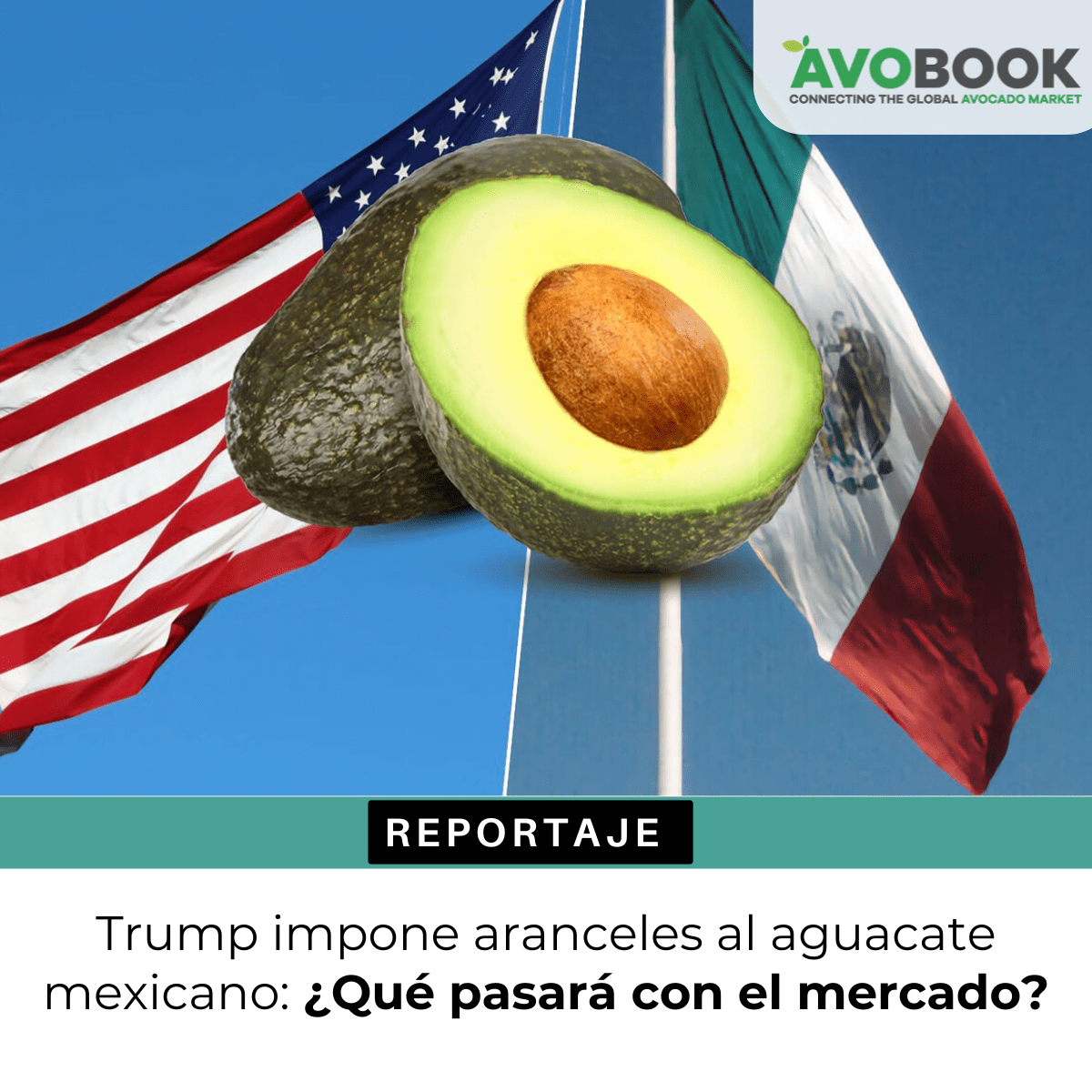
However, recent actions by the Trump administration indicate an intensification of its protectionist approach, which could trigger new trade tensions and affect key sectors of the Mexican economy, such as agriculture and automotive.
Given this scenario, the question arises as to whether Mexico could diversify its avocado exports to other markets. Regarding this, Antonio Villaseñor believes it will be difficult: "In the case of diversification, I see it as very complicated due to logistical issues and the problems Mexico faces with arrivals at their destinations. Exports to other markets might increase slightly, but not significantly."
For their part, some business leaders have indicated that market diversification could become a key strategy for reducing dependence on the U.S. market; while some economists warn that this process will not be easy, since diversification requires overcoming logistical challenges and establishing new trade relationships, which takes time and resources. Furthermore, Mexico's current infrastructure and trade routes are predominantly oriented toward the United States, making it difficult to redirect exports to other markets immediately.
Despite these difficulties, business leaders emphasize the need for Mexican and U.S. authorities to establish dialogue mechanisms to prevent these tariffs from causing a larger crisis.
The impact of Trump's new tariffs on the Mexican avocado industry will be significant, potentially affecting both producers and consumers in the United States. In this context, producers and exporters must prepare for a challenging scenario in the coming months.