The fall in avocado prices in Spain has slowed after five weeks of decline.
According to the Avobook Week 33 Report , this is the first time in five weeks that medium and large sizes have rebounded at this entry point to Europe. Meanwhile, in the United States, Peru and Colombia are down, while Mexico continues to grow.
The amount of avocados in the United States continues to grow, albeit in small increments. During week 33, a 4% increase was recorded in the total volume arriving in that country. However, this is 7% less than the same week last year.
This is shown in the Avobook Week 33 Report , where market share shifts in Mexico's favor, as its volume increases: it once again surpasses 30 million pounds, a level it hadn't reached for several weeks. This is now thanks to its new fruit.
The same cannot be said for Peru, which has dropped from 14.5 million pounds a few weeks ago to 10 million pounds. Its share will gradually decrease, as will Colombia's, a situation occurring in parallel with Mexico's rise. Mexican fruit holds 57% of the market, followed by California with 21%, and Peru with 18%, leaving Colombia far behind with 4%.
The projection is that, as these last two countries reduce their presence in the United States, Chile will increase.
Regarding prices, week 33 shows a slight decrease in large sizes, while medium sizes remained the same as last week.
Spain improves prices for the first time in over a month
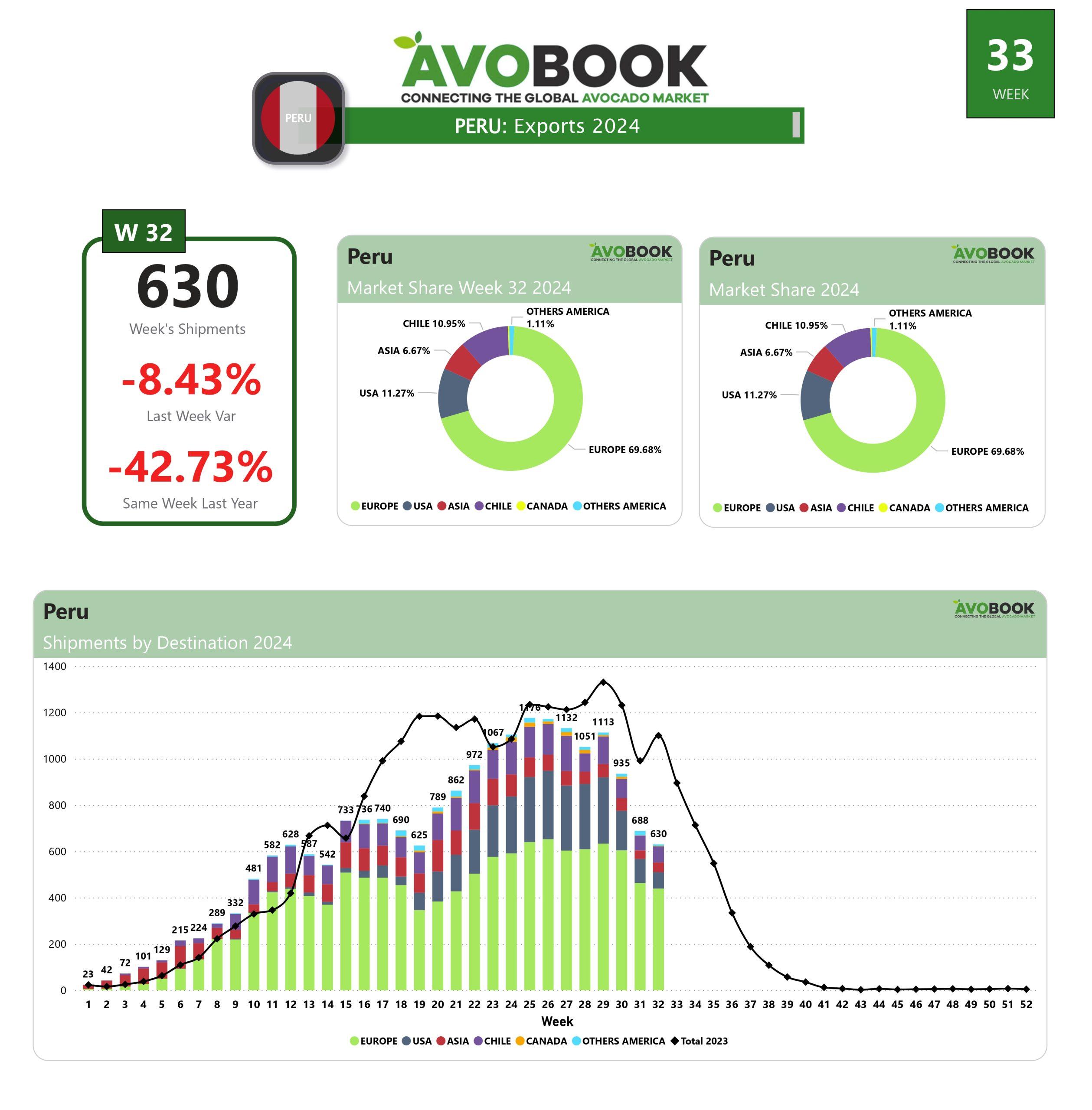
This week, avocado volumes in Europe grew by 7% compared to last week. However, this figure remains lower than the same week last year, when there was 20% more fruit on the continent than there is today. Evidence suggests that much of the reason for this year-on-year decrease is due to Peru. In fact, at this time last year, Peru had recorded 741 shipments, while this year it has shipped 604.
Even so, Peru still accounts for 79% of the participation. South Africa follows with 15%, while the remaining origins (Kenya, Colombia, and Chile) do not exceed 6%.
The most relevant news is in the prices, as the port area of Algeciras (Spain) shows for the first time a rebound in prices, after five weeks of falling prices.
The change is mainly occurring in the large and medium calibers, a condition that we will see if it is a trend for the coming weeks.
One of Avobook's reference sizes is a good example of what's happening: during week 27, size 24 was at $3.08 per kilo, and last week (32) it reached $1.87 per kilo. This is the first week it has rebounded, registering a value of $2.58 per kilo. Smaller sizes remained stable compared to the previous week.
In the Dutch port area, slightly higher prices were observed across almost all sizes, for both Hass and Green Skin varieties. Market specialists maintain their warning regarding a potential supply shortage in the next two to three weeks, which should create opportunities for countries like Kenya, which could increase their shipments. However, in that case, it will depend on how well they manage the quality of their fruit, so that the product shortage is absorbed by that origin, which has sufficient volume.
The mix of sizes remains smaller in Europe, a trend that has persisted this season. It remains to be seen how strongly Chile and Colombia, which are just beginning their shipments, will grow. In Chile's case, this is ahead of schedule compared to 2023.
China with ever-decreasing volumes, but higher prices
Avocado exports to China remain marginal compared to other markets. While shipments increased by 20%, this translates to a stagnant market, representing only 25 shipments.
What's striking is that this represents a 75% decrease compared to week 33 of the previous year. Apparently, exporters are prioritizing shipments to Europe, which seems to offer better opportunities, in a scenario of reduced fruit availability. Another factor is that, in the case of Peru, its gradual withdrawal from the harvest season was brought forward compared to the previous year, which has disrupted its entire schedule.
For example, during week 10, Avobook registered 94 shipments from Peru, and at that time, shipments from China to Chile were also being processed. Last year, the peak periods were between weeks 20 and 23, which was three times higher than the volume shipped during those weeks this year.
Chile, for its part, has begun avocado shipments to China, although it does not project reaching volumes similar to those of Peru. Its first shipment consisted of eight consignments. Last year, it had weeks with as many as 38 shipments to that market. Mexico has entered the market in previous years, but not with more than 10 containers in any given week.
This shortage may explain why prices for large and medium sizes (between 18 and 24) have generally increased. In fact, they remain higher than in previous years. Something similar is happening with smaller fruit.