Renew or expand: the current dilemma of Hass avocados in Colombia
The global Hass avocado market has experienced steady growth in recent years, with annual volume increases exceeding 10% and prices rising faster than inflation in the two main destinations: the United States and Europe. This dynamism has spurred new plantings in producing countries, and Colombia is no exception. Since beginning to consolidate its exports in 2015, the country has risen from 12th place in the world rankings to become the third largest exporter by 2024, behind only Mexico and Peru. The growth in planted area is a clear indication of this evolution.
A sustained and strategic expansion
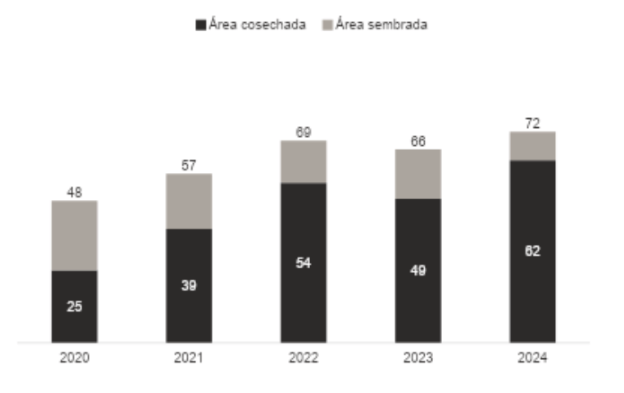
In the last five years, according to UPRA figures, Colombia went from having 48,181 hectares planted with Hass avocados to 71,524 in 2024, representing a 48% increase. This growth has not been linear, but it has been constant: between 2020 and 2022, more than 20,000 new hectares were added, and although there was a slight contraction in 2023, 2024 marked a record in plantings. Investment in plantations has consisted of both new areas and the renewal of aging crops.
Area planted with Hass avocado in Colombia (thousands of hectares)
More hectares in production, but not all certified for export
Of the total area planted with Hass avocados in 2024, almost 87% is currently being harvested. However, a significant portion of this fruit lacks certification for export. As of May 2025, according to ICA figures, only 40,800 hectares were authorized for export, representing just 65% of the production area.
This means that, although Colombia is increasing its production, not all of that supply reaches the highest-value markets. Much of it remains in the domestic market, where Colombians tend to prefer varieties like Piel de Sapo or Piel Verde, rather than the Hass variety. Departments like Quindío, Tolima, and Huila clearly illustrate this gap: together they account for 20% of the harvested area, but only 52% of it is certified for export.
The challenge: to raise the standards of cultivation
Planting more is no longer enough. The stage Colombia is currently facing as a major avocado exporter demands a change of approach: now it's about planting better. This implies making strategic decisions about farm location, access to infrastructure, water availability, and, above all, adopting good agricultural practices, traceability systems, and certification from planting onward.
The expansion of the agricultural frontier has been accompanied by professionalization and sustainability. Growth has been remarkable, and these 20 years of experience in the country have allowed us to adapt and improve production techniques to our agro-climatic conditions. The challenge now will be to bring that knowledge to all producers.
The key question: renew or expand the plantations?
Alongside the growth of avocado cultivation in Colombia, advances in genetic material and agronomic management have also evolved. Therefore, it's time for producers to ask themselves whether the path forward is to continue expanding the agricultural frontier for avocados or to make better use of the hectares they already have.
The 2024 production figures show significant differences in yields between regions. While Antioquia and Caldas exceeded the national average (with productivities of 13.6 and 12.9 t/ha, respectively), other departments, such as Quindío, Tolima, and Valle del Cauca, were between 15% and 30% below the national average, which was 11.7 t/ha that year. These differences may be due not only to agroclimatic conditions but also to factors such as the age of the crop and the type of plant material used.
Each producer knows their farm better than anyone else. That's why, before planting more, it's worth asking: is it time to grow or to renew?
In many cases, improving the productivity of existing plantations, through better establishment and plant material, can generate more value than simply expanding the cultivated area.