The new scenario for Mexican avocados encourages a shift from speculation to certainty for the customer.
The growth of new exporting origins, the demand for greater trade stability, and the need to increase productivity per hectare could require a change in the model that for decades has made Mexico the undisputed leader of the US market.
For years, Mexico was the dominant source of avocados in the United States. Its volume, geographic proximity, and supply capacity made it the natural choice for retailers, importers, and wholesalers. However, this scenario is facing changes that, while not radical, are having some impact.
This is according to Sergio Paz, general manager of Coliman Avocados, who explains that this change is due to the arrival and consolidation of new players —mainly Peru, Colombia and Guatemala— who have learned to manage logistics, commercial windows and a calibrated offer for the United States.
One of Mexico's competitive advantages has been its proximity to the market. But importers are learning to handle avocados from distant origins. Paz agrees that the landscape is changing: “In fact, Colombia is quickly reaching the East Coast, and Guatemala is an example of a growing source. As you can see, they're not that far away. We were alone for many years, accustomed to not competing, the only option. That's over.”
The lesson of the current season
Current market challenges offer insight into the future. The coexistence of large volumes, downwardly driven prices, changes in California's harvest management practices, which have extended its growing seasons, and a more diversified market have forced Mexico to operate under new rules.
Paz himself argues that the industry must abandon speculation and offer a stable supply: “There needs to be stability, a constant supply, and we need to be less speculative with Mexican fruit. It’s very clear to us that if we offer that to retailers, they will prefer Mexican fruit. It’s very well positioned to compete; it will have the volume. But if we continue with this speculation, knowing that the big chains don’t like it, they will go to other origins as soon as fruit is available.”
According to Paz, the country must develop trade strategies that combine stability, service, and a relationship that allows it to protect its leadership.
“We need to give certainty to importers, wholesalers, and retailers—to whoever our clients are. We don't want to be selling them a box for $25 one day, then $32 three days later, and $45 ten days later. There can be ups and downs. That's unavoidable, but they have to be much more moderate. If we run a promotion, the retailer can be confident that we'll honor the promotional price and not change it just because demand has increased and prices have skyrocketed,” he explains.
Productivity: the Achilles' heel
But the future doesn't depend solely on prices or logistics. It also lies in the fields. Low productivity per hectare is one of the structural factors that most urgently needs addressing. For years, producing 10 tons per hectare was still a profitable business. Today, that's no longer the case.
“We need to improve productivity per hectare, especially in Michoacán, more so than in Jalisco. Although in Jalisco some old orchards are starting to be restored and they will begin to have their problems. But here in Michoacán we have to increase our productivity per hectare,” he states.
Paz explains: “Producers are very used to the idea that even with low yields, it was still a good business. Not anymore. A producer who yields less than 12 or 13 tons per hectare is no longer going to be profitable. It will be profitable if they yield more than 15 tons. We're far from that. I'm not talking about impossible yields. But we've been too complacent: if I produce 10 tons and do very well, I don't need to produce 11. But the situation has changed.”
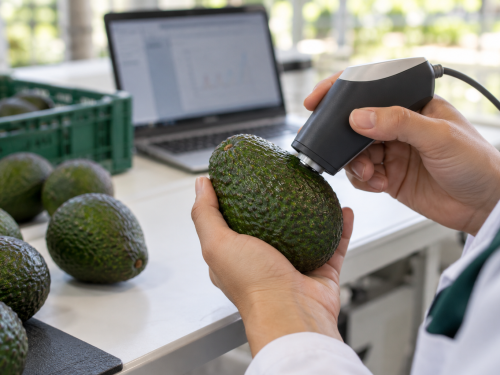
This involves incorporating better agronomic practices, renewing aging orchards, improving water management, and adopting technologies that allow us to understand the evolution of fruit size and yield.
A competition that demands strategy
The strengthening of Peru and Colombia is not temporary. Nor is the growth of Californian production. Faced with this scenario, Mexico cannot rely solely on its history or the size of its industry.
The current landscape of producers and exporters reveals a wide range of realities. Approaches to market challenges, particularly under the new conditions, also vary considerably.
“There are many of us exporters. Currently, in APEAM, we have about 95 or a little more exporters. There are very large companies and very small ones. Some are also producers, and others are not. Everyone manages the business as best they can. I can explain the strategy we follow: harvest and buy back what we have already sold. We try not to accumulate inventory and adjust the sizes and percentages according to what we know will be coming from the fields. But it's impossible to think that we can tailor everything to very good clients and very good prices. We know that we might have to push a certain size, but at Coliman, the philosophy is: if I don't have orders, I don't harvest,” explains Sergio Paz.
In this regard, he summarizes the main lesson for the Mexican industry: “We have to put on our gloves to compete with other origins, a fair competition. You become aware that we are no longer alone.”