New avocado consumption trends in the United States create room for smaller sizes
The executive director of the Hass Avocado Board (HUB) explains how supermarket consumption patterns have evolved, driven by increased demand for bags containing smaller fruit.
Mexico's massive presence in the U.S. avocado market makes it impossible for other origins to compete in terms of volume. However, consumption is increasing in states other than the traditional avocado-producing regions, opening up opportunities for suppliers like Peru, Colombia, Chile, and the Dominican Republic. These origins have a smaller market share, but their sales positively impact their bottom lines, especially when prices are more attractive than in Europe.
For both growing producers and those aiming to maintain or enter the world's largest avocado market, understanding the type of fruit demanded by North American consumers is a key opportunity. This is especially true now that retail demand for a wider range of sizes than in the past.
Avonews delved into the numbers, with the help of Emiliano Escobedo, executive director of the Hass Avocado Board (HAB), who describes that the organization has detected an evolution in the demand for sizes: while the characteristic pieces for the North American market remain stable, the need for smaller fruit is growing.
“The opportunity lies in offering what the market is really demanding,” he says.
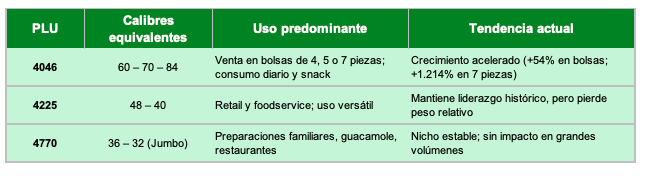
The executive director of the HAB explains that, for many years, the US avocado market was structured around a single fruit code: PLU 4225, which corresponds to medium sizes (48 and 40). These standard-sized fruits became established in both supermarkets and restaurants as the most versatile and popular size. However, the global supply curve has led distributors to adapt.
“For several years the most popular PLU in supermarkets was 4225, equivalent to sizes 48 and 40. However, with the change in the size curve and the greater availability of sizes 60 and smaller, an opportunity has arisen to offer the market what is currently being produced,” explains Emiliano Escobedo.
The reasons for this evolution
In this context, two situations intersect: the greater supply of smaller fruit and the new consumption habits, which are considering the avocado as an ideal snack fruit, which can be distributed in small daily consumptions.
This has driven the change in trend, appearing strongly in the sale of bags, which complements the purchase of bulk fruit, becoming one of the most important growth drivers of the category.
According to Escobedo, “in supermarkets this change is reflected in the growth of PLU 4046, especially in the bagged avocado segment. The 4 and 5 small piece presentations represented more than 54% of the unit sales of bagged avocados.”
Even more surprising has been the growth of the small 7-piece format, which saw an increase of 1,214% in the last year.
“This format is ideal for those looking for a personal portion for each day of the week,” Escobedo explains.
There's a reason for this change: smaller avocados are perceived as more practical, manageable, and less wasteful. This is what consumers themselves say.
“A recent HAB survey on consumer perception confirmed that many shoppers prefer small avocados for everyday consumption and as a snack. People are already buying four or five per purchase, but they are smaller avocados. We also saw significant growth in the seven-piece bag. I buy them myself: they come with five or six small avocados, perfect for serving whole, without any leftovers. It's very practical,” Escobedo explains.
Large calibers: for special moments
Despite the rise in popularity of smaller sizes, larger sizes—Jumbo, PLU 4770—maintain a strategic place. Their use is different: family gatherings, restaurants, and large-scale preparations like guacamole. They are especially in demand during important North American cultural holidays.
The same HAB survey shows that consumers indicate that when they purchase larger quantities to prepare dishes like guacamole, they tend to choose larger avocados, as they facilitate and speed up the preparation process.”
In a market that is growing in almost every region of the country, the real battle is not just in the quantity of fruit, but in the exact size of the avocado that reaches the consumer's table.
Transition in the calibers preferred by US consumers