Avocado market: Why are volumes falling in Europe, prices in China, and shipments from Mexico to the United States decreasing?
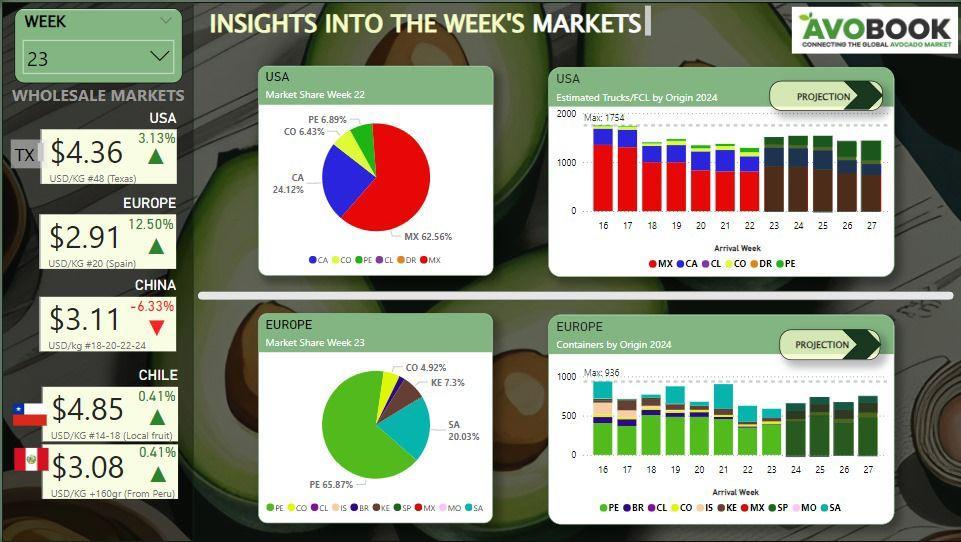
The Avobook W 23 Report shows interesting data, comparing the same week in 2023 and 2024
Swimming in a sea of numbers is interesting, when the data speaks for itself. In the Avobook W23 Report , the numbers reveal things that make this exercise compelling.
There are at least three findings that appear when comparing the same week, between 2023 and 2024: a global decrease in the presence of avocados in Europe; the identical downward trend in prices in China; and the progressive disappearance of the Mexican fruit in the United States, although - as we all know - it never completely disappears.
In the case of Europe, Peru is one of the main causes of the reduced avocado supply, as shown by the data from the same week in 2023 and 2024. The continent is registering its lowest volume of the product since February, the month in which this drop is expected. However, in June, shipments typically reach around 900 containers, a figure far below what was recorded this week.
In fact, in 2023, 1,000 containers were arriving, 734 of which originated in Peru. This week, week 23 shows 590. Of these, 388 come from that country, which, even so, leads the market with a 65% share.
The decrease in product between this week and last week is due to a decline in South African exports, which fell by 42%, from 204 to 188 containers. This trend has been observed for the last three reports, although South Africa still maintains a tenth of the market share. Kenya (7.5%) and Colombia (5%) follow.
The general rule is that low product availability is followed by a price increase. This is confirmed by the data in the Avobook W 23 Report , where Spain is a good example. In that country, all sizes have been valued, but mainly medium and small sizes, which have been rising in price for the past two weeks.
Mexican avocados are declining in the United States… but only for a while.
When the United States was expecting a surge in avocados from California, the Memorial Day holiday (May 27) caused a drop in volume due to the reduced harvesting time. However, production remains on par with Mexico, whose market share is steadily declining.
While the reduction in Mexican avocados was minimal in this week's report (100,000 pounds), it's certain that the decline will continue as the harvest in Michoacán and Jalisco nears its end. California avocados are also closing the gap in inventory, with 24.5 million pounds, while Mexico holds 27.3 million.
But it's not that Mexico is asleep. It's more like a "snooze," because in two weeks the "crazy flower" season is expected to arrive in full force, regaining its popularity among consumers in the northern country.
And here's a piece of data that can serve as a projection when looking at 2023. Avobook's report for week 23 of that year showed that the lowest point for Mexican volume was in week 29. That could be repeated.
Peru is taking advantage of these opportunities and has reached its highest level this year, with 3.5 million pounds. Colombia's activity in this market is also noticeable, as it follows Peru very closely with 3.3 million pounds.
Another relevant piece of data is that the average farmgate price rose by 18%, a trend similar to that reported by Avobook on the same date last year. In fact, this could also be seen in exported fruit. In mid-June 2023, prices jumped from $30 to $60 in just two weeks. Of course, it was a brief phenomenon, but we should be vigilant in case it recurs.
China continues to punish prices, but from a higher floor.
In China, volume continues its trend from previous weeks: small fluctuations both upward and downward, making it difficult to predict future trends. This is not the case with prices, which have been falling for three weeks across all sizes. Size 30 is now down 23% compared to last week.
Looking at last year's data, we see that the downward trend in week 23 isn't particularly unusual, as it's almost identical when looking at 2023 and 2024. However, the starting point is different, because while there is a weekly downward trend, it's based on a significantly better price than the previous year. In 2023, the price increase began in week 25.
Everything that happens in China depends on how Peru fares, as it is the owner and master of shipments, a space it shares with some minimal participation from other origins.
However, South Africa is expected to make its first arrivals between mid and late June, responding to the need to allocate more of its production to a destination closer to Europe, where - as we saw - it will continue to decline.