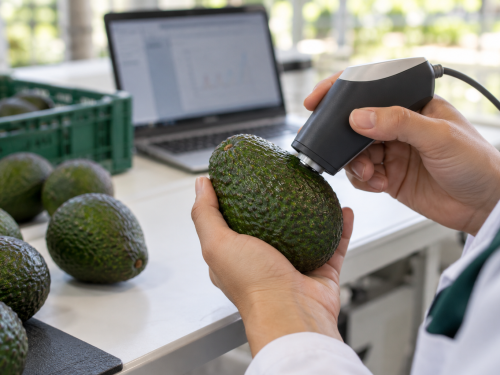
Morocco expects a large avocado harvest, strengthening its position in the global market
Avocado production has made Morocco a major player in the global market since its introduction. Mohamed Lakchouch, owner of an avocado plantation of approximately 10 hectares in Larache, in northwestern Morocco, has around 5,000 avocado trees.
On his plantation, he produces three varieties of avocado: Hass, Fuerte, and Zutano, with 80% of the trees being Hass. This year, he has achieved a production of 90 tons of Hass avocados, a 30% increase compared to the last three years.
However, Lakchouch points out that the avocado tree is thirsty: "Each avocado tree can consume approximately 30 liters per hour, and the amount can vary depending on the season. We can use only half that amount, almost 15 liters per hour, and it can reach up to 60 liters per hour." He also mentions that high temperatures and wind "can cause significant losses to avocado trees due to their high sensitivity."
Abdellah Elyamlahi, President of the Moroccan Avocado Exporters Association, highlights the water reserves in the northern regions of Morocco that have boosted agricultural production: "The northern region of Morocco experiences rainfall and has significant water reserves, unlike the south of the country, such as Agadir and the Sahara. Twenty percent of the increase in production is due to the growth of farms."
Despite the recent severe drought, Morocco has shown resilience in its avocado industry. Mustapha Laissate, an environmental researcher in Rabat, emphasizes the importance of regulating farms to ensure they are not located in water-scarce areas: "The state has developed a strategy to address water scarcity. In this context, it is necessary to regulate the cultivation of avocados, as well as melons, which should be grown in areas with abundant water."
Elyamlahi notes that avocado production across the country for this season could reach 60,000 tons, and last year it reached 40,000 tons, with 90% being the Hass variety.
However, currently two-thirds of this year's avocado harvest still has no destination and several export units have had to close due to competition and the smaller size of the fruit.
Elyamlahi warns of the dangers to the industry: "Large quantities of avocados still in Morocco, if they accumulate, will cause adverse results, such as decreased prices and the inability to export them or to export them at low prices, and this is neither healthy nor sustainable."