Avocado imports in Japan have not rebounded in recent years.
The Japanese market has historically been a key destination for avocado exports, especially for Mexico, a country that began developing this market more than two decades ago. However, recent years have shown a clear downward trend in import volumes to Japan, a situation that has sparked the interest of industry analysts and raises questions about the sustainability of this market in the medium term.
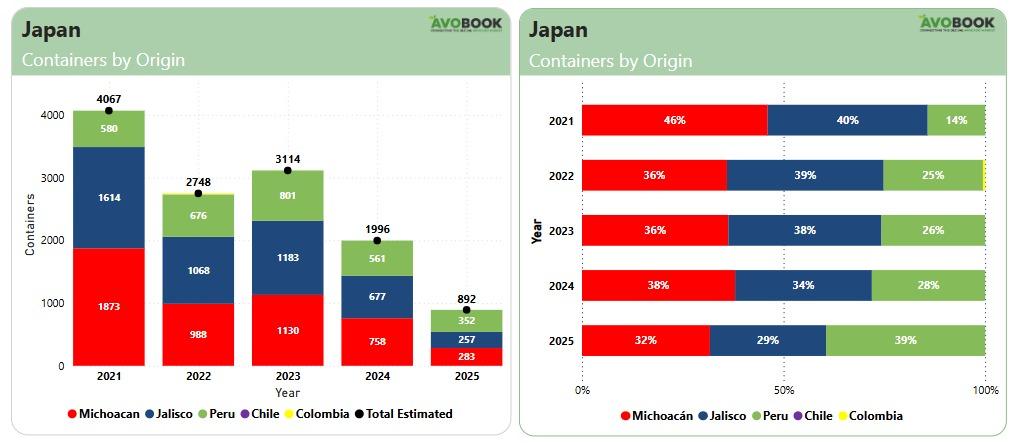
According to data from Avobook, total avocado exports to Japan have decreased significantly between 2021 and 2025. In 2021, a total of 4,067 containers were shipped, a figure that fell to 2,748 in 2022, then to 3,114 in 2023, and dropped to 1,996 in 2024. As of May 2025, the current volume is 892 containers.
Analysis by origin shows that Michoacán, historically the largest supplier, has steadily reduced its share. In 2021, it contributed 1,873 containers (46% of the total), and by 2025 its estimated volume falls to 283 containers, representing a 32% share.
Jalisco also shows a reduction, dropping from 1,614 containers in 2021 (40%) to 257 in 2025 (29%). In contrast, Peru and Chile have increased their presence. Peru went from 580 containers in 2021 to 352 in 2025, raising its share from 14% to 39%. Chile and Colombia have maintained a marginal or nonexistent presence during this period.
This shift in market dynamics is due to multiple factors. First, avocados are not part of the traditional Japanese diet, and their consumption has been driven primarily by younger segments of the population. However, Japan is undergoing a significant demographic transition, with a steadily aging population that limits the growth in consumption of imported products like avocados, especially among older adults, who tend to be more conservative in their dietary habits.
This demographic reality is compounded by significant logistical challenges. While Mexico has high-quality fruit, it faces increasing maritime transit times due to problems with shipping companies.
What used to be a two-week journey can now extend to a month, compromising the quality of the fruit upon arrival, especially that from Michoacán, which has less tolerance for prolonged travel. In contrast, Peru and Chile have managed to position themselves as suppliers of fruit that can withstand long transit times.
Another key aspect is the price negotiation model. While Mexico operates mostly under "spot" schemes—adjusted to real-time market conditions—Peruvian and Chilean exporters offer the possibility of establishing fixed prices for specific periods. This approach is more attractive to Japanese importers, who value stability and predictability in their trade relationships.
Finally, the Japanese market presents an additional requirement that further complicates the situation: only two specific fruit sizes are accepted. This limitation creates inefficiencies in order fulfillment, as it forces exporters to set aside the best sizes for Japan, leaving the remaining volume without a defined destination or sacrificing sales to markets that do accept a wider range of sizes.
Taken together, these factors explain the loss of dynamism in the Japanese avocado market, especially for Mexico, and point to the need to adapt commercial and logistical strategies to the new structural conditions of this destination.