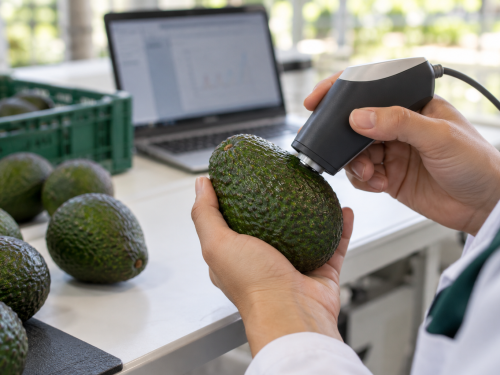
“The wild flowering shows that there is a good production compared to last year”
This is according to Ricardo Vega López, general manager of Frutícola Velo, who analyzes the close of the 24-25 season and explains the circumstances that impacted its results.
Ricardo Javier Vega López is the general manager of Frutícola Velo - a company that markets under the Flavocado brand - a family company with more than 50 years of experience in the export industry, from the heart of Michoacán, Mexico.
Heir to a family tradition started by his father, a pioneer in avocado cultivation in Michoacán, Vega has witnessed firsthand the evolution of the sector and its consolidation as one of the pillars of Mexican agriculture. Today, his company represents a model of vertical integration, with operations ranging from production to the export of fresh fruit, primarily to the U.S. market.
In this conversation, he addresses the closing of the main Mexican avocado season and sheds light on what's coming in the "crazy bloom," as a prelude to a campaign that looks set to have better prospects than the one that is concluding.
- From the perspective of an exporter, what does the rest of the year look like for Mexican avocados in the United States and Canada?
“We are nearing the end of the 2024-25 season. The second half of the campaign has been very difficult. We have very high prices due to a drop in production in Mexico of between 10% and 12%. So, what we see is that the demand for avocados is very inelastic, both here in Mexico and in the United States. Therefore, any shortage of fruit causes a tremendous price increase—more than proportional to that shortage.”
- Are we talking about the price that the producer charges the exporter?
“It’s the price the market ultimately gives us. Because it’s a wonderfully natural chain reaction. So we’ve had a season of very high prices. We as exporters don’t like that very much, because it creates a lot of uncertainty in the market. We prefer to have more stable prices for as much of the year as possible. But the conditions of nature sometimes dictate different patterns. We must be able to adapt. So we’re finishing a very difficult season. In the last three weeks, we’ve seen downward trends in prices, which is good for the market.”
Will the next season be similar or will it offer better conditions?
“As we begin the new season, we do foresee a better production season than the previous one. So, the 2025-2026 season here in Mexico looks set to have higher production, although we don't yet have estimates, or at least statistically reliable estimates, to predict the next season. We're talking about perceptions. But we're about to start the rainy season, and it depends a lot on whether there's a good level of rainfall and whether there are any weather events that could harm production.”
- What factor had the biggest impact on the season that is now ending?
“This past season was very difficult because we didn't have the right size fruit due to a tremendous lack of rain. The fruit stayed small. This caused us many problems in the market because retailers already have their sales programs based on the sizes their market demands. We were unable to meet those demands, and this caused many problems. We had to sell small quantities of low-quality fruit at high prices. Nobody likes that.”
- How did they manage to move that fruit?
“That’s where the inelasticity of demand comes into play: in the United States, the market wants to eat a kilo of avocados, and if it costs 10 pesos, they’ll pay it. And if it’s 20 pesos, they’ll still pay it. Maybe instead of a kilo, they’ll buy 800 grams, but they’ll buy it. That’s the beauty of our product. Because there’s another very important factor: unlike berries, like papayas, which must be picked if they’re ready to harvest today, avocados can stay on the tree for a while. If the price isn’t right for the producer, they can decide not to harvest and resume negotiations in 15 days. That’s a factor that helps to level the supply somewhat. But it also contributes to more speculation. So it’s not necessarily a good thing.”
- Who had to bear the brunt of the loss or suffer the greatest impact from the decrease in calibers?
“Initially, considering the entire production and value chain, it was the producer who suffered. A significant number of producers had no harvest, so it was pointless for them if the price was extremely high, since they had nothing to sell. Even if they had very little: if the previous year they had produced 10 tons per hectare and this year they had 2 tons per hectare, they couldn't compensate for that drop in production with the price increase. So, initially, it was the producer. But ultimately, the consumer paid the price for all of this, because they received scarcer fruit, smaller in size, but at a much higher price. In the end, it's the consumer who will bear the brunt of the consequences.”
- What was the highest price the fruit reached?
“We were selling some sizes for around $100 a box 'mid-season'. For the larger sizes, we were seeing prices of $60, $70. For a good portion, for two or three months. Here in the fields, we also saw prices of 80 pesos per kilo for the producer, for the good sizes. That is, for size 48. And 70 pesos for size 60. So yes, those were extraordinary prices, but not everyone had access to those prices, because they didn't have fruit or they didn't have those sizes of fruit.”
- Will there be more normal price behavior in 2025-2026?
“The number we already have is for the ‘crazy’ bloom, the early fruit. There we do see good production compared to last year. So, we'll be able to have a very good supply for the summer. We still need to project how much we'll have for the normal season, which runs from the end of September onward. Just based on intuition or what the producers are saying, it seems like it's going to be a better season than the one that's ending. How much better? It's not the time to know. I wouldn't have enough information to say. What is clear is that it's important that we can have better prices so that more people want to eat avocados everywhere, not just in the United States.”
- What are the volume estimates for the crazy flower?
"It seems that we will be around 220 to 250 thousand tons, in total as an industry."