General Manager of Arba Colombia: “70% of avocados are going to the United States”
Luz Adriana Villa Ramírez explains to Avobook how they are redirecting shipments to Europe to better supply the United States market
Luz Adriana Villa Ramírez is the general manager of Arba Colombia, a company that was founded five years ago, as part of the Danper group, one of the most representative agro-industrial companies in Peru.
The creation was intended to complement avocado production, knowing that the Peruvian harvest occurs mainly between March and September, so it finds excellent opportunities to complement with the Colombian avocado, which has a significant supply between October and January.
Although Luz Villa points out that one of Colombia's advantages is having the fruit available all year round, both during its main season and the off-season.
In this conversation with Avobook, he shares the business projections not only from the company's perspective, but also with a focus on its origin, Colombia, which is experiencing significant changes in the destination of its exports, generating for the first time a balance between its shipments to Europe and those to the United States.
Geographic and productive presence of Arba Colombia
Arba Colombia owns 450 hectares of avocado orchards, primarily in two regions: Valle del Cauca and Antioquia. In addition, they manage approximately 1,400 hectares with third-party growers located throughout the country. These nearly 100 farmers are known as "Arba allies."
With this foundation, Arba Colombia finished 2024 with the shipment of 115 containers of avocados. In 2025, they aim to double that figure, with a projected goal of reaching 230.
“Currently, 70% of exportable production is going to the United States,” explains Luz Villa, highlighting a paradigm shift that aims to achieve at least a 50-50 split between the US and Europe, considering shipments from the entire industry.
- Does that mean the company will gradually withdraw from the European market?
“It’s a strategy focused on the clients we’ve always worked with. We call them our “top clients,” through whom we ship fruit to European consumers under very specific conditions of quality, certifications, and care. The idea is not to enter the spot market, but rather through a planned approach. Our growth is heavily focused on the United States. We took our first steps there last year. Now we’re consolidating that market, with 70% of our exports going to the US. To achieve this, we’re working on strengthening our relationships with retailers, distributors, and ripening facilities, seeking outlets for our fruit, which is generally size 84. We know it’s not the most in-demand size in the United States, but we’re adding value with netting, offering fruit for guacamole, and other strategies.”
- So, is the process of balancing Colombian exports between the United States and Europe already underway?
“It’s already happening, and I’ll explain why: we have direct communication with Damper’s owners, which allows us to stay very up-to-date with information on what’s happening in Peru and Europe. In addition, the company has offices in Europe. So, they’re telling us that Peru is ‘ON,’ which is why it’s not the right time to expand into Colombia. Therefore, we know we have to focus on the United States, keeping in mind that there’s another risk: the new tariffs. This requires us to have a good relationship with our clients to define how the transition to paying these additional charges will work.”
- Is this a change you made when you realized that Peruvian fruit was coming in very large volumes, or was it a plan you had been working on for a long time?
“I joined the company last November, and a strategic plan was developed. A hard choice we defined was precisely to move away from dependence on Europe and focus on the United States. When you have that clarity about where you're going, execution becomes easier. That's what has allowed us to make these moves in January, February, March, and now April.”
- It's entering a complex competitive landscape, where Mexico is the giant that's recovering its volumes and, so far, without extraordinary tariffs. That gives them a competitive advantage. Meanwhile, there are few remaining opportunities in Europe with a very powerful Peru, a very powerful Morocco, and so on. How is Colombia managing this scenario?
“The Mexican avocado is actually the preferred choice for Americans. However, Colombian avocados come in to balance the price in the United States. We will always be roughly 10% to 20% below the Mexican price. And that gives us the advantage of being able to compete with Mexico.”
- Even applying the new tariff factor?
“Yes. And there’s another issue that could be very relevant: on the East Coast, almost all Mexican produce arrives from McAllen. But getting from there to Miami or the entire East Coast is done by land and takes more than 33 hours. Meanwhile, we’re only two or three days away from Cartagena to the port. So, the quality of Colombian avocados is becoming much more valued. Another advantage is that they are the most similar to Mexican avocados, in terms of oil content and physical appearance.”
- How do the shipping times compare between Mexican and Colombian fruit to the East Coast?
“A truck leaving Mexico for McAllen can take between 10 and 12 hours. Add to that the 33 hours to get to Miami. So, we're talking about almost 48 hours, which is very similar to the time it takes us. It's a head-to-head competition in that fruit market.”
- What is the quality difference between an avocado from Mexico and one from Colombia in terms of quality, for example in dry matter?
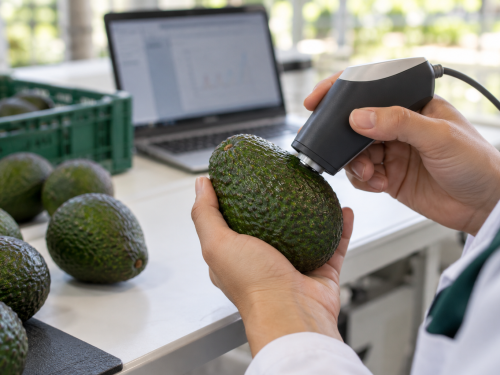
“At this time of year, Mexico has a very high dry matter content, around 28-30%. We're actually offering fruit with 25-27% dry matter. So there's a difference. However, it's a product that ripens very well. If we can export a product with 23-24% dry matter, we'll have a guarantee of exceptional ripening. We have to take care of the fruit from the tree to prevent any kind of anthracnose, and all the field management practices will be excellent. That will allow us to achieve good ripening. These are the challenges the country faces here in the tropics.”
- How much growth do you project for Colombian origin this year and in the United States - Europe ratio?
“I think we are growing overall this year by 25% in total volume in Colombia. I believe that together we will reach roughly a 50-50 split in sales between the United States and Europe this year.”
- It's part of a period of rapid growth. Are logistics, transportation, and port services able to cope with this growth in shipments?
“At the port level, I foresee very positive development with the opening of Puerto Antioquia for the entire Colombian agribusiness sector. It will be a very important engine of development. This needs to be supported by a comprehensive land transportation program. Here in Colombia, we work extensively with truckers, and it's expected that they will have enough vehicles to handle this transport from the packing facilities to the port. However, I believe there's another major challenge we face in Colombia, and that's ensuring our packing facilities have sufficient cold storage capacity. We're entering a period where we need to carefully consider that we have different destinations that operate in different ways, and we must have refrigeration infrastructure that guarantees we can meet the fruit's storage requirements.”
- What is the distance between the production areas and the port area to begin the sea journey?
“If we're talking about going to Cartagena from where we are, it can take us about 18 or 20 hours. But once Puerto Antioquia is open, we could be talking about about 9 hours. The land trip will be cut in half. Especially for these areas of the coffee region, for whom this opportunity to reach Puerto Antioquia via Pacific 2 and Pacific 3 is fantastic.”
- When will the Antioquia port service be available?
“In three months, we'll have the port operational. It's fantastic. This port has all the necessary infrastructure for cold chain transport, giving Antioquia the opportunity to export not only bananas but other fruits as well. Furthermore, it's working very closely with CMA, which is also one of the investors. It's a port specializing in the agricultural export industry.”
- What are the calibers that Colombia will be offering most strongly this season?
“We are focused on the sizes for the United States, which is what is 84 and 70. That is 60% of our fruit.”