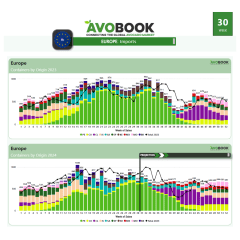
Europe received 20% less avocado compared to week 30 of 2023
The Avobook Premium Report details how avocados arriving in Europe show a lower volume in both weekly and annual comparisons; while in the United States, Mexico has 41% fewer hectares available for harvesting; and for the first time this year, China expects fewer shipments than Japan.
These are times when avocado markets are showing a transition between seasons in different origins. This can be seen in both the United States and Europe, where fruit is being prepared for shipment to replace the volume from those origins that will be reducing their market share.
In North America, the figures confirm what Antonio Villaseñor warned in his column, with 41% less supply of hectares for cutting in the United States program, compared to last year, during the same week.
That origin is waiting for Peru and California to reduce their volumes, which is projected for mid-August, when the Mexican fruit will also have a higher percentage of dry matter and will be optimal for marketing, at a good price.
This week, Peru and California are tied for second place, with 25% each, behind Mexican fruit, which holds 42% of the market.
Europe has less avocado than last week and in 2023
Europe is receiving 683 avocado shipments this week. Of these, 88% are from Peru, followed by South Africa, which comes in a much smaller share. However, the continent's total volume shows a downward trend, both in weekly and year-on-year comparisons: it is 16.4% lower than last week and almost 20% lower than the same week in 2023.
The market is mostly dominated by small-sized fruit, with prices showing a slight decrease, but active demand, mainly from the retail market.
This marks the beginning of the fruit seasons in Colombia and Chile, which will gradually fill the gap left by Peruvian avocados. Chile is preparing for an early increase in its shipments, projected to begin in Week 33.
The week's peculiarities are taking place in Asia
Two particularities are occurring in Asia this week. The first is that it is the first week of the year where shipments en route from Peru to China (21) are fewer than those transiting to Japan (29).
Week 30 reports the arrival of 39 shipments to China, which show a slight increase in prices. This is where the second noteworthy feature of the week becomes apparent, when looking at Week 30 of 2022, 2023, and 2024. The reference values (corresponding to sizes 18 to 24) are the highest reported for the same week in the last three years.
Chile receiving more than double the amount of Peruvian avocados
What we're seeing in the Chilean market is interesting: last week 79 shipments of Peruvian fruit entered, and this week 119 entered. Even the price of avocados from their neighbor is better than what's being offered for Peruvian fruit.
What we learned from Avobook is that the marketer is preferring avocados from Peru because they have a higher percentage of dry matter and ripen a few days after purchase, which is highly valued by the consumer, unlike the local avocados found on supermarket shelves.
Browse through the numbers of the global avocado market by clicking on the Avobook Premium Report for Week 30 .