China and avocados: how the game changed for exporters between 2023 and 2025
The Asian market set volume records, but also exhibited increasing volatility that challenges industry players.
At first glance, avocado exports to China have followed an upward trend over the past three years. However, behind the volume growth, the figures reveal an increasingly competitive, volatile, and demanding market. The dynamics of the first four months of 2023, 2024, and 2025 offer a clear picture of the structural changes, logistical pressures, and tactical decisions that Latin American exporters must make.
Avobook data analyst Tomás de la Cuadra observes a pattern of continuous expansion, albeit with some nuances: in 2023, 718 containers of avocados were exported to China between January and April; in 2024, the figure rose to 791, and in 2025, 830 containers were reached during the same period. This latest figure slightly exceeds that of the previous year, but it doesn't imply growth without challenges. “The first five weeks of the year remain slow in every year, with exports not exceeding 50 containers per week. The real activity picks up starting in March,” De la Cuadra explains.
The most visible changes are in market share by country. In 2023, Peru led with 76% of the market, followed by Mexico with 13% and Chile with 11%. A year later, Mexico entered the equation more firmly, capturing 5%, while Peru rose to 88% and Chile fell to 8%. But it was in 2025 that Peruvian dominance was consolidated with 84% of the volume, compared to Chile's 16%, while Mexico was left out of the market share during that first four months.
“Until week 6, Chile was the main supplier, but then Peru quickly took the lead. The last arrivals from Chile were recorded until week 13, when the volumes were already practically marginal ,” explains De la Cuadra.
Although the total volume reached in 2025 was the highest of the three-year period, market behavior—especially in April—showed signs of strain. André Vargas, Global Procurement Manager at South American Express Co., warns that “April presented significant challenges for Hass avocado exporters who focused on the Chinese market, reflecting a combination of extreme volatility, low prices, and very specific strategic opportunities.”
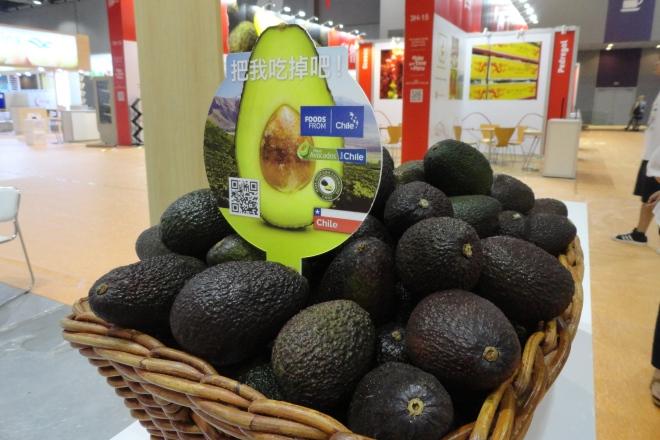
The weekly sequence was illustrative. In week 14, the Chinese market received 66 containers aboard the OOCL Chennai, causing a sharp drop in prices: generic 4kg boxes fell to RMB 80.00/85.00, and branded boxes settled between RMB 90.00 and 100.00. By week 15, with 100 Peruvian containers arriving, the inventory saturation affected even premium brands. “The 4kg boxes faced strong pressure, and although the 10kg boxes held up better, quality became a critical factor,” Vargas points out.
Week 16 marked the lowest point of the month. On April 14, prices for 4kg boxes fell to RMB 50.00, levels not seen since 2023.
“The decision by well-known brands to reduce their prices, in the face of slow inventory turnover, triggered a domino effect. The market became completely depressed,” says Vargas. Even 10 kg boxes, which historically showed greater stability, fell to a range of RMB 150.00/160.00, with lows reported at RMB 120.00.
A slight recovery came in week 17, when average prices reached RMB 100.00 for sizes 20 and 22, and up to RMB 220.00 for 10 kg boxes in markets like Guangzhou. However, the volume shipped dropped drastically: barely a single container from Peru. This decline was partly due to blank sailings on the route via Chancay, which prevent reliable shipment planning. “These days it’s very difficult to make a clear forecast of how many containers will leave through this port. That greatly complicates the exporters’ strategy,” Vargas points out.
Week 18 was marked by the Chinese Labor Day holiday, which slowed sales without significantly impacting prices for good-quality fruit. Even so, the month's results offered a clear warning: increased volume does not guarantee profitability. “Oversupply can quickly destabilize the market. In this context, the strategy should focus on product quality, controlling shipment volumes, and constantly monitoring arrivals,” Vargas emphasizes.
Looking ahead to May, the projections are no more encouraging. A record price drop is anticipated in weeks 19 and 20, with up to 231 containers arriving in just a few days, which would put extraordinary pressure on demand. Furthermore, there are exporters with large volumes who have not yet begun to trade aggressively, which—if it materializes—could further exacerbate the price decline.
Overall, the evolution of the Chinese avocado market between 2023 and 2025 reflects accelerated maturation, but also exposes the limits of growth without diversification or tactical adjustment.
Vargas sums it up very well: “Volatility is still the norm. It’s not enough to just arrive: you have to know when, how much, and how.”