Chile started its season early, but the cold weather has slowed its avocado production.
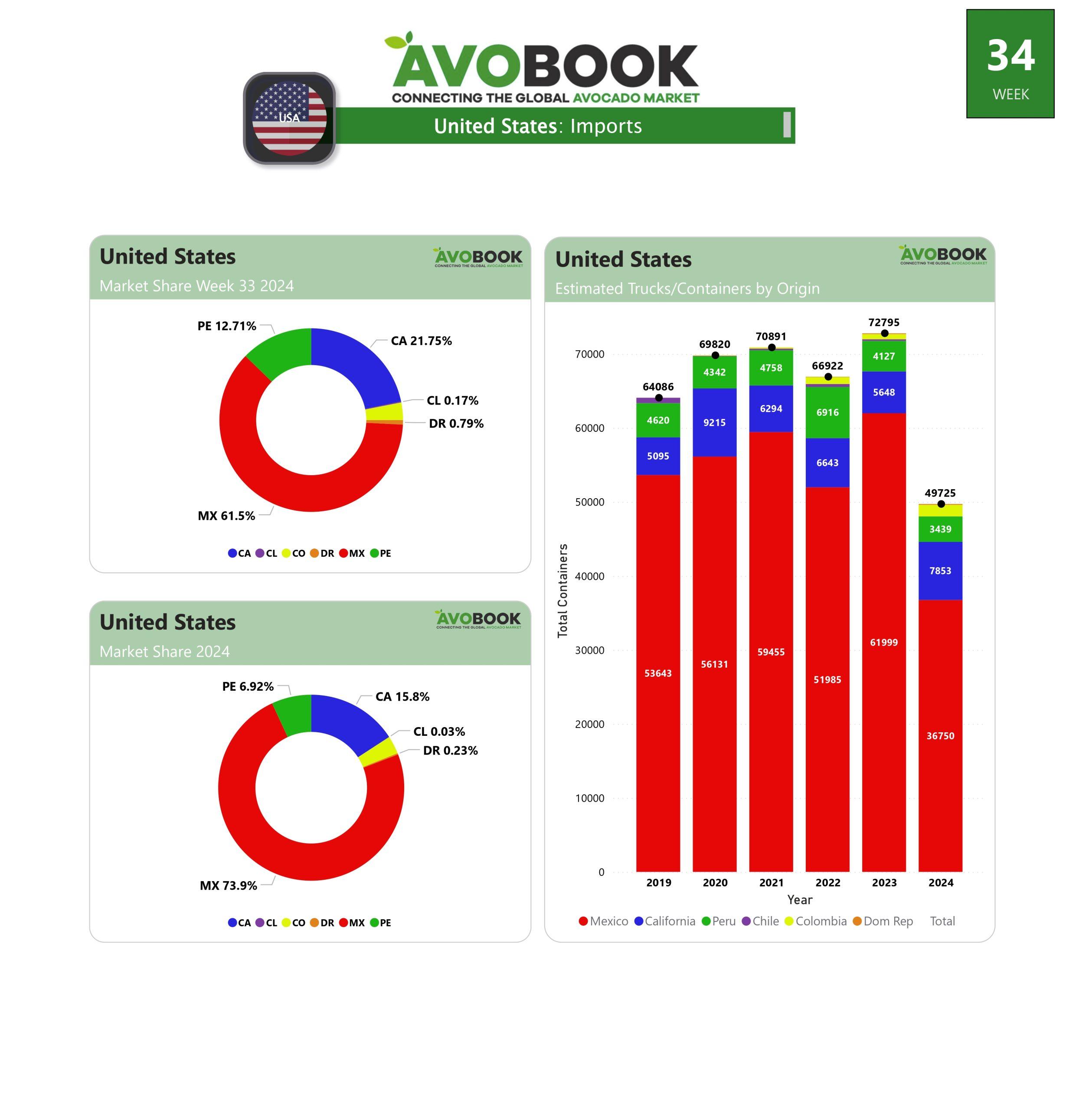
This reality can be seen in the numbers of the Avobook Report for Week 34, which also shows Mexico's breakaway in the North American market and Peru's continued dominance in Europe, with 80% of the market.
Chile is starting its season earlier than last year. This is already good news for the country's exporters, who have nonetheless had to accept that the season isn't starting with all the fruit they had hoped for.
This is demonstrated by the Avobook Report for Week 34, which records 20 containers shipped to the United States. An additional 20 containers have also been dispatched to Europe, where they are expected to arrive in Week 37. This initial phase includes 15 shipments to China, beginning to complement the gradual increase in Peruvian fruit exports to the Asian giant.
The reason for this less "boisterous" shipment is due to the cold weeks Chile has experienced, which affected the speed at which the fruit is reaching the appropriate dry matter content. However, as the ripening process normalizes, the surge from this origin will be strongly felt in the United States and Europe. In the former case, it will displace Peru from third place, as it seems unlikely that it will reach California's market share.
Peru remains the leader in Europe, but will not reach the 2023 target.
In Europe, Peruvian exporters continue to lead the race, although they have been gradually disappearing from China, but they exhibit an 80% share of the European market, followed by avocados from South Africa (13%) and, much further down, those from Colombia and Kenya, which have little volume compared to previous weeks.
Prices in Europe are once again behaving differently in the arrival zones of the Netherlands and Spain: in Amsterdam, prices have remained stable for almost all sizes, awaiting the quality of the fruit arriving in larger quantities from Kenya, as well as the volumes expected from Chile, Israel, and Morocco. Morocco is anticipating the start of its season in October. All of these countries will gradually fill the gaps left by Peru. Meanwhile, in Spain, prices for small and medium-sized fruit have remained stable, while larger sizes have risen slightly, maintaining the gentle upward trend that began last week.
However, the total volume of fruit in Europe is still lower compared to the same week in 2023, as the 588 containers received this week represent 24% less than last year, mainly due to the impact of the decline in production in Peru.
Mexico views its competitors in the United States from afar.
In the United States, Mexico continues to grow. That's true. But, at the same time, Peru continues to decline, albeit slowly. These two situations have resulted in Mexican fruit holding a 61% market share, with California following considerably behind; and Colombia dropping below 2 million pounds per week for the first time since week 15.
Chile and the Dominican Republic are present, but still very marginally, in a market where prices for larger sizes are stable, while smaller sizes have seen a decline in the weekly comparison. One example is size 70, which used the Avobook Report as a reference, showing a 33% drop.
China with low volume and improving price for small fruit
China remains a market that will definitely receive a lower total volume of avocados compared to 2023. Peru is prioritizing other destinations, and the shift from Chile is slow. Chile sent 15 containers, which will arrive in four weeks, but this number will increase as production reaches the expected levels to withstand the journey.
The fact is that China is not receiving more than 25 containers per week, most of which continue to come from Peru, which is projected to either cease shipments to that country beyond the end of September or do so by discarding fruit, after securing its prioritization towards other markets.
Prices show a slight drop in the larger calibers, but the smaller ones have risen considerably, comparing this week to last. However, there is little price variation between calibers.
If you want to learn more, you can check out the Avobook Report for week 34 and subscribe to the Premium version, with all the records, charts and statistics of the global avocado market.