Chile: the sustainability “benchmark” for the global avocado industry
Seven years ago, the Chilean Avocado Committee initiated a plan that today allows it to show successful results in initiatives to reduce water consumption, improve energy efficiency, and foster relationships between companies and communities, among other public commitments made by its members.
A decade ago, sustainability wasn't a priority for the Chilean avocado industry. Successive dry years left producers without enough water to maintain crop volume in traditional growing areas. Meanwhile, environmental groups launched smear campaigns in countries that imported Chilean avocados, fueled by widespread misinformation.
The combination of productive and reputational impacts, in addition to the geographical shift of areas with cultivation potential towards southern Chile, showed the need to deepen and make visible sustainable development as an essential element in the practices of Hass avocado producers and exporters.
The task was actively undertaken seven years ago by the Chilean Avocado Committee, with the aim of obtaining objective information on the environmental performance of the industry and, on that basis, taking action to design management systems and overcome gaps.
This is how Francisco Contardo Sfeir, the executive president of the Chilean committee, remembers it to Avobook, recalling that in 2018, a first analysis useful for these purposes appeared: a study with the UNESCO Center for Water in Arid and Semi-Arid Zones of Latin America and the Caribbean (CAZALAC), one of whose focuses was the management of water resources in areas with these characteristics, where the main avocado crops in Chile are located.
“This was a study funded by this UNESCO agency. After a year and a half, it yielded many interesting results, derived from a very comprehensive analysis, with chapters dedicated to soil, water, biodiversity, international environmental agreements, among others,” explains the Committee's executive president.
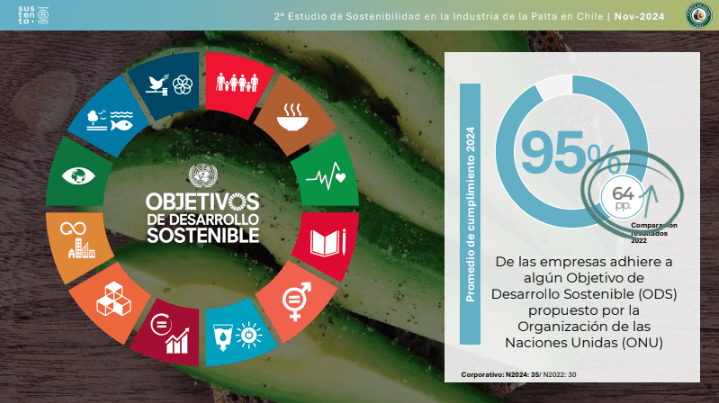
In one of its chapters, the Sustainable Development Goals (SDGs) were discussed in depth, in which the United Nations indicated that avocado cultivation in Chile cooperates with 14 of the 17 SDGs.
“It was a positive result, which forced us to decide whether to be content with a diagnosis that was already very positive or to take it as a starting point to improve even more. We chose the latter,” Contardo recalls.
Specialized self-assessment
The plan began in 2022, establishing a baseline, with the first “Study on the State of Sustainability in the Avocado Industry in Chile”, carried out by the specialized consulting firm “Sustenta +”.
“The goal was to self-evaluate, using a survey of around 77 questions. It was administered simultaneously to corporate representatives and people working in the fields. We used the results as a baseline, and they were quite positive,” explains Contardo Sfeir.
With that data in hand, the Committee decided to sign and make public 14 essential commitments in Sustainability from its partners, presenting them as a "starting point", to work on each one and improve them with concrete metrics.
“We set ourselves the goal that, in 24 months (from 2022 to 2024), there would be improvements through the incorporation of practices that would shape a sustainability management system. In 2024, we measured again. Overall, we greatly improved the results,” explains Contardo Sfeir.
During those two years, talks, working groups, technology transfer between partners, and other actions were carried out.
Exceeding sustainability goals
Among the outstanding achievements, the 2024 analysis shows that there was an average improvement of 64% in the total practices of the partners.
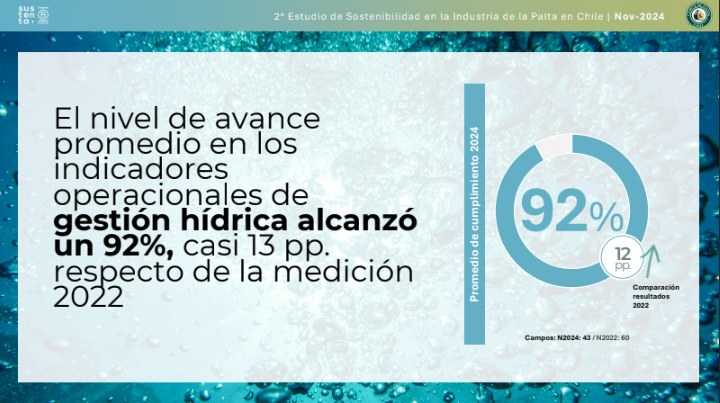
While the sector already boasts high levels of irrigation technology, enabling efficient water use, the average progress in operational water management indicators improved, reaching 92%. This represents an increase of almost 13 percentage points compared to the 2022 measurement.
“It is noteworthy that there are practices in place to reduce the volume of water used in agriculture and that there are commitments to make more efficient use of the resource. Also, the number of those contributing to communities with water supplies has increased,” says Francisco Contardo Sfeir.
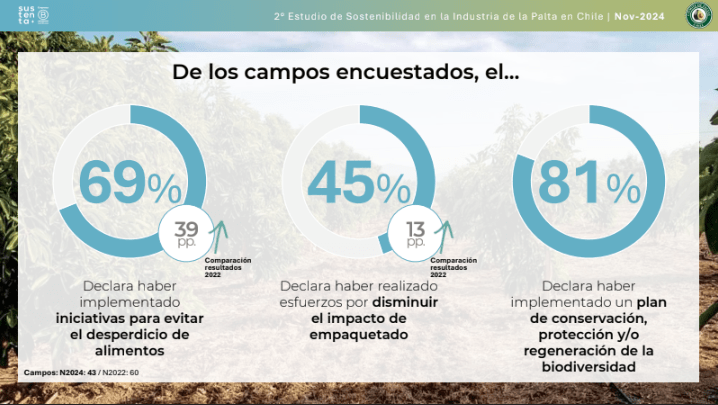
In terms of energy practices, there was significant improvement. According to the report, the percentage of farms implementing measures to reduce fossil fuel use increased from 33% to 60%, and 67% (+20 points) are implementing practices to transition to renewable energy. Furthermore, 86% are implementing energy efficiency initiatives.
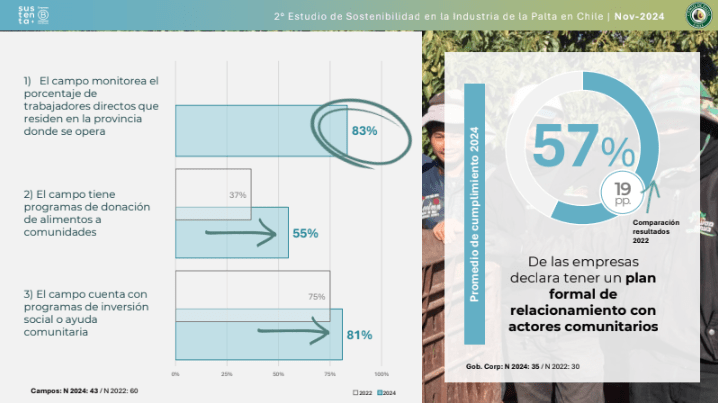
Contardo Sfeir also points out that “currently, around 60% of the partners have a formal community work plan, which is part of the governance of the companies.”
The association acknowledges that it has been a very relevant cultural change for the industry players represented by the association's members, incorporating the issue of sustainability into their DNA.
Chile: “the benchmark in sustainability”
The Chilean experience is becoming a benchmark for other countries that are not yet facing, or are just beginning to face, environmental challenges that represent potential risks to operational continuity.
“When the tenth World Avocado Congress was held in New Zealand in 2023, all the industry leaders gathered, and we, as Chile, were the only country of origin to present on sustainability. Another instance was during an open panel, with around 400 people in the audience, where I asked to speak about sustainability. After these two events, and after everyone heard what we Chileans were doing, it was recognized that we were the most advanced in sustainability,” commented the president of the Chilean Avocado Committee.
According to Contardo Sfeir, Chile became "the benchmark in sustainability" at the avocado industry level.
“That was corroborated in 2024, in Territorio de Aguacate, where we were invited to a panel called 'Inspiration Cases', to tell the Colombian industry what we are doing,” he says.
“In companies, decision-making is hierarchical. In the trade association world, we must convince and inspire, and that's what we're doing. That's why I always give special recognition to our members, because without them, without their willingness and availability, we couldn't have done it. They truly embraced sustainability,” concludes the representative of the Chilean avocado growers' association.