California increased its share of the North American market while Mexico experienced a significant decline
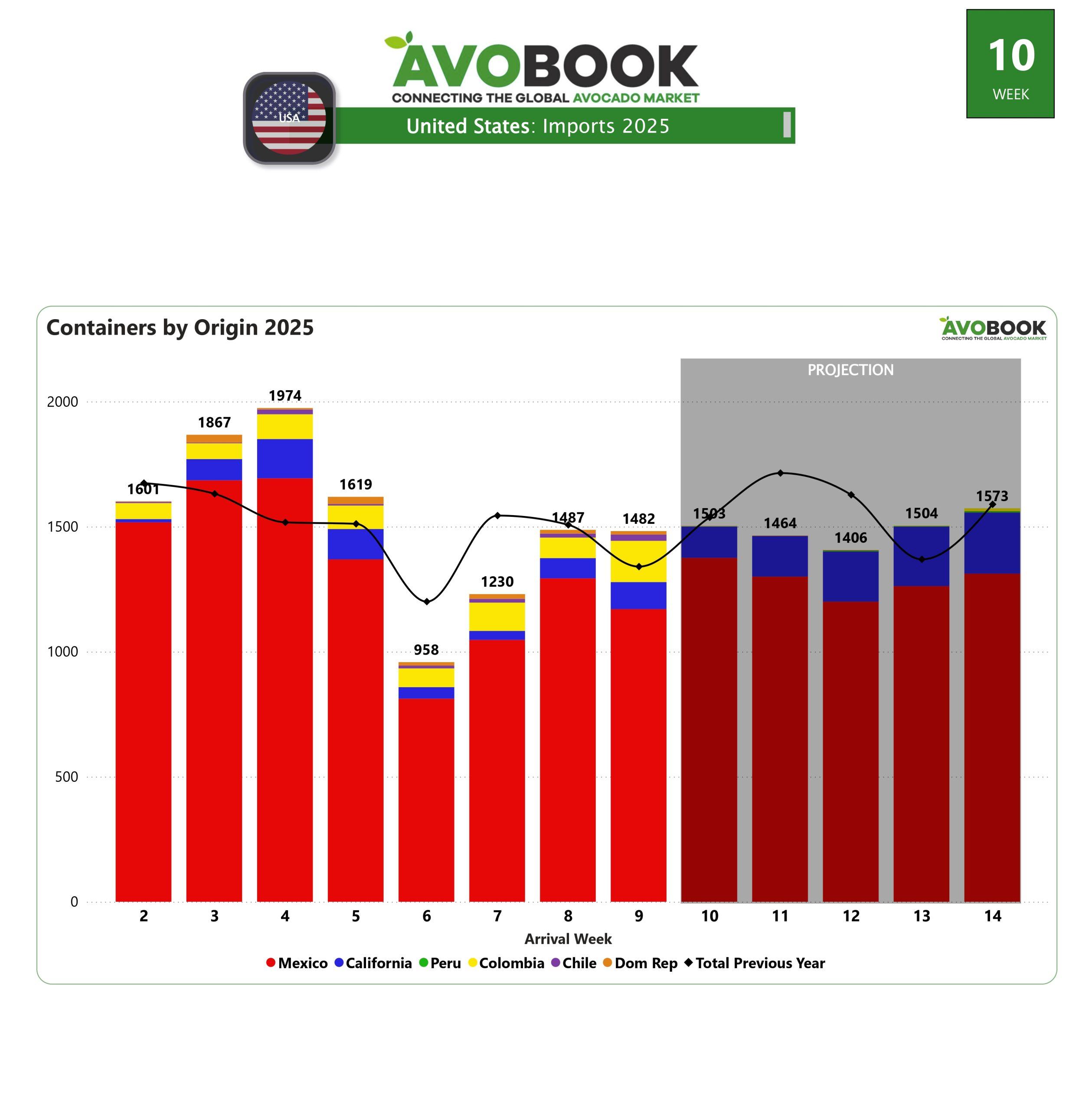
At the close of week 9, avocado shipments to the United States reached approximately 1,482 containers, a level similar to the previous week, with a difference of less than 1%. Compared to the same period last year, the volume shows a 10% increase.
Mexico remains the main supplier, accounting for 79% of the total, followed by Colombia with 11%, California with 7%, and Chile with 2%. Peru has not yet begun shipments, as its production is focused on the European market.
Prices in the US market vary depending on the gauge. Larger gauges have remained relatively stable, with a slight decrease of between 2% and 3%. In contrast, smaller gauges have seen increases, most notably the 84 gauge with an 11% rise, which has narrowed the price gap between segments. The 60 gauge, meanwhile, experienced the largest drop at 6%, although this did not represent a significant adjustment.
In terms of origin, California increased its share compared to the previous week. Mexico, on the other hand, registered a drop in its export volume compared to week 8.
According to Sergio Paz's latest column, this decrease is not only due to production factors, but also to the implementation of the 25% tariff on Mexican exports starting March 4. Faced with the resulting uncertainty, many exporters opted to halt their harvests and shipments until they could assess the impact on costs and prices, while importers, responsible for paying the tariff, also exercised caution.
As a result of the smaller harvest at the start of week 10, inventories have decreased, raising concerns about a potential increase in farmgate prices. To mitigate the situation, retailers have begun pressuring other origins to increase their market share. California, Colombia, and eventually Peru are expected to increase their shipment volumes. Only California is currently exempt from these tariffs, although general tariffs on agricultural imports are scheduled to take effect on April 2, which could also affect Colombia and Peru.
Find more charts and data in the Avobook Report . Subscribe to the Premium version at avobook.com