Asia as a window, not a destination: How long will Chilean avocados last and who will take their place?
The presence of Chilean avocados in Asia remains relatively relevant during the season, but continues to be limited and tactical. Data from Avobook confirms that the Asian market surpasses the United States as a destination, although its role is concentrated in the first weeks of the season and quickly diminishes. Europe and Latin America emerge as the main recipients of the volumes that Chile withdraws from the Asian market, in a context where domestic consumption and structural costs influence export decisions.
During the 2025/26 season, Asia accounted for 7.22% of total Chilean avocado exports, making it the third largest destination region, behind Europe and Latin America. Although its share is higher than that of the United States, it failed to establish itself as a long-term market within the season, instead serving as an initial window that quickly closes.
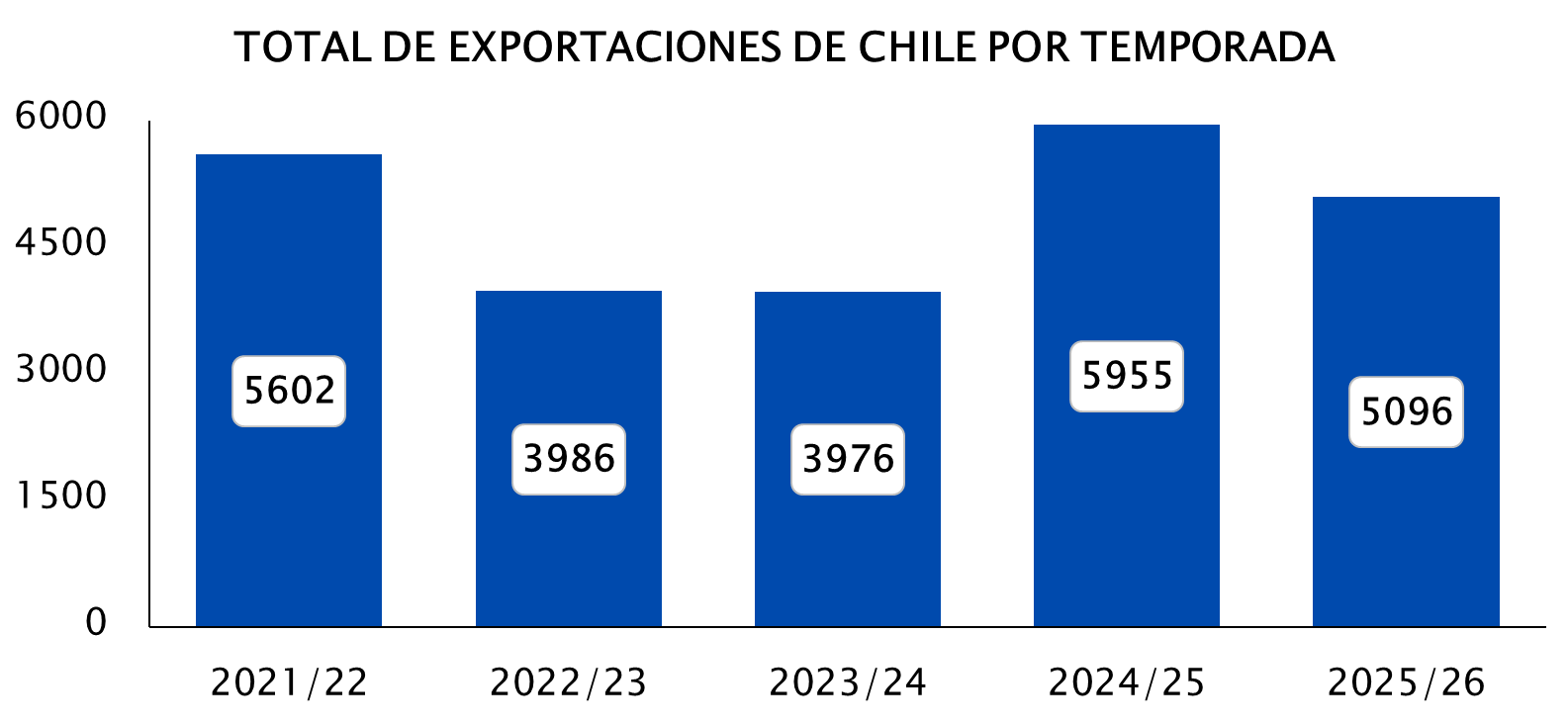
In absolute terms, Chile has shipped 5,096 containers of avocados this season, of which 426 went to Asia, representing 8.4% of total exports. China leads shipments within this region with 368 containers, followed by South Korea with 58, while Japan maintains a smaller share this season.
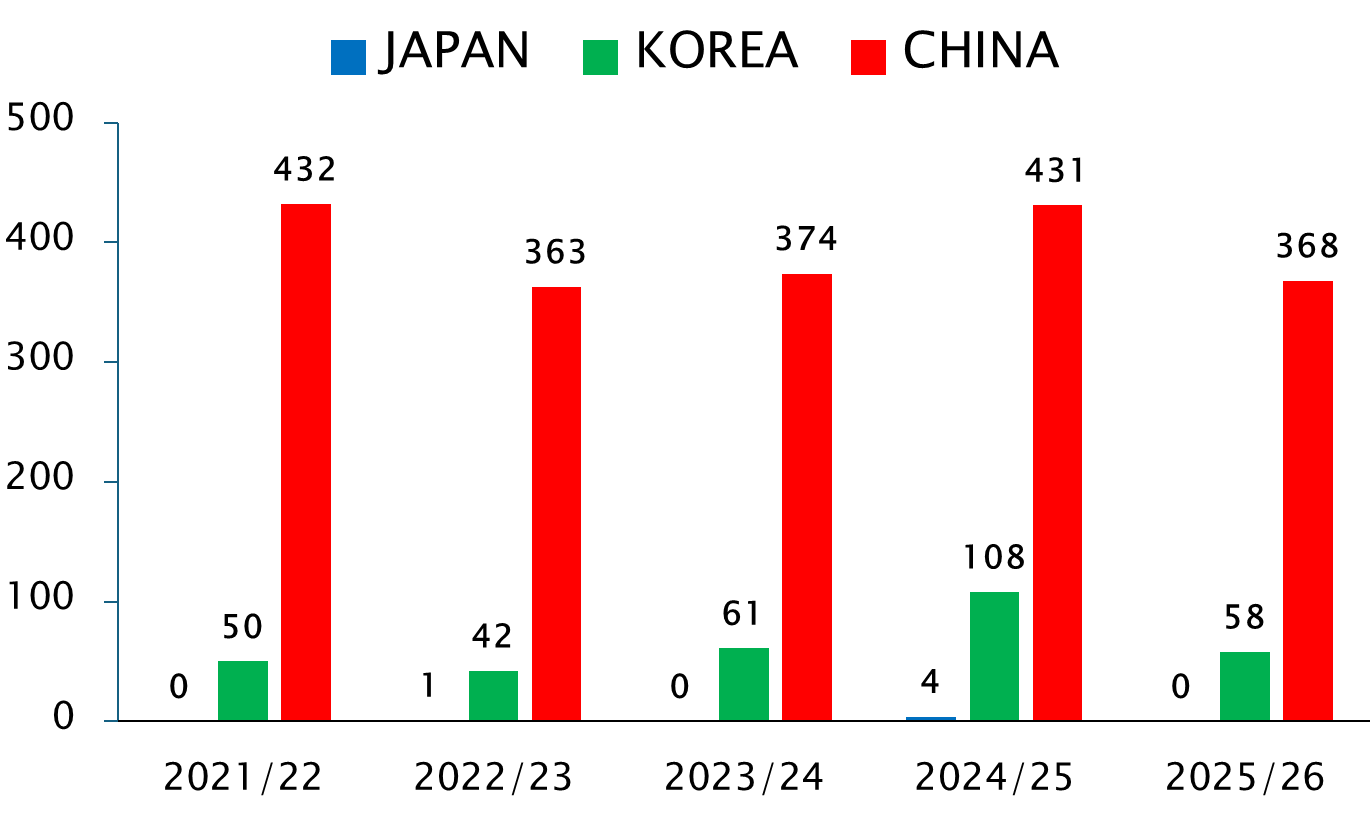
Avobook's historical analysis reinforces the idea of an increasingly shorter window. In the previous season, weekly shipments to China only fell below 10 containers in week 5 of the year. In the 2023/24 season, that same threshold was reached earlier, in week 52, indicating an earlier exit from the Asian market and a reduction in the effective marketing period.
From a business perspective, this dynamic is less due to a lack of demand and more to an unfavorable economic equation for Chilean avocados. This is the view of André Vargas, Global Procurement Manager of South American Express Co. and Commercial Director at Fruwer Produce LLC, who maintains that “the truth is that Chilean avocados are attractive to the Chinese market, but China is not necessarily an attractive destination for Chile.”
One of the key factors is the strength of the domestic market. According to Vargas, “Chile has strong and sustained domestic consumption of Hass avocados, where prices are usually equal to or even higher than those obtainable in China, with quick returns and without assuming the logistical risks of long transit.” This relative advantage reduces the incentive to sustain shipments to Asia beyond a specific period.
Added to this is the cost structure. The executive warns that “Chilean avocados have one of the highest purchase costs among the main exporting origins, which significantly raises the break-even point of any international operation.” In markets like China, characterized by their high volatility, this condition complicates the risk-reward ratio.
This scenario explains why Chilean presence in Asia remains limited to a few companies and specific times of the season. “Few companies venture into the Chinese market on a sustained basis; when they do, it’s usually as part of a diversification strategy or as a safety valve during periods of local oversupply,” Vargas points out, dismissing the idea that it’s a structural commitment.
Meanwhile, Europe and Latin America continue to absorb the majority of Chilean exports. Countries like the Netherlands, Spain, England, and Italy account for significantly larger volumes, while Latin American markets such as Argentina and Uruguay are gaining ground as the season progresses, benefiting from shorter transit times and greater commercial flexibility.
Regarding prices in Asia, there are no consolidated historical records of Chilean avocado prices in China, which limits long-term comparative analysis. This lack of transparency reinforces the perception of Asia as a more complex and less predictable market for Chilean avocados.
In this context, Chile's withdrawal from the Asian market is not due to an abrupt break, but rather a natural reconfiguration of its export flow. Asia continues to play a specific role, but one increasingly limited to the first weeks of the season. As André Vargas summarizes, "China represents a tactical opportunity for Chilean avocados, but not a priority structural market as long as domestic consumption continues to offer competitive prices, high turnover, and lower risk exposure."
Thus, the strategic weight of Chilean avocados is gradually shifting towards markets where it finds greater continuity, volume and predictability, redefining the map of its exports season by season.