Kenyan avocado: the new bet that challenges the giants of the market
With production exceeding 500,000 tons in 2023 and leading regions like Murang'a and Kisii at the forefront, Kenya is accelerating its strategy to solidify its position as a global supplier of Hass avocados. The roadmap, explained by Grace Ngungi, CEO of Karakuta Fresh Produce LTD., and Moses Karanja, also of Karakuta Fresh Produce LTD ., aims to maintain its presence in Europe and the UK while gaining an early advantage in India, the Middle East, and Asia.
Kenya has placed avocados at the heart of its agricultural export strategy and is emerging as one of the countries with the greatest potential in the global avocado market. In 2023, its production exceeded 500,000 metric tons, a volume that reflects not only the potential of its producing regions but also the efforts of thousands of small farmers who have found in this crop an opportunity for economic and social growth.
The challenge now is to transform that production capacity into a solid presence in key international markets and carve out a niche among established giants like Mexico, Peru, and Colombia. In this context, Grace Ngungi, CEO of Karakuta Fresh Produce LTD., and Moses Karanja, also from Karakuta, detail how the industry has evolved in the African country: from the production areas that concentrate most of the supply to domestic consumption, growth prospects, the differentiated value proposition, and the solutions being implemented to overcome the complex logistical challenges of global trade.
Production and key regions
The driving force behind this expansion is the central highlands and western regions, where ideal climatic conditions for the Hass and Fuerte varieties are concentrated.
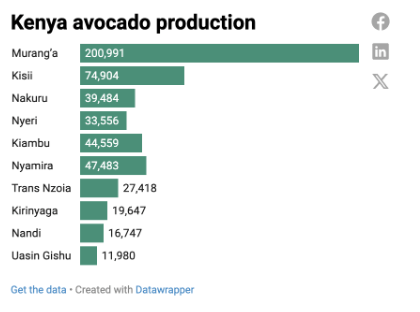
Murang'a County leads production with over 200,991 metric tons, thanks to established orchards, favorable altitudes, and a strong organization of small farmers. Other notable areas include Kisii (74,904 metric tons), Kiambu (44,559 metric tons), Nakuru (39,484 metric tons), and Nyeri (33,556 metric tons), while regions such as Trans Nzoia, Kirinyaga, Nyamira, Nandi, and Uasin Gishu each contribute between 12,000 and 27,000 metric tons.
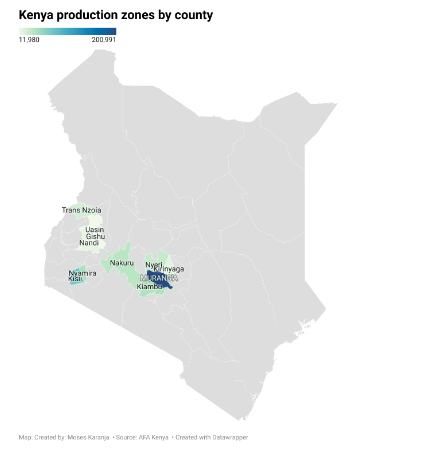
This geographical diversification not only ensures a continuous supply across different harvest windows, but also offers resilience to climate variations, which is key to meeting demanding international programs.
Furthermore, the majority of Hass avocado production is destined for export, solidifying this variety's role as the global standard for the fresh avocado trade. Only a small proportion remains in the local market, primarily fruit that does not meet export requirements and is typically redirected to the avocado oil industry.
For Kenyan consumers, the supply focuses on the Fuerte and Jumbo varieties, preferred for their flavor and texture, although less appealing to international markets due to their short shelf life. In this way, the country manages to supply both local consumers and foreign buyers without the two segments competing with each other.
The industry's growth is supported by the expansion of orchards, improved agronomic practices, and the integration of small producers into high-standard export chains. Furthermore, Kenya's diverse climate allows for staggered harvests, which, combined with supplies from neighboring countries like Uganda and Burundi, provides the potential for a near-continuous supply throughout the year.
In traditional markets like the European Union and the United Kingdom, demand remains stable, with consumption in some countries exceeding 2 kilos per person per year. However, the real growth engine is emerging markets. India, for example, is experiencing a 50% compound annual growth rate (CAGR), driven by an expanding middle class, increased interest in healthy habits, and availability in premium retail chains. The Middle East and several Asian countries are also showing increasing dynamism.
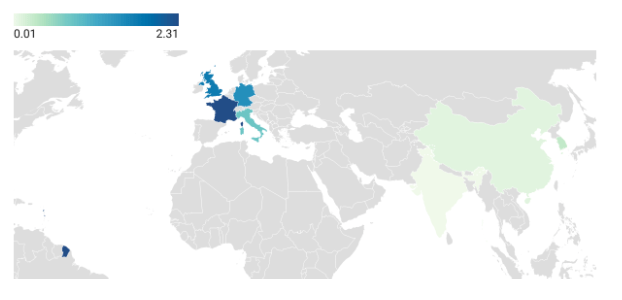
Kenya's strategy is clear: maintain its presence in established high-value markets and, at the same time, position itself as an early player in fast-growing destinations.
The value proposition of Kenyan avocados
Kenyan avocados stand out for their value proposition based on quality, seasonality, and sustainability. The agro-climatic conditions, from the highlands of Murang'a to the volcanic soils of Kisii and Nakuru, allow for obtaining fruit with excellent oil content, flavor and uniformity of sizes, meeting the standards of premium buyers.
In addition, regional integration within the East African Community (EAC) allows for extending the season by sourcing from Uganda and Burundi, ensuring continuity of supply.
Sustainability plays a central role: a large part of the production comes from small farmers who receive training, certifications and access to export markets, generating a positive social impact and responding to global demands for ethically sourced products.
Finally, Kenya's strategic location facing the Middle Eastern and Asian markets gives it a logistical advantage compared to other origins, as it reduces transit times and improves freshness at the destination.
Despite its potential, the industry is not without its challenges. The risks of transit through the Suez Canal, with delays, diversions, and cost overruns, remain a latent threat. Faced with this, Kenyan exporters have chosen to adapt rather than wait for external solutions.
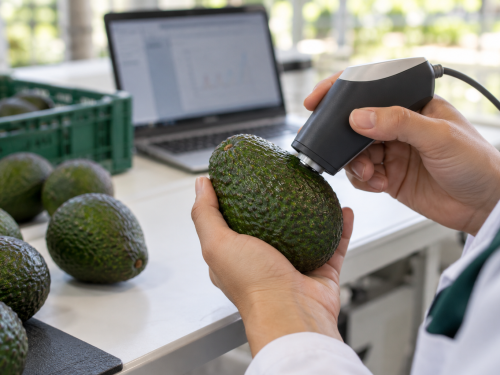
The strategies include investment in cold ripening facilities, strengthening the measurement of dry matter to ensure that the fruit is harvested at the optimal point, and a staggered zonal harvesting scheme, which ensures quality and stability in supply.
Domestically, improvements in the cold chain — from pre-cooling on the farm to refrigerated transport — are strengthening the country's ability to maintain fruit quality over long distances.
These actions are building a more resilient and competitive export system, capable of responding to both foreseeable and unexpected disruptions.
With growing production, diversified markets and a strong commitment to sustainability, Kenya is positioning itself on the global radar as a new player with clear aspirations to join the club of major avocado exporters.