Ramadan month and Moroccan avocados: domestic consumption increases while exports to Europe decrease
Ramadan boosts domestic avocado consumption in Morocco. This holy period coincides with a reduction in export volumes to Europe, a trend that appears to be reinforced by the progressive increase in domestic consumption during this time. This analysis combines data from Avobook and comments from Yassin Chaib, a Moroccan market operator.
Every year, the arrival of Ramadan alters consumption habits in Morocco, a country with a sustained avocado production, mostly destined for Europe. During the holy month of fasting, meals are concentrated before dawn (suhoor) and at dusk (iftar), increasing the demand for energy-rich and nutritious foods. In this context, avocados have gained increasing importance in the local diet, beginning to develop significant domestic demand.
Coincidentally, the increase in domestic consumption coincides with the weeks in which Moroccan exports decline. Is there a relationship between the two? Is Ramadan influencing the number of shipments? This analysis by Avobook seeks to answer that question.
Morocco's avocado export window is between weeks 45 and 13. The sacred fast has slightly variable dates, depending on the moon's phases, but it usually falls between weeks 8 and 12. Right during this period, a "valley" is occurring in the curve of fruit shipments to Europe.
But it's unclear whether domestic demand has grown enough to significantly impact exports. As Yassin Chaib, an operator in Morocco's avocado export business, explained to Avobook, although his country is a significant player in the fruit market, domestic consumption is relatively recent, having consolidated in the last decade, and doesn't necessarily require top-quality fruit.
“Unlike other markets, in Morocco about 95% of consumption is in the form of smoothies, rather than in salads or other preparations,” he explains.
During Ramadan, this custom intensifies and increases domestic demand. This is where Yassin Chaib reveals an important fact: “The domestic market usually deals primarily with category 2 avocados. Only when that supply is scarce do local buyers switch to demanding category 1.”
Only then is there an impact on exportable volumes, since some of the fruit that could be destined for Europe ends up staying in the domestic market.
Moroccan avocado season
For the current season, Yassin Chaib says that estimates place Moroccan avocado shipments to Europe "in a range of between 50,000 and 70,000 tons, with a higher probability of being closer to 50,000-60,000 tons."
Orchard yields have been affected by adverse weather conditions, which slowed the harvest at various times and caused delays in the normal export schedule. Nevertheless, it is a region that has established itself as a key supplier to Europe, with destinations including Spain, France, the Netherlands, and Germany.
The behavior of their shipments is seasonal. This is how Avobook analyst Tomás de la Cuadra describes it, explaining that “the weeks with the highest figures appear in December and January. The last week recorded had the steepest drop of the year, but there is still volume. Normally, during March the export volume begins to decline and, in parallel, domestic consumption increases.”
The following graph shows the behavior of shipments to Europe during the first weeks of 2026.
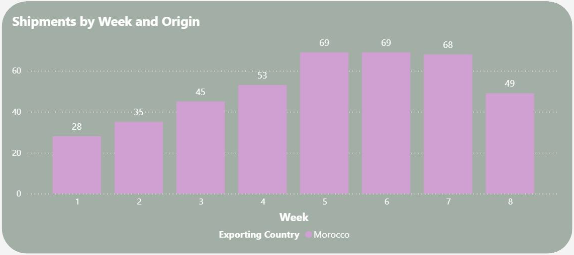 According to the shipments recorded by Avobook, the trajectory is clearly upward at the beginning of the period, going from 28 shipments in week 1; to 35 in week 2; 45 in week 3; and 53 in week 4.
The peak in shipments was reached in weeks 5 and 6, with 69 shipments in each, confirming a surge in export activity in the middle of the European winter. In week 7, the volume remained high (68), very close to the peak.
Up until that week, shipments from Morocco to Europe remained at very high and stable levels (69, 69, and 68 in weeks 5, 6, and 7). Right in week 8, when Ramadan began, there was an abrupt drop, from 68 to 49 shipments, breaking the trend of the previous weeks.
Comparison of avocado shipments from Morocco between 2023 and 2026
The comparison of weekly fruit shipments from Morocco to Europe between 2023 and 2026 shows a fairly consistent seasonal pattern, with some important nuances between years.
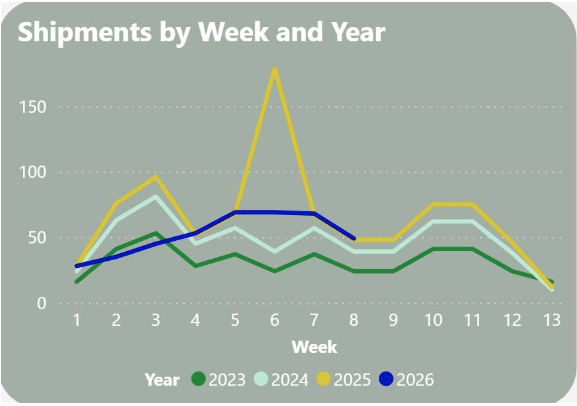
In 2023 and 2024 the curve is relatively stable: volumes grow from week 1 to an initial peak around weeks 3–5. They then decline, rebounding near weeks 10–11, before falling sharply towards week 13. The only exception to this pattern occurs in 2025, when an unusual peak appeared in week 6, at levels much higher than at the same time in other seasons.
According to this historical review, there is no phenomenon linked exclusively to Ramadan, but it is true that the greater domestic consumption would be amplifying a commercial dynamic that was already developing in previous seasons.