Peru's 2026 avocado campaign: expert anticipates a later start and consolidation of new supply windows
Peruvian consultant Alfredo Lira Chirif explains the real impact of the cold on Peruvian avocado production, but downplays its impact, projecting a volume increase that could be around 5%.
Year after year, the big question for avocado suppliers in Europe is the same: how is the Peruvian season shaping up? Just as Mexico is the major player influencing the business within the United States, Peru is the most important player in Europe, both in terms of the volume and quality of fruit shipped to that market.
Peru contributes between 600,000 and 700,000 tons per season, allocating more than 60% of its exportable production to that market, so its fruit volume and commercial decisions are closely watched by the other origins that supply the continent.
Alfredo Lira Chirif, a Peruvian consultant specializing in agribusiness and a columnist for Avobook, predicts that the campaign will start slightly later, but not as late as last year. He also notes that the country is beginning to establish a presence in markets where it traditionally did not supply fruit in significant volumes.
“The fruit is clean and healthy; it’s a good year and there’s been enough water . The cold weather this past winter has delayed the start of the season a bit. Not as much as last year. I think the northernmost areas will start harvesting towards the end of March or the beginning of April. It could be moved up, but only a little,” he explains.
Another quality of the exports projected for 2026 is that they will provide larger caliber units, because - he explains - "the trees have been more rested and that energy they have saved is channeled into the fruit."
“The greens that are ready for harvest starting this week will likely yield significant volumes. Regarding volumes in Olmos, I think they are slightly lower than last year. And towards the more central coast there could be a slight increase,” he explains.
In summary, he projects that the total volume from Peru could be in the same range as last year: “Perhaps 5% more . And I'm referring to the Peruvian coastal campaign, because the highlands always surprise us with a slightly higher volume due to the transplants that have been done.” in recent years in that region. It is a fruit of January, February, and March.”
“In short, there won’t be much more volume and I think it will be better distributed than last year,” Lira commented.
Extension of Peru's avocado export calendar
What we see in the productive areas of the highlands is interesting. But it has its own timeline. Alfredo Lira explains that this area has planted considerably more land " and it takes a little longer to come into production than the coast, because it's cold."
“The coast could produce around 7,000 kilos if it takes 24 months from transplanting to harvest. And from there, 15,000, then 20,000. In the highlands, that increase is slower because there are very cold nights. Those volumes are only now coming in from the transplants of recent years . There is an area in Cusco that I visited not long ago, which has a lot of new avocado acreage , early-ripening for Peru, with peaks in January, February, and March, and that increases the volume for the whole country,” he explains.
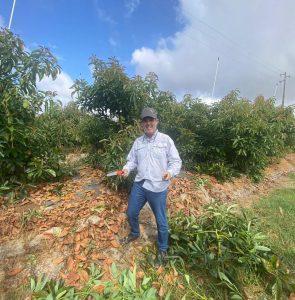
He mentions this as a way of demonstrating that the calendar adds new periods to the year, complementing the traditional season. Peru's export season has traditionally run from April to August, but currently, it includes active areas in September and October in Arequipa, and between January and March in the Andes.
“The highlands have been growing over the last six years. So we can no longer talk only about the 700,000 or 800,000 tons of the central coast harvest . In Arequipa, there's a farm we advise that harvests fruit from August 1st to September 30th, which is an extraordinary window. Our Chilean friends buy all that fruit right at the packing plant because it's just before their own harvest and at the end of the traditional Peruvian harvest. They also find good prices in Europe,” he explains.
How did the cold weather affect the 2026 Peruvian avocado crop?
The cold weather affected Peruvian production until November and part of December. It only returned to normal levels in January. This had an effect on timing and size.
“In simple terms, they have fewer ‘children’ to care for, or they have the same number of ‘children’ but without the heat that causes them to lose energy. That energy that is no longer lost is channeled to the fruit, and this makes the fruit grow larger. In fields we are advising in the north, in Olmos, we are finding larger fruit sizes, compared to the same date last year,” explains Alfredo Lira.
This situation could be repeated in other areas that usually produce smaller fruit.
“Everything suggests that the sizes will be closer to 16 or 18 in European sizes; and not so much to 18, 20 or 22. It's a small difference, but it's important, because of the destination of the fruit, which is segmented by size,” the specialist explains.
However, Alfredo Lira believes that this factor will not be the most influential in defining the markets to be conquered, but rather the commercial strategies.
The expert explains that the growth in consumption in Europe is a fact and that would help to avoid creating imbalances due to the high volume of avocados coming from many supplier countries.
“At the last trade fair in Berlin, the World Avocado Organisation (WAO) showed that in Eastern Europe—Germany, Italy, Russia, and the entire northeast of the continent— consumption growth is impressive. The same organization reported that, at the Lidl supermarket in Germany, avocado sales have grown by 85% year-on-year,” he says.
However, Lira is convinced that Peru's strategy should be to adopt a more aggressive commercial approach in the United States, trying to ripen the fruit at its destination, in order to improve prices.
“Mexico’s fruit ripens on the tree, just like Colombia’s, due to the distance to the market . The ‘valley’ of the Mexican export curve is right at the Peruvian market window. So, that’s where we should be working to capture the price they have , because today they pay us less than Mexican fruit, not because of the fruit’s quality, but because of its condition upon arrival,” he argues.
When comparing Peruvian strategies for exporting to Europe and the United States, a difficult-to-understand difference emerges: Peruvian avocados travel 25 days to Europe to ripen there. Sixty-two percent of the volume produced for export is shipped there. Transit to the United States takes between 12 and 15 days, but the fruit does not ripen.
“Because of their arrival status, we can’t capture a price similar to that of Mexico, because they receive fruit that is less creamy than what Mexicans and Colombians can offer. That penalizes our price. So we have to work on resolving it,” the consultant says.