International market
Hass avocado sizes: how they are classified and what they mean for the market
The global Hass avocado industry uses a sizing system that defines sizes, prices, and market destinations. Europe and the United States use different nomenclatures, while countries like Peru, Mexico, and South Africa are known for producing specific types of fruit.
In the international Hass avocado trade, there's a language that producers, exporters, supermarkets, and importers use daily: size. While for many consumers the size of the fruit may seem like a simple visual difference, within the industry it represents one of the most relevant factors for setting prices, segmenting markets, and planning exports.
Grading by size allows fruit to be sorted according to its size and weight, creating a commercial standard that facilitates trade between different countries and retail chains. This system is used in the world's major markets, especially in Europe and the United States, although each uses different terminology.
The United Nations Economic Commission for Europe (UNECE), the body that sets international standards for fresh fruits and vegetables, indicates that avocados intended for trade must meet uniform requirements for quality, presentation, and size to facilitate their international marketing. For its part, the FAO/WHO Codex Alimentarius also establishes classification and quality parameters for the global fruit and vegetable trade.
The size of the avocado defines the caliber
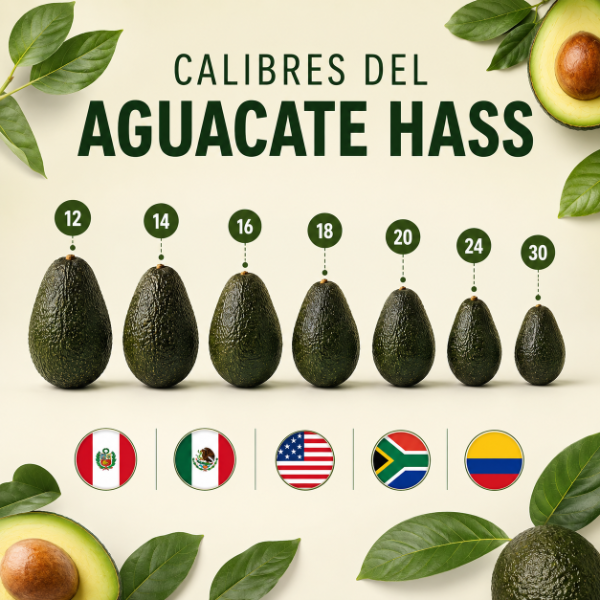
The classification principle is simple: the lower the size number, the larger the fruit.
In Europe, the most common reference point is boxes of approximately four kilos. Thus, a size 16 means that about 16 fruits fit in the box. A size 24, on the other hand, corresponds to smaller fruits because more units are needed to reach the same weight.
Within the European market, larger sizes typically start in categories like 10, 12, or 14, where the fruit can easily exceed 300 grams per unit. Sizes 16, 18, and 20 are further down the range, considered by many supermarkets to be the most balanced sizes for retail sale. Finally, smaller sizes like 24, 26, or 30 are usually geared towards promotions, individual formats, or segments where the unit price is more important.
The Centre for the Promotion of Imports from Developing Countries (CBI) in Europe and the Import Promotion Desk in Germany indicate that European supermarkets tend to favor medium and large sizes due to consumer preferences and the predominant marketing formats on the continent.
In the United States, the logic is similar, although the nomenclature differs. The industry primarily works with sizes 32, 36, 40, 48, 60, 70, and 84. Again, lower numbers represent larger fruit. Boxes are primarily 25 lb (11.3 kg).
The U.S. market has historically shown a strong preference for medium and small sizes, especially 48, 60, and 70, due to the weight of the retail and foodservice sectors, and the high consumption associated with guacamole and processed products. The U.S. Hass Avocado Board, the organization responsible for research and promotion of the industry, has indicated in various technical manuals that medium sizes are key to a consistent supply for the North American market.
Peru, Mexico and Africa: each origin has distinct profiles
The size of an avocado depends on multiple factors: climate, water availability, yield, agronomic management, orchard age, and genetics. Therefore, different countries have developed commercial profiles associated with certain sizes.
Peru is internationally recognized for producing large-sized avocados, especially during its peak season. Sizes 12, 14, 16, and 18 are frequently found in Peruvian avocados thanks to the desert conditions combined with modern irrigation and the vigorous productivity of its plantations. This characteristic has allowed the country to establish a strong presence in Europe, where these sizes typically command high prices.
Mexico, the world's leading producer and exporter of Hass avocados, focuses much of its supply on medium sizes such as 48 and 60 to serve the U.S. market. The enormous production scale in Michoacán and Jalisco also allows for a wide variety of sizes, although North American demand has historically favored medium-sized fruit.
The Association of Avocado Producers and Exporters of Mexico (APEAM) and the United States Department of Agriculture (USDA) have highlighted that the US market prioritizes homogeneous fruit and consistent sizes for supermarkets and food service chains.
California, for its part, typically produces medium and large sizes associated with premium segments of the US market. The California Avocado Commission and the Hass Avocado Board emphasize that harvest management, maturity, and yield directly influence the final fruit size and marketing strategy.
In Africa, countries like South Africa, Kenya, and Tanzania also typically produce medium and small sizes, particularly between 18 and 30, primarily destined for the European market. South Africa has also promoted varieties like Maluma, known for producing larger fruit.
The Food and Agriculture Organization of the United Nations (FAO) has indicated in various reports on fruit and vegetable trade that Africa has established itself as one of the main emerging centers of Hass avocado production to supply Europe.
Colombia presents a more variable reality due to the diversity of altitudes and production zones. Depending on the region and the season, the Colombian industry can produce both medium and small sizes, although it is still working to improve export uniformity.
A key factor for pricing and business strategies
Within the industry, caliber impacts virtually the entire commercial chain.
For growers, fruit size can determine a season's profitability. At certain times of the year, larger sizes fetch better returns in Europe, while during other market periods, medium sizes are in highest demand.
For exporters, fruit size serves as a strategic tool. A single harvest can be divided among different markets depending on the available size. Large fruit can be destined for Europe, while medium or small sizes find a better market in the United States, Asia, or through supermarket promotions.
Grading is also crucial for retail. Supermarkets design promotions, sales formats, and pricing strategies considering fruit size and consumption habits. Some markets favor large fruits for family consumption, while others prioritize smaller sizes for convenience, lower unit price, or less waste.
The United States Hass Avocado Board also points out that size directly influences cooling, storage, ripening and logistics handling during export, since different sizes require specific post-harvest behaviors.
Ultimately, Hass avocado sizes function as a universal language in global trade. Behind each number lies not only a specific fruit size, but also a marketing strategy, a consumer preference, and a business opportunity within an increasingly globalized industry.