EUROPE ANALYSIS
South Africa and Brazil double the volume of avocados to the European market
Europe reaches 1,051 shipments (+41% vs 2025) with Peru leading the way. South Africa and Brazil double their volume and medium sizes increase by up to 10%.
The European avocado market continued its strong performance in week 13, with a total of 1,051 shipments arriving on the continent. This figure represents a slight increase compared to the previous week, but, more importantly, a significant 41% growth compared to the same period in 2025, consolidating a marked year-on-year expansion.
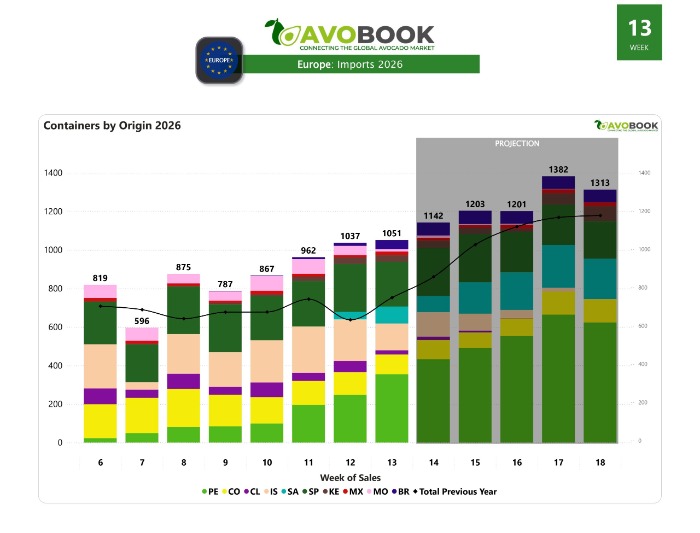
In this scenario, Peru stands out as the leading source, accounting for 34% of the total volume. Spain follows with 22%, and Israel with 13%, while Colombia reaches 10%. Further behind, South Africa is beginning to stand out, gaining ground in the market with 8%, a trend that has intensified in recent weeks. Brazil, with 5%, and Kenya, with 3%, complete an increasingly diversified map of origins, while Chile and Mexico each account for around 2%, and Morocco closes the list with approximately 1%.
The most significant movements are observed in the recent performance of certain players. In particular, Brazil and South Africa have more than doubled their volumes in a three-week period, reflecting a greater presence in the European market. In contrast, Chile and Morocco have registered the most significant proportional declines during the same period.
Regarding price trends, the market shows variations depending on the size. In Rotterdam, the largest sizes—such as 18 and 14—show a slight decrease of around 2%. Conversely, medium sizes, especially 24 and 26, demonstrate greater dynamism, with the latter registering increases of up to 10% in value. The smallest sizes, meanwhile, remain practically unchanged.
In the case of Spain, the behavior is different. The larger sizes are experiencing significant drops, around 15%, in a context of widespread adjustments in the local market.
Thus, Europe not only consolidates its growth in volume, but also reflects a reordering in the participation of origins and an increasingly marked differentiation in price behavior according to sizes.