Andrew Logan
What standards does avocado oil need to meet?
New Zealand
Defining Avocado Oil – Part 3 of 4. Proposed Specifications for Discussion
The Stage 3 objective is to encourage debate by raising discussion ideas. For this difficult-to-write article, I eventually decided to just share how AvoHealth offers Avocado Oil Buyers better/higher standards than Codex.
An interesting idea is that higher crude oil standards aren't so necessary, if the industry ‘self-regulates’ and manufacturers realise it’s crazy to make low quality crude oil for less sales $$$ as all problems can ultimately be ‘fixed’ by spending much more money on high temperature, chemical refining. But life’s not like that!
This week, some machinery salesmen suggested a 2022 research paper written by Selina Wang & Hilary Green proves Extra Virgin Avocado Oil can be made from whole avocado. As a great admirer of Selina Wang’s work, I question the ‘real-life’ credibility of that study. AvoHealth’s rule about being happy to eat all Extra Virgin Avocado Oil ingredients, is highlighted in this photo from a Marie Wong study.
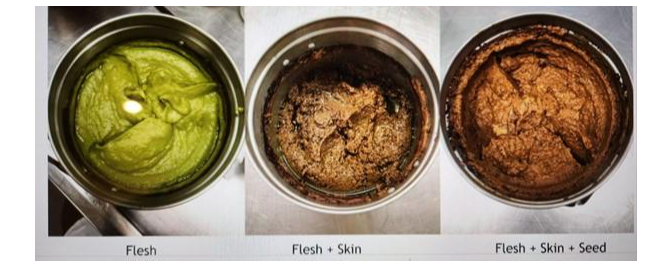
- Selina Wang’s tests might be more realistic, during hour #97 of a factory continuously processing 200,000 times more avocado, (14,000 kgs per hour). than the 70 gram samples she laboratory tested.
- Color, taste and smell of the oil must be an integral part of any assessment.
High Extra Virgin standards are very important, as no other ‘clean-up’ options occur after pressing, (e.g. treating with solvents, refining, bleaching, or de-odorizing).
Avocado Oil currently faces an enormous, international credibility problem. The solution starts with consistently high standards and ethical business behaviour.
Many stakeholders do not realise our industry is based on three closely related factors which are impossible for any factory to outperform:
- The Fruit - maturity, quality, ripeness of the fruit.
- The Machines - quality and suitability of each machine on the process line.
- The People - knowledge, skill and experience of the oil makers.
If fruit are rotten and/or one of 30+ process line engines is not suitable, and/or if business owners and staff, are not motivated or skilled enough, then ………!!
AvoHealth requires these standards for all Avocado Oil grades:
All fruit must ripen under a roof, as direct sunlight causes very uneven ripening. Laboratory tests often look great immediately after pressing, but the oil deteriorates in quality very rapidly from so much oxidation of fruit.
- Early in the process line, each whole avocado needs to be washed or rinsed.
- Each avocado entering a process line is assessed via a conveyor system. Over-ripe fruit are separated then processed after an Extra Virgin run finishes. Hard fruit are put aside until perfectly ripe, perhaps in the next day or two.
Manually sorting avocado in boxes is tough, (often) back-straining work. At 2,500 kgs per person per day average, it’s also very expensive.
- DeStoner must remove the seed and 90-95% of skin from each avocado.
- Recommend a Heat Exchanger warms all paste enroute to the malaxer, even though CODEX Draft version (25 October 2023), says: “Cold pressed oils are obtained, without altering the oil, by mechanical procedures only, e.g. expelling or pressing, without the application of heat.”
A long time ago, Switzerland’s very sensible regulation defined ‘Cold Press’ as temperatures ‘never exceeding 50°C from the fruit to oil-in-the-bottle’.
Growing on a tree, fruit temperatures may easily reach 50°C on a sunny day. It’s illogical if Codex requires lower oil extraction temperatures.
If refining at 220°-275°C is the objective, then (perhaps) the malaxing temperatures for Crude Oil don’t matter?
It’s common, but incorrect, to see “cold-pressed” on Refined Oil labels. It’s rather like saying: “Here’s your very hot cup of coffee. It was made using cold water. (before we boiled it)”
- Malaxer design causes debate. AvoHealth paste only enters one single, small malaxer unit. Small malaxers cost more per liter but offer better quality control of paste. It’s easy to switch between oil grades without interrupting production flow.
- AvoHealth decanters are set at three-phase, rather than two-phase, to achieve 3 separated waste products that are much easier to add value to. (1) seed/skin from Destoner, (2 + 3) paste and water from decanter.
- Electronic Scales accurately weigh oil, enroute from Vertical Separator to separate storage tank for each grade of oil. Flushing all tanks with Nitrogen or Argon gas, (both heavier than oxygen), forms a ‘protective blanket’ over the oil.
Vitone Eco is the only European machinery supplier, who fully understands and supplies the equipment we require. Their prices and quality are always excellent.
A line able to process 5,000 kgs of paste per hour, with all the specifications above, costs 70,000 Euro (approx. US$80,400) more than a line without that extra equipment. The AvoHealth line supplied by Vitone Eco:
- Creates higher quality oil with low FFA, Moisture Content & Peroxide Levels. Vibrant green color, and more pleasant taste and smell. cheaper to refine Crude Oil achieves higher value.
- The most difficult task making avocado oil is to ripen fruit perfectly. If this is achieved then it’s possible >95+% of production is AvoHealth Extra Virgin standard, currently earning about 40% more per kilogram than highest quality crude oil.
- In theory, slightly more oil is made by removing seed and skin. At a guess, yield might increase a maximum 0.75% when processing Hass Avocado.
- Many observers might ask: “What’s the big deal? There’s scarcely any difference between (say) 7.50% and 8.25% yield.”
- An extra 7.5 kgs of oil per 1,000 kgs of fruit from 75 kgs to 82.5 kgs of oil, represents a machine achieving 10% more oil.
Removing seed and skin from ‘local’ East African avocado varieties might achieve even higher yield increases, because local fruit often have:
- Proportionately larger seeds which absorb more oil when crushed.
- More moisture and less oil than Hass. Paste breaks down more efficiently in the malaxer, without any seed.
- Tougher, woody, thicker skin disrupts separation inside the decanter.
Removing Seed/Skin creates further benefit because it’s easier adding value to less toxic waste paste and waste water.
AvoHealth modelled a Kenyan waste paste and a waste water project; but unfortunately there is still no real data.
It seems easy to earn US$100,000 per production week from waste paste and potentially possible to earn +/-$750,000 from waste water at end of season. Sales value from seed and skin is not yet estimated.
Financial models show bulk oil sales, running machines described above, for 126 hours X 30 weeks, at full capacity, an AvoHealth system might earn 2.4 times (240%) more Sales $$, than a ‘traditional Crude Oil system averaging 8.0% FFA. This calculation includes value added waste paste and water.
Refinery Oil Buyers report that many factories FFA average is >8.0%.
We also know some factories achieve lower FFA and slightly higher earnings..
Every factory is ‘unique’. 12 months independent AvoHealth advice & tailored solutions, might cost about 4-5 hours production time. On a line working 3,780+ hours per year (e.g. as above) the benefits AvoHealth provides may last +/- 25 years.
The time needed to recover any additional cost to buy the
most suitable, equipment to consistently make highest
quality oil, is probably best measured by stopwatch!!
-----------------------------------------
AvoHealth suggests Codex Alimentarius Standard CXS 210-1999, dated 25 November 2024, needs to say:
Avocado Oil is extracted from the flesh (mesocarp) of avocado fruit (persea americana) When producing cold-pressed oils, only by expelling or pressing procedures, no ingredients can exceed 50° Celsius.
Extra Virgin Avocado Oil
Think about any large wine retailer with hundreds of different wine brands made from many grape varieties. Some people prefer red, white or rose, sparkling versus still wines, freshly pressed or vintage mature. And then there’s alcohol content, flavors, mouth feel and aroma.
Wine has been around for thousands of years. People pride themselves on their preferences. And that’s why this ‘mature’ market can easily have a significant range of products.
The market for Extra Virgin Avocado Oil is very different. Typically, supplies are limited and quality is often a ‘disaster’!
Poor product experience stopped many buyers. Retail consumers are not laboratory chemists, and they perceive the quality is too low for the price they pay, primarily based on poor color, taste and smell.
AvoHealth believes the market needs to be carefully ‘rebuilt’ with consistent and reliably excellent product. In future, we hope the market will become vibrant enough to handle Extra Virgin made from many different varieties of avocado.
In the meantime, a conservative market development strategy is necessary. For now, all our Extra Virgin product will be made from 100% pure Hass Avocado, and all labels will clearly promote this. AvoHealth currently seek a partner to make Extra Virgin to our specifications.
Avocado Oil Grades: It’s ‘high risk’ to sell retail consumers Virgin Avocado Oil. Buyers are never keen when they understand color, taste, smell, and laboratory Tests, might not be 100% perfect. There’s a very good case to only suggest:
|
Avocado Oil Type |
Conventional |
Certified Organic |
|
Extra Virgin |
☑ |
☑ |
|
Crude |
☑ |
☑ |
|
Refined, Bleached, Deodorised = RBD |
☑ |
☑ |
|
RBD plus Winterized = RBDW |
☑ |
☑ |
The charts below only show where AvoHealth specifications differ from Codex:
|
Code: |
Fatty Acid Name: |
Category of Acid: |
Codex Standards |
AvoHealth |
|
C16:0 |
Palmitic |
Saturated |
11.0 – 26.0% |
11.0 – 18.0% |
|
C18:0 |
Stearic |
Saturated |
0.1 – 1.3% |
0.4% - 1.2% |
|
Total Saturated Fatty Acids |
11.1 – 27.3% |
11.4 – 19.2% |
||
|
C16:1 |
Palmitoleic |
Mono-unsaturated |
4.0 – 17.1% |
3.5 – 8.5% |
|
C18:1 |
Oleic |
Mono-unsaturated |
42.0 – 79.0% |
55 – 74% |
|
Total Mono-unsaturated Fatty Acids |
46.0 – 96.1% |
58.5 – 82.5% |
||
|
C18:2 |
Linoleic |
Essential Fat |
7.8 – 19.0% |
6.0 – 18.0% |
|
C18:3 |
Linolenic |
Essential Fat |
0.5 – 2.1% |
0.5 – 2.0% |
|
Total Essential Fatty Acids |
8.3 – 21.1% |
6.5 – 20.2% |
||
|
Other Fats |
0.0 – 2.4% |
<2.0% |
||
Fatty Acid Profile: Avocado Oil prides itself on very high mono-unsaturated fats, and low saturated Fats.
Philosophical Issue: For avocado used to make oil, 2006 research suggested minimum temperatures of 8-10°C, perhaps just before sunrise, for at least part of the growing season.
In very hot Pacific Islands, SE Asia, India and NE Australia, saturated fats can reach 32-35%. Mono-unsaturated fat levels are correspondingly lower,
The oil looks cloudy, (‘turbid’) and is described as very difficult to work with.
Traditional East African and Mexican avocado growing areas are high altitude with cooler temperatures. AvoHealth strongly advises an Avocado Oil factory shouldn’t use fruit grown in areas that are ‘hot’ all-day-every-day.
The Codex 27.3% maximum total for the two main Saturated Fatty Acids, already restricts production in some areas (in theory). AvoHealth believes our clients do not want Avocado Oil with 27.3% Saturated Fats, so we do not offer such product.
|
Chemical & Physical Characteristics |
Current Codex |
AvoHealth Standards |
|
|
Free Fatty Acids: % as Oleic |
Extra Virgin |
not defined |
<0.5% |
|
Crude |
not defined |
>0.5% |
|
|
Refined |
not defined |
0.1% max |
|
|
Moisture Content: Karl Fischer Method |
Extra Virgin |
not defined |
<0.1% |
|
Crude |
not defined |
<0.2% |
|
|
Refined |
not defined |
0.1% max |
|
|
Peroxide Value: Milli-equivalents of active oxygen /kg oil |
Extra Virgin |
not defined |
<4 meq |
|
Crude |
not defined |
4 - <10 meq |
|
|
Refined |
10 meq max |
2 meq max |
|
Andrew Logan
Avocado Health Limited
WhatsApp:+64 21 428 645
andrew@AvoHealth.com
www.AvoHealth.com|