Avobook data reveals the behavior of avocado shipments from Jalisco outside the United States in 2025.
Jalisco and its exports outside the U.S.: what the 2025 data reveals
Canada and Japan account for Jalisco's exports outside the U.S., while Asia maintains a relevant role but is still far from the volume absorbed by the U.S. market.
The United States remains the primary destination for Mexican avocados, but 2025 export data also provides a clearer picture of shipments to other markets. Avobook's analysis shows that, outside the U.S., Jalisco's export business is concentrated in a few destinations and exhibits a fairly pronounced seasonality throughout the year.
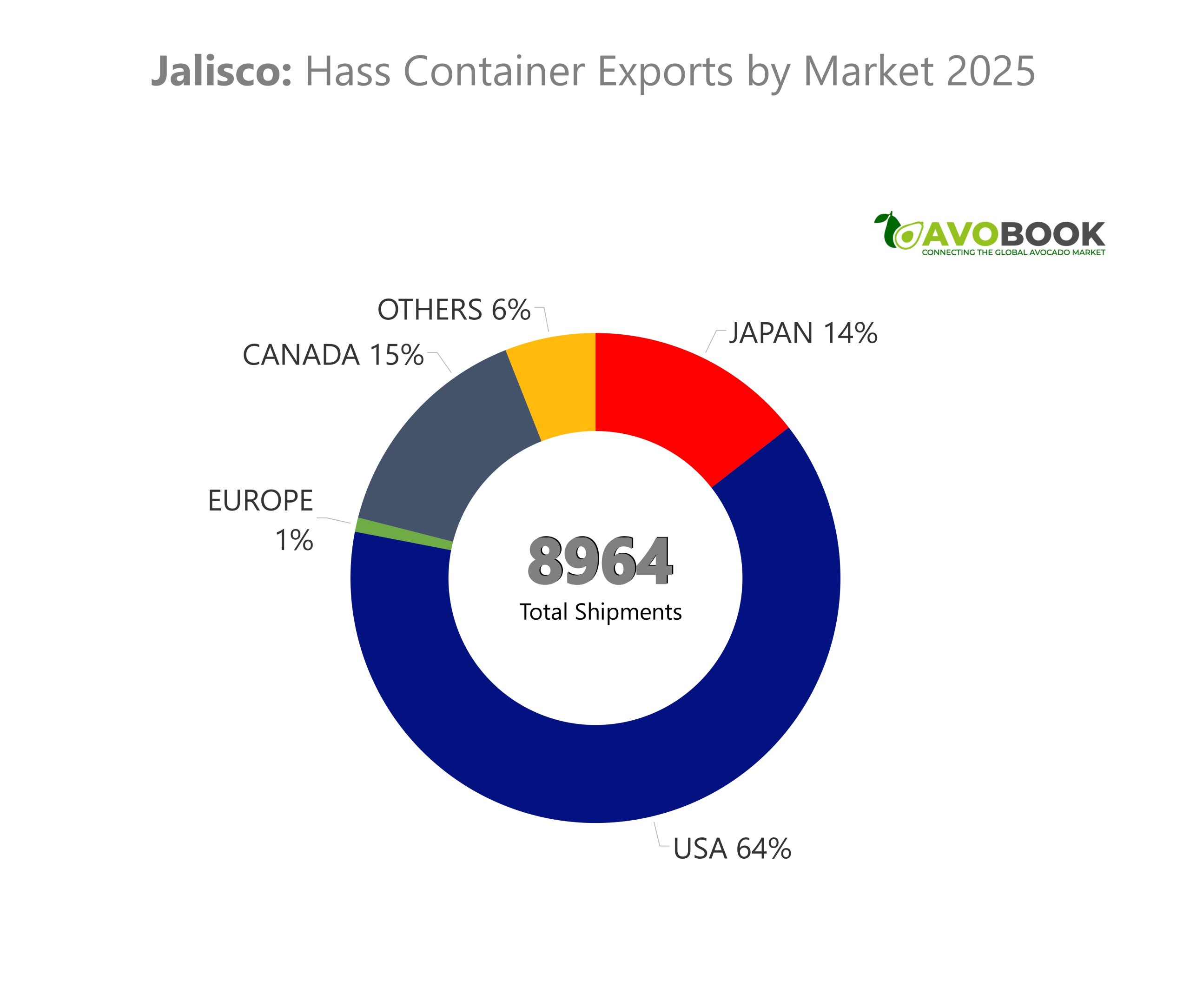
According to data from Avobook's team, outside the US market, shipments from Jalisco were primarily destined for Canada, which accounted for approximately 15% of shipments, followed by Japan at 14%. From there, considerably smaller volumes were sent to other destinations, including some Middle Eastern markets, certain European countries, and specific markets in Asia and Latin America. Overall, the business outside the United States is heavily concentrated in these two main markets: Canada and Japan.
The behavior of shipments throughout the year also reflects a seasonal dynamic. The data shows two particularly strong periods in 2025: the first at the beginning of the year, between weeks 3 and 6, and a second, stronger period between weeks 33 and 41. These two cycles are followed by a slight additional increase toward the end of the year. In both cases, the main driver of shipments was the US market, followed by Canada and Japan as significant secondary destinations.
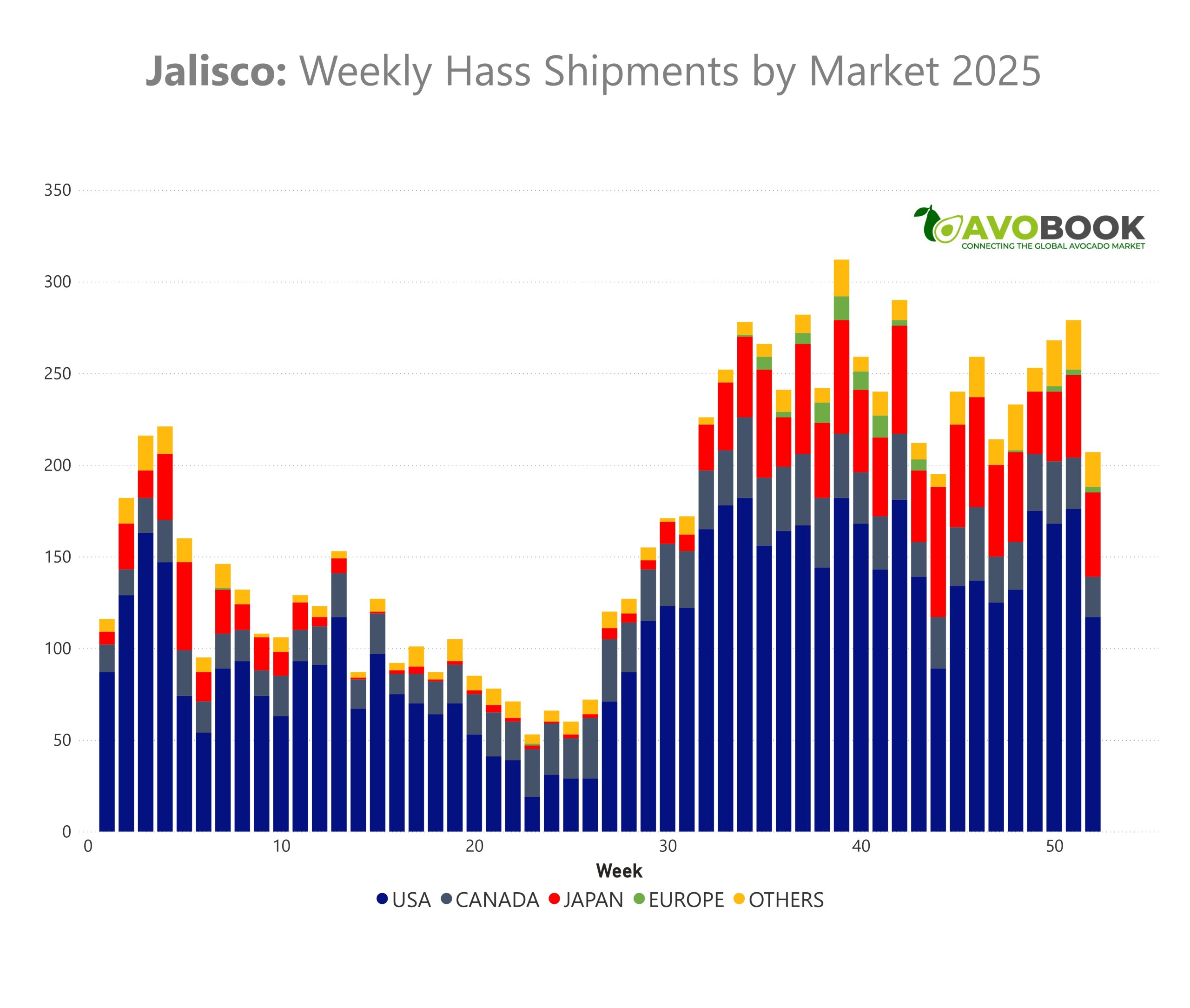
In contrast, between weeks 18 and 25, a clear decrease in shipments to virtually all destinations is observed. This period marks a general slowdown in export flows, which subsequently recover in the second half of the year.
Asia's performance also reflects this seasonality. The region is almost entirely dominated by Japan as a destination for fruit from Jalisco. Shipments to this market show a slowdown in the middle of the year, coinciding with the second quarter, before regaining strength in the second half of the year. The data do not show a structural decline in this destination, but rather a temporary adjustment in the second quarter followed by a subsequent recovery.
In terms of volume, Asia received approximately 1,800 avocado shipments from Jalisco during 2025. While this is a significant volume within the diversification of markets, it still falls far short of the U.S. market. During the same period, the United States received over 5,600 shipments, solidifying its position as the primary destination for Mexican avocados.
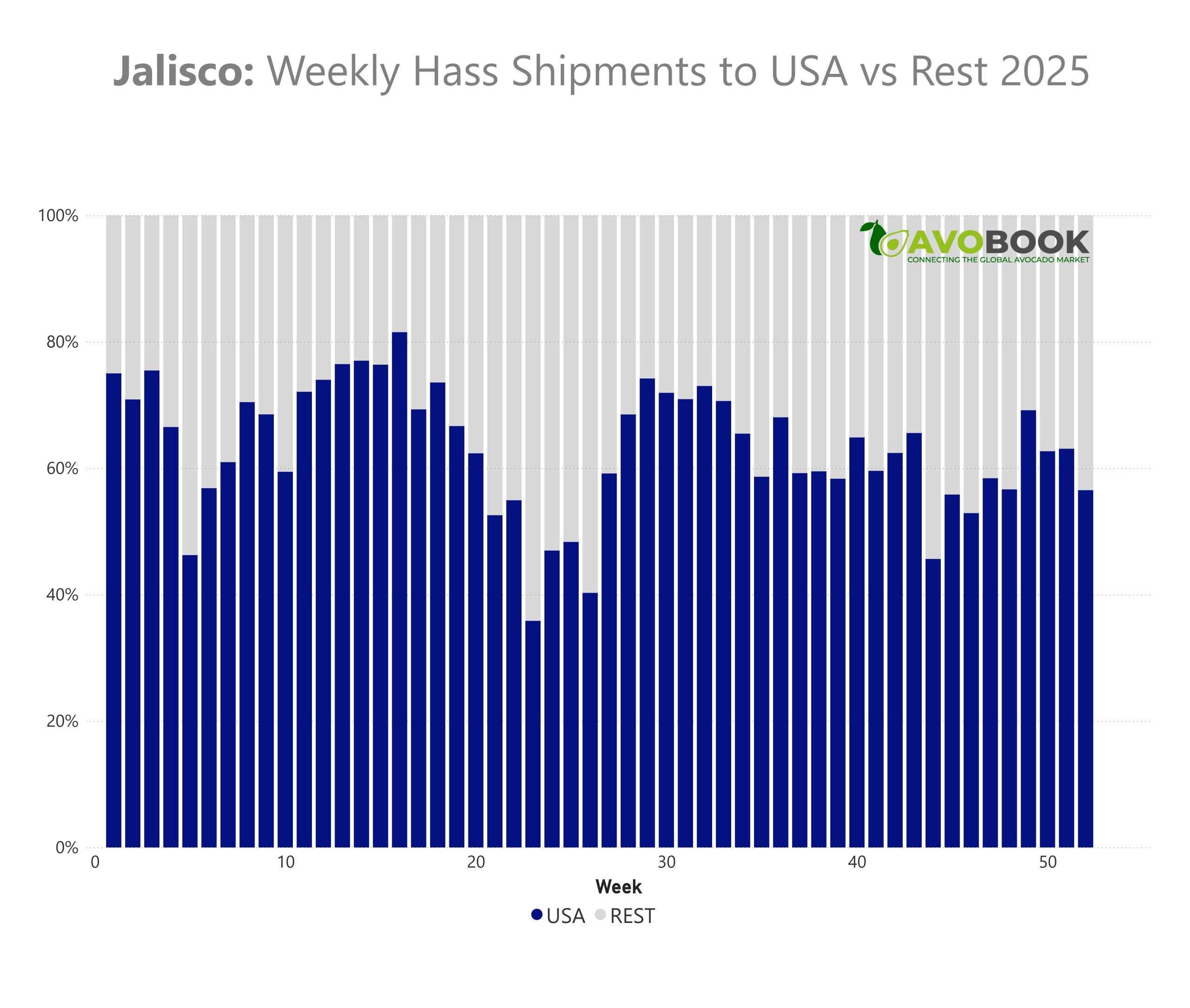
In this scenario, although markets like Canada and Japan play a significant role in diversifying the destination for Jalisco avocados, the 2025 data confirms that the United States remains the central focus of the export business. Asia, with approximately 1,800 shipments, represents an important alternative in the commercial strategy, but it is still far from the more than 5,600 shipments absorbed by the U.S. market during the same period.