Mercado internacional del aguacate
Aguacate de Jalisco mantiene a EE.UU. como principal mercado
Estados Unidos concentra el 64,5% de los embarques de aguacate de Jalisco en el acumulado de 2026, mientras Japón supera ligeramente a Canadá y se posiciona como su segundo mercado de destino.
Los embarques de aguacate de Jalisco mantienen una marcada concentración en Estados Unidos durante el año 2026. De acuerdo con los datos de Avobook, el mercado estadounidense recibió 4.062 de los 6.298 embarques registrados en el período analizado, cifra equivalente al 64,5% del total.
La participación de Estados Unidos ha aumentado gradualmente durante los últimos tres años. En 2024, el país recibió 4.494 de los 7.312 embarques observados, un 61,5% del total, mientras que en 2025 alcanzó 5.698 de 8.964, lo que representa un 63,6%.
Pese a la presencia de otros destinos dentro de la matriz exportadora de Jalisco, Estados Unidos incrementa su protagonismo hasta alcanzar el 64,5% en lo que va de 2026.
Canadá y Japón concentran los principales destinos alternativos
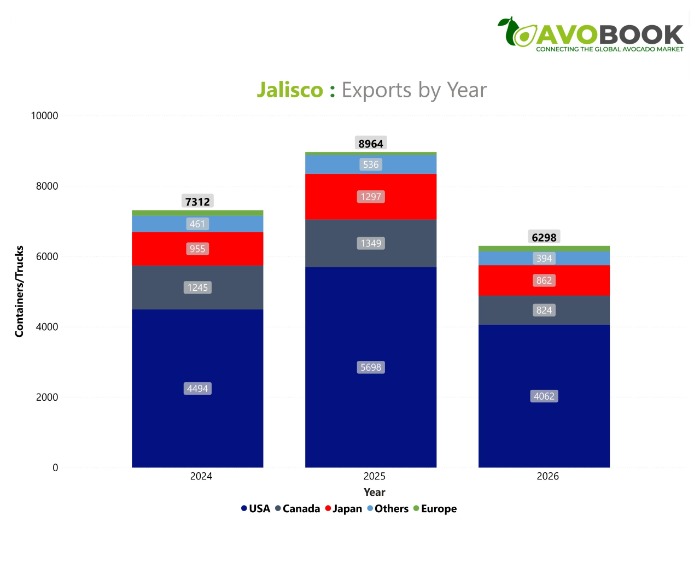
Fuera de Estados Unidos, los embarques de Jalisco se distribuyen principalmente entre Japón y Canadá. Durante el avance del 2026, Japón registra 862 embarques, equivalentes al 13,7% del total, mientras Canadá suma 824, con una participación del 13,1%.
Más atrás se ubican otros destinos en conjunto, alcanzando 394 embarques y representando el 6,3%. Finalmente, Europa registra 156 envíos, equivalentes al 2,5% del total.
La comparación con años anteriores muestra algunos cambios dentro de esta distribución. Canadá representaba el 17,0% de los embarques de Jalisco en 2024 y el 15,0% en 2025, antes de disminuir al 13,1% en el acumulado de 2026. Japón, en cambio, pasó del 13,1% en 2024 al 14,5% en 2025 y actualmente representa el 13,7%.
De esta manera, la diversificación de los embarques de Jalisco continúa concentrándose principalmente en Canadá y Japón, aunque ambos mercados mantienen una distancia considerable respecto de Estados Unidos.
Japón se posiciona como segundo mercado
Uno de los principales cambios que muestran los datos de 2026 está en el segundo mercado de destino. Japón acumula 862 embarques y supera por 38 a Canadá, que registra 824, invirtiendo el orden observado durante los dos años anteriores.
En 2024, Japón recibió 955 embarques de Jalisco, equivalentes al 13,1% del total. Durante 2025, el volumen aumentó a 1.297 y su participación alcanzó el 14,5%. En el período acumulado de 2026, registra 862 envíos y representa el 13,7%.
Canadá, por el contrario, ha reducido progresivamente su participación. Pasando del 15,0% en 2025 al 13,1% en el avance de 2026. La diferencia entre ambos destinos es actualmente estrecha, pero Japón se posiciona por primera vez en el período analizado como el segundo mercado individual para los embarques de aguacate de Jalisco.
Los datos muestran que Estados Unidos continúa ampliando su participación como principal destino, mientras Japón y Canadá conforman un segundo nivel con volúmenes similares. La evolución de estos mercados durante los próximos meses permitirá observar si el cambio de posiciones entre Japón y Canadá se mantiene al cierre del año.