European market
Europe faces high supply and pressure for sizes
The European Hass avocado market is entering a phase of abundant supply and stable demand, with strong pressure on smaller sizes and a growing prominence of Peru and Colombia.
The European Hass avocado market is experiencing a period of dynamic equilibrium in the second half of March, characterized by high supply volumes, strong demand, and increasing differences in size and origin. This is how Gabriel Katkovcin describes it, arguing that the current scenario is in a "comfortable" zone: neither overheating nor showing signs of a crisis due to surpluses.
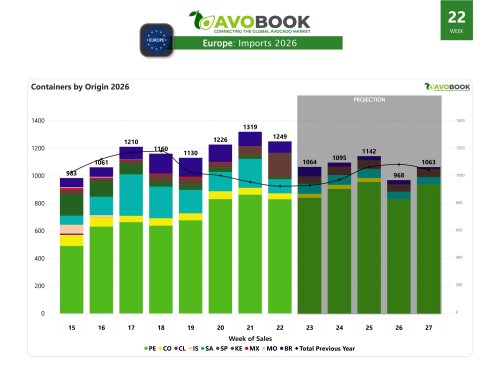
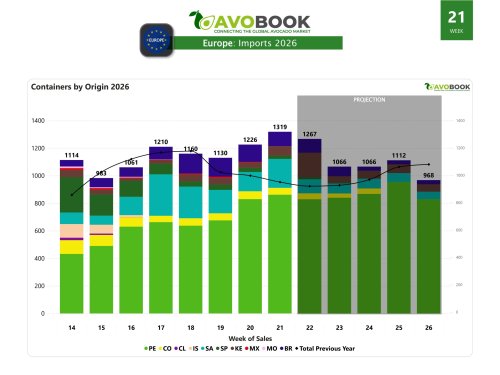
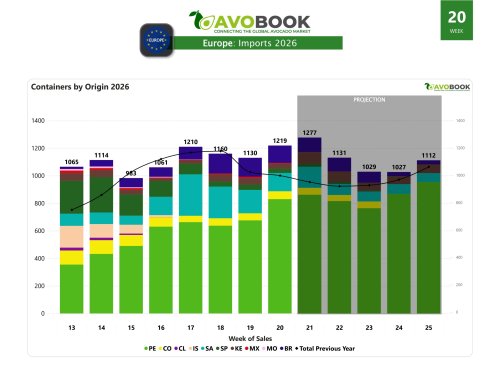
At major European ports, fruit arrivals are significantly exceeding last year's levels, creating an environment where buyers have greater selection capacity. The supply is broad in terms of both origin and quality, with traditional players—Israel, Spain, Peru, and Colombia—playing a leading role, complemented by countries such as Morocco, Chile, Kenya, and Mexico.
One of the most relevant features of the current market is its fragmentation. As Katkovcin explains, “the market is far from uniform,” with clear differences between northern and southern Europe.
In the north of the continent, particularly in ports like Rotterdam, smaller sizes face moderate pressure, with gradual price adjustments. In contrast, larger, higher-quality sizes remain more stable, driven by retail demand, where buyers continue to pay for fruit that meets high standards.
The situation is more challenging in southern Europe, especially in Spain, where the overlap between local production and imports intensifies the pressure on smaller sizes, leading to steeper price drops. In contrast, larger sizes—particularly those between 14 and 20—manage to maintain a healthier balance between supply and demand.
Peru and Colombia gain prominence
The progress of Peru and Colombia is another key element of the current scenario. Peru enters the season with a visible increase in export volumes and a strategy focused on improving timing and prioritizing quality in the early stages, avoiding saturating the market with low-priced fruit.
For its part, Colombia continues to consolidate its presence in key markets such as the Netherlands, Germany, Spain, France, and the United Kingdom. “From the perspective of European buyers, Colombia is attractive because it can supply for much of the year and react flexibly to peak demand,” notes the TITBIT executive.
Although Spain and Israel remain relevant during their seasonal window, the trend points to a progressive loss of participation compared to the sustained growth of Latin American origins in the coming weeks.
Regarding demand, European consumption of Hass avocados remains high, firmly established as a staple in the shopping basket. However, the growth rate is more moderate, and retailers are operating more cautiously, planning promotions more strategically and demanding stricter standards for quality, dry matter content, and uniformity.
Looking ahead to the next two to three weeks, the expectation is for a well-supplied market, with no physical shortage of fruit, generally stable prices, and persistent pressure on smaller sizes. In this context, Katkovcin concludes that the current scenario favors buyers in certain segments, especially those where supply clearly exceeds demand.