Logistics and the European market
Armed conflict impacts avocado trade in Europe
The war in the Middle East is driving up costs, reducing logistical reliability, and increasing the volatility of avocado trade in Europe.
The deepening conflict in the Middle East is ceasing to be a temporary factor and becoming a structural variable in international trade. In the case of avocados, its impact is not only expressed in higher logistics costs, but also in a more profound disruption to the system's operation: redesigned routes, less reliable transit times, reduced equipment availability, and increasing uncertainty in sustaining commercial programs at the destination. This is the view of Jorge Rosés W., International Sales Manager of the Seemann Group, as he analyzes how this scenario is affecting global operations and, in particular, the marketing of fresh fruit to Europe.
According to him, from a cost perspective the effect is already visible in the following aspects:
- The rise in oil prices has driven up bunker surcharges.
- War insurance is at very high levels or, in some cases, simply unavailable.
- There are extraordinary charges, such as war risk or contingency, applied by shipping companies such as Maersk, MSC or Hapag-Lloyd.
However, for Rosés the underlying problem is not only the increased cost of transport, but also the loss of efficiency of the global logistics system.
The reconfiguration of routes to avoid hazardous areas like Hormuz or the Red Sea has led to longer transit times, service suspensions or modifications, and more frequent use of hubs or multimodal connections. Although the total number of ships doesn't necessarily decrease, the fact that each one takes longer to complete its journey reduces the effective capacity available. In practical terms, the system becomes more expensive, slower, and, above all, less predictable.
How armed conflict affects avocado logistics to Europe
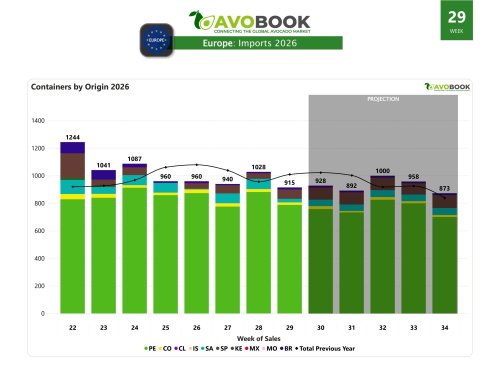
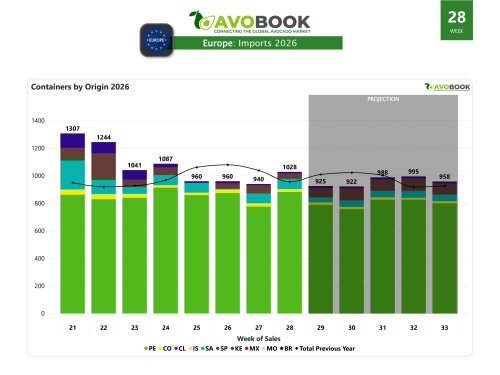
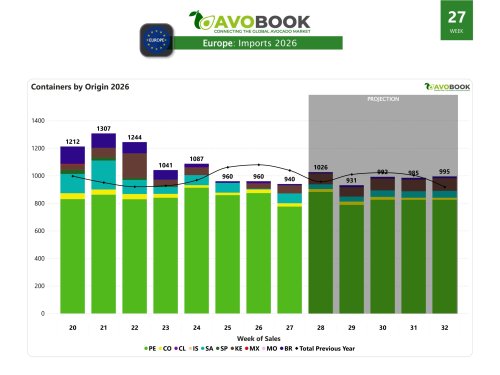
This shift in the landscape also impacts Europe, though not always due to the direct cost of freight. Rosés warns that the main effect stems from the disruption of logistical flows. Shipping companies are prioritizing the Asia-Europe axis, which redistributes capacity from secondary routes, such as South America-Europe, and disrupts the synchronization of arrivals. The result is an irregular supply pattern, with cargo arriving in waves followed by periods of lower activity, a situation further amplified by port congestion.
For avocados, this dynamic is particularly sensitive. The price no longer depends solely on the total volume available, but also on the precise moment the fruit reaches the market. In this context, price volatility increases, implementing programs with retailers becomes more complex, and the risk of commercial losses due to supply and demand mismatches grows. In other words, logistical instability ultimately translates into market performance.
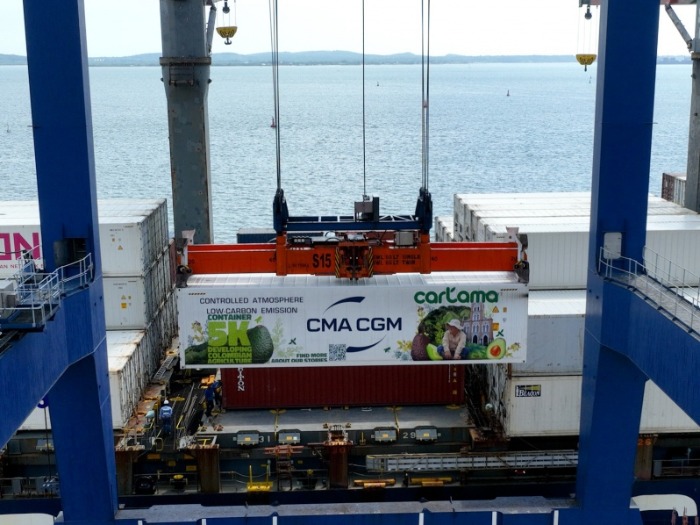
In the avocado trade from the west coast of South America to Europe, the impact is also direct. Although these routes don't directly cross conflict zones, they do experience the cascading effects of global adjustments made by shipping companies. Rosés points out that rather than a structural increase in travel times, what is observed today is greater variability: frequent itinerary changes, modified port calls, and a growing reliance on transshipments or last-minute adjustments. For a fresh fruit like avocados, whose supply chain depends on precise coordination between harvesting, transit, and ripening, the central issue is no longer how many days the journey takes, but rather how reliable that timeframe is.
Vessel availability is also suffering. By prioritizing services considered more strategic, shipping lines are reducing frequency or capacity on routes from South America, resulting in fewer boarding options, more limited space, the need to book further in advance, and a greater risk of rollovers. This is compounded by lower overall fleet productivity, as ships in other regions are sailing longer routes. For exporters, this represents a loss of operational reliability that directly impacts business management.
Why is volatility increasing in the European avocado market?
Another critical point lies in the reefer container circuit. Rosés warns that congestion in Europe and a lack of synchronization in arrivals are causing equipment to remain longer than usual at its destination, delaying its return to the production areas. This generates a shortage of containers at the point of origin, precisely at key shipping times. In the avocado business, this delay has immediate consequences:
- Higher costs
- Difficulties in obtaining equipment
- In some cases, the inability to board within the appropriate window
When that happens, not only is the logistics compromised, but the sale itself is also compromised.
From this perspective, the armed conflict is having an impact that extends beyond the operational level. The loss of timing can translate into a worse commercial situation or even lost opportunities, affecting the continuity of programs with European clients. For Rosés, this is one of the most concrete effects already being seen: a logistical problem that quickly becomes a commercial problem.
Added to this is an additional element: the loss of system visibility. Tracking, ETAs, and even congestion models now operate with less reliable information, forcing decisions to be made under a greater level of uncertainty. At the same time, the logic of maritime transport is no longer driven solely by commercial factors. Geopolitical elements are increasingly conditioning cargo movement, introducing real operational constraints and adding political risk to the logistics equation.
Under this scenario, the avocado industry faces a fundamental shift rather than a passing contingency. Volatility is emerging as the new normal, logistics networks continue to adapt, and alternative solutions are becoming a permanent part of operations. For exporters and marketers, this means learning to navigate a less certain environment, where logistical reliability becomes as crucial as fruit availability or demand levels.