Overview of avocado consumption in Brazil
Brazil
Avocado consumption in Brazil has distinctive characteristics in terms of consumption patterns, varieties, and season.
The country, the world's seventh-largest producer, with an estimated annual production of 400,000 tons, a volume that has fluctuated in recent years mainly due to climate variations, is known for its predominantly tropical varieties (Fortuna, Breda, Margarida, and Geada), which account for more than 90% of the total volume produced, while the Hass variety represents less than 10%. However, its market share has grown over the last five years, with an upward trend in both volume and share of total production.
National consumption is characterized primarily by the use of avocado in sweet recipes, with a special emphasis on avocado smoothies, a cultural tradition that spans generations. Tropical varieties are ideal for this type of consumption, as they contain less oil and are well-suited for this use. However, Brazilians are increasingly experimenting with savory recipes (guacamole, toast, salads) or eating the fruit fresh, using varieties with a higher oil content, especially Hass.
The increase in Hass avocado plantings has been remarkable, with total projected production reaching 100,000 tons in the next 5-6 years, which could represent between 20% and 25% of the country's total production. For tropical varieties, the trend we are seeing is the replacement of older orchards with new ones, which should lead to an increase in total production, as these areas exhibit greater technological adoption.
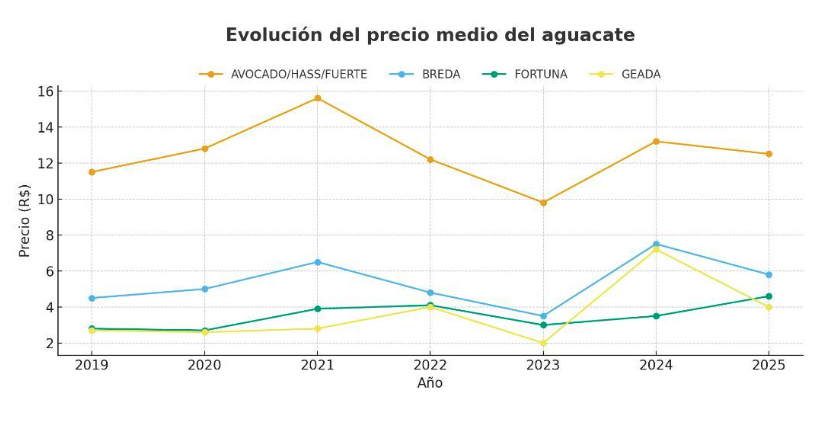
Given this new trend in production distribution, we face two challenges: increasing per capita consumption, currently around 1.7 kg/person/year, and educating Brazilians about the Hass variety, based on its skin color at the time of consumption. With a total annual volume of 100,000 tons of Hass, part of which will be destined for the export market and the rest for the domestic market, this action is crucial. According to CEAGESP, the country's largest fruit and vegetable receiving center, located in the city of São Paulo, the supply is concentrated between April and July (55% of the annual total), with the lowest supply between November and February (21%), with a price distribution by variety shown in the graph below (prices in reais – current exchange rate: US$1.00 = R$5.40).
The year 2023 was characterized by a sharp drop in prices across all varieties due to a very high supply. Hass avocados also commanded a higher price compared to tropical varieties, as they are consumed by a population with greater purchasing power.
We have enormous potential for growth in production, as well as for expanding domestic consumption and exports. Currently, we export between 25,000 and 30,000 tons per year, mainly Hass avocados, and this volume should soon reach between 50,000 and 60,000 tons annually. With an increase in per capita consumption to 2.5 kg/year, given the growth in consumption (population growth and greater adoption of the fruit in people's diets), we could reach a production of around 600,000 tons per year. We have land and a climate conducive to agricultural production, and we are expanding our knowledge of production technologies. More and more people are interested in entering the sector, which represents both a great challenge and a great opportunity.
 Adilson Luis Penariol Partner/director AvoPrime Ftutas SA adilson.luis@avoprime.com.br