Renzo Canepa
Commercial importance of analyzing sap in avocado orchards, considering storing fruit in the trees and harvesting with purely commercial objectives
Chili
- The Dilemma of Fruit "Hoarding"
Storing fruit on the tree is a financial gamble that comes at a high biological cost. Avocado trees have a natural tendency towards biennial bearing (alternate production), and delaying the harvest exacerbates this phenomenon.
- Commercial Advantage: Capturing higher prices in the domestic market and late export windows with lower global supply. Factors change year after year, making it crucial to understand market prospects through expert agents like Avobook.
- Physiological Disadvantage: The fruit acts as a massive "sink" for carbohydrates and minerals. The longer the fruit remains on the branch, the more it depletes the plant's reserves, directly competing with the development of summer shoots and the induction of flowering in the following season.
- Mineral Monitoring: "The Control Panel"
In a late harvest scenario, soil analysis is no longer sufficient; sap analysis becomes mandatory to adjust fertilization in real time.
Key Nutrients in the Transition
- Nitrogen (N): Essential for vegetative growth, but an excess in late spring can induce vigorous growth that competes with the fruit for calcium, favoring internal disorders.
- Potassium (K): This is the element of "transport". If we keep fruit loaded, the demand for K is very high to maintain size and fill. A deficiency here will weaken the chemical signal for floral induction.
- Boron (B) and Zinc (Zn): Both minerals are critical for pollen viability and bud differentiation. In trees depleted by old fruit, these micronutrients are often below optimum levels precisely when new flowering needs to be defined.
- Impact on Induction and the Upcoming Harvest
Avocado trees flower on wood produced in the previous season. If the plant is stressed by supporting the current load, phenomena such as the following occur:
- Hormonal Inhibition: The presence of ripe fruit generates hormonal signals (mainly gibberellins produced by the seeds) that inhibit the transformation of vegetative buds into floral buds.
- Competition for Reserves: The starch stored in roots and trunks is depleted. Without reserves, next spring's flowering will be weak, with low-quality flowers and poor fruit set.
- Mitigation Strategy: The Role of Precision
If the business decision is to go for late prices, nutritional management must compensate for the depletion:
- Extreme Fractionation: Nutritional gaps cannot be tolerated. The use of moisture and electrical conductivity sensors in the irrigation bulb ensures a consistent soil solution.
- Biostimulation: The use of specific amino acids and seaweed extracts (Ascophyllum nodosum) helps the plant to manage the abiotic stress of maintaining a heavy load with summer temperatures.
- Arginine Analysis: Monitoring this amino acid in roots towards winter will tell you how much "fuel" the tree has to cope with flowering after being pushed to its limits.
- Girdling: A common and very efficient practice for inducing flowering for the next season. However, the malnutrition that the tree may suffer from due to late harvests or high yields will prevent the flowers from setting, and even if we achieve high flowering, the production will not be as beneficial as expected.
Summary for Decision Making
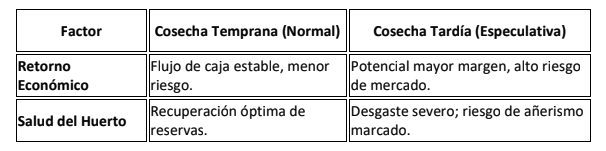
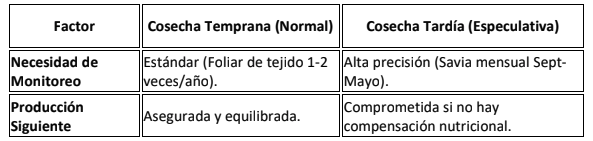
Conclusion: Delaying the harvest in Chile is a valid tool, but without high-precision nutritional monitoring, what is gained in price this year could be lost (and then some) in yield the following season. The key is to "feed the older fruit while continuing to nourish the tree in preparation for new blossoms . "
Renzo Canepa Gutierrez
Chili
renzo@agrocanepa.cl – +56 9 79053241
Agro Canepa SpA