Grace Ngungi
Kenyan avocado: strategic growth in the face of global challenges
Kenya
According to Kenya's avocado export data for the first half of the year, the market outlook is very strong. Exports have reached a nominal value of $174 million, and if the current trend continues, Kenya will surpass its 2024 export figure of $251 million.
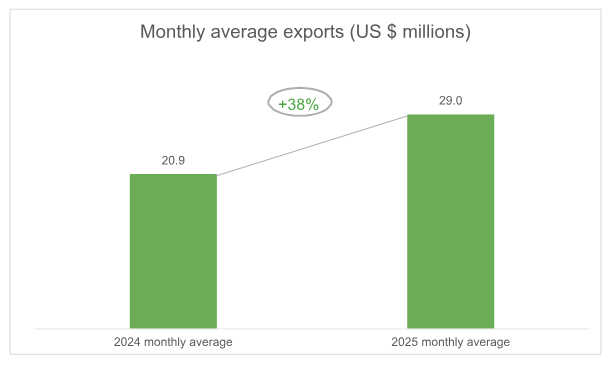
During the first half of the year, year-on-year growth was 19.86%, compared to Peru, whose figure fell by 16.74% in the same period. Average monthly export earnings increased by 38.7%, reflecting better planning and earlier participation in the season.
In recent years, Kenya has significantly expanded its orchard area, from 14,000 hectares in 2016 to a projected 34,000 hectares in 2025 (according to the USDA Foreign Agricultural Service). This growth is driven by favorable weather conditions and enabling policies. Overall, Kenya's export growth is on track to reach 38% at current volumes, outpacing the global compound annual growth rate of 7%.
Markets: According to Kenyan customs data, Europe remains the primary export destination. During the period, 66.08% of exports went to Europe, with the Netherlands, Italy, Turkey, and Spain being the main buyers. Although the Netherlands, France, and Germany are important European markets for Kenya, sales volume fell significantly by 19%, 11%, and 9.59%, respectively, which is attributed to the long transit times to these destinations.
Growth : The highest growth in exports to newer markets such as China and Italy (197.70% and 191.39% respectively) stands out, followed by Turkey (72.94%) and the United Arab Emirates (71.2%), according to Kenyan customs data. Shorter transit times make these destinations more attractive for businesses.
Logistics and Supply Chain Bottlenecks: The industry continues to face various challenges, including long transit times, which cause supply disruptions and price pressure due to overlapping seasons. This extended transit time increases shipping costs, raises risk factors, and reduces avocado exports to Europe and the UK. To mitigate these problems, Kenyan exporters have diversified their destinations to markets with shorter transit times.
Seasonality and Supply Windows: In 2025, the season started early in some of Kenya's major avocado-producing regions, allowing exporters to obtain better prices due to fruit shortages. In 2024, Kenya's average monthly exports were US$20.9 million, and in 2025 the average monthly figure rose to US$29.0 million, representing a 38.7% increase (Kenyan customs data). Kenya's diverse production areas offer year-round trading opportunities, providing buyers with both early and late market windows.
Supply dynamics by small producers
Unlike other avocado-producing countries, production in Kenya is driven predominantly by smallholder farmers in the Muranga and Kiambu regions. These smallholder farming areas produce 70% of Kenya's exported avocados. For exporters, achieving quality and consistency by sourcing produce from multiple farmers in different areas is a significant challenge. Karakuta Fresh Produce.
Supply dynamics by small producers
Unlike other avocado-producing countries, production in Kenya is driven predominantly by smallholder farmers in the Muranga and Kiambu regions. These smallholder farming areas produce 70% of Kenya's exported avocados. For exporters, achieving quality and consistency by sourcing produce from multiple farmers in different areas is a significant challenge. Karakuta Fresh Produce supports farmers in accessing high-value markets through training and certification in global agricultural practices. “Our partner farms grow fruit like we do and pack it alongside us, adhering to our customers' standards. Packing facilities are becoming the fastest-growing pillars of competitive advantage. The physical proximity of our facility enhances fruit traceability and quality monitoring,” says Grace Ngungi, CEO of Karakuta Fresh Produce.
Market: Exporters rush to avoid the 'Peruvian flu'. The avocado season in Kenya starts slightly earlier than in Peru. This creates a brief but strategic export window that guarantees high gross margins for exporters.
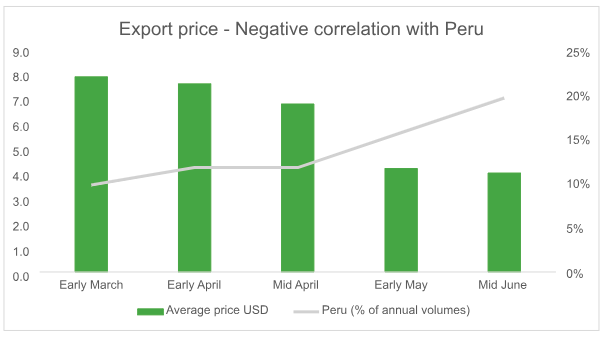
European prices and seasonal dynamics The average European price for Kenyan avocados remains strong from March until mid-April. However, in May, when Peru releases 16% of its annual supply, the market is flooded, and Kenyan exporters are unable to export in a cost-effective manner.
Future projections Kenya's export market has become more coordinated in 2025, and increased attention from high-value importers is driving growth. However, the saturation of the European market by Peruvian producers will continue, which carries the risk that Kenyan exporters will become "hit-and-run" businesses.
Fortunately, Kenya's diverse geography allows for a second growing season. While achieving the current average growth rate of 38.7% seems unlikely, the mountainous regions have the potential to maintain Kenya's momentum. These winter-harvesting areas are resistant to the "Peruvian flu" and are the fastest adopters of avocado cultivation, making them attractive for professional orchard investments.
Furthermore, Kenyan exporters are among the most sophisticated and currently possess the legal and financial capacity to engage in regional sourcing, facilitated by the AfCFTA's regulatory environment. As a result, previously overlooked fruit-producing countries can now access the market, improving rural livelihoods.
Strategies
Focus on high-quality clients in high-value markets such as the Netherlands and Spain. In a highly price-sensitive market, it is essential to understand changes in the overall supply to remain competitive. For example, in May and June, when Peru is present in the market, Kenyan exporters should shift their strategy and focus on markets less affected by the saturation of Peruvian fruit.
Added value
Often, second-grade fruit is used for oil extraction, which generates less than a dollar. Integrating value-added systems like IQF (individually quick freezing) and oil extraction is needed, not only to diversify revenue streams but also to mitigate business risk from seasonal volatility. The ability to change product formats increases flexibility and customer retention, especially during times of crisis.
Emerging markets Kenya is looking to develop alternative markets with shorter transit times. While these offer lower prices, they also provide more stable and reliable rates during the "Peruvian flu" (a period of high water pollution).
Grace Ngungi - Karakuta Fresh Produce LTD. CEO | +254 722516878 Moses Karanja - Karakuta Fresh Produce LTD. | +44 7522196521 Kenya