Ricardo Acha
End-of-line automation vs. manual processes: beyond efficiency... let's talk about effectiveness!
Peru
In today's agricultural export industry, the end-of-line processes in post-harvest handling (those operations encompassing everything from fruit packaging to pallet readiness for storage or shipment) can represent a critical bottleneck. Their primary function is to prepare the product for storage or shipment, ensuring quality, safety, traceability, and logistical efficiency, thereby reducing costs and errors.
While continuous packaging lines have evolved in speed and technology, many plants still rely on human effort for palletizing and strapping, impacting the profitability of the operation, a situation that is very common in markets where labor is cheap.
What considerations should we keep in mind when choosing one or the other work modality?
1. Productivity and Operational Continuity
The fundamental difference lies in consistency. An automated system doesn't experience fatigue and can work accurately and consistently 24 hours a day, if necessary. In contrast, in manual mode, performance varies from person to person, and for the same person, it declines as the shift progresses. Furthermore, working during the day is not the same as working at night.
In avocado handling, pallets are tall, exceeding 2 meters in height depending on the box size. Manually palletizing 10, 15, or 17 kg boxes under these conditions increases the risk of errors and accidents. In automated mode, whether using a Cartesian system or a robotic arm, a sustained throughput (20-30 boxes/min) is guaranteed, ensuring that the packing line does not stop.
2. Stacking Quality and Load Safety
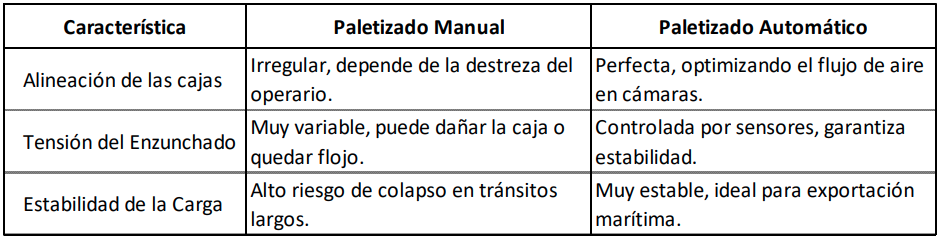
In fruit exports, a poorly assembled pallet means loss at the destination. The precision of automation guarantees the integrity of the product during transit.
3. Occupational Safety and Ergonomics
Manual palletizing and strapping are ergonomically demanding tasks. Operators are exposed to lower back injuries due to heavy lifting and repetitive movements. In this regard, automation drastically reduces work absences and the costs associated with workers' compensation insurance, transforming the operator's role from one of "physical exertion" to that of "machinery supervisor."
4. Return on Investment (ROI) and Operating Costs
Although the initial investment in palletizing cells and automatic strapping machines is high, the resulting cost per pallet produced will decrease significantly in the medium term. Automation will allow for: - Reduction of losses and future claims: less fruit damaged by rough handling. - Savings in supplies: automatic strapping optimizes material use, applying the exact amount of strapping per pallet. - Scalability: It allows for handling harvest peaks without the need to hire and train large numbers of temporary staff.
5. Company image: a great business card
Ensuring that each of our pallets of finished product arrives at its destination in optimal condition, intact, with boxes well stacked and mounted on top of each other, without visible damage, and strapping at the same height and pressure on each and every pallet, is synonymous with our respect for the market and a high standard of work.
The neatness of our shipments, beyond the aesthetic aspect, is a direct message to the customer about the care and professionalism of our company.
6. Availability and cost of end-of-line personnel
In industrialized countries, automation is not a mere whim; it is a necessity, a strategic decision throughout the entire production chain, driven by the high cost and scarcity of labor—factors that leave companies with no other option. Labor costs can be ten times higher than in Latin American producing countries, where a low-cost workforce is still readily available.
Conclusion
The transition to automated end-of-line production is not just a matter of modernization; it's a strategic issue and a matter of logistical survival. In a market where fruit margins are tight and the demands of international receivers and retailers are high, the precision of an automatically assembled pallet offers a competitive advantage that manual labor simply cannot match.
End-of-line processes in the agricultural industry are the final critical stages of the post-harvest chain, including automated packaging, labeling, inspection, weighing, palletizing, and strapping. Their function is to prepare the product for storage and transport to its destination, ensuring quality, safety, traceability, and logistical efficiency, thereby reducing costs and errors.
Ricardo Acha
General Manager , PROYECTA Associates
+51-989177896
ricardo.acha@proyectasociados. com
Peru