The anxiety of curdling in Hass: Peruvian campaign 2024
Every spring or during flowering season, it's normal to feel anxious about how the event will unfold, as the success of the campaign depends on it.
The moment the newly set fruit begins to fall, the technical teams become anxious that the fruit set is poor. Let's not forget that 10,000 flowers are needed to harvest one fruit, so if a tree bears 80 kilos of fruit (400 fruits) at harvest, it means there were 4 million flowers. Therefore, more fruit clusters should be visible on the ground, among the flowers and small fruits, than those hanging on the tree.
As the current campaign unfolds on the Peruvian coast, there is no excessive heat, and this is corroborated by the ETo values.
These low and variable evaporation rates, along with other factors related to technical management (and not solely radiation), are precisely what cause the physiological decline expected in December and January. How can this process be understood?
- A spring with variable cloudy and sunny days, and high and low ETo levels translates into disordered risks in volume, frequency, and bulb salinization; therefore, alarms are activated that something is happening in the plant, and one of these risks is the synthesis of ethylene, which induces fruit drop.
- This season, the quality of the bee colonies was poor, with incomplete frames, which will negatively affect fruit set. Furthermore, as I've mentioned in several talks, bees must be managed and encouraged to collect pollen from pollinators, not just Hass, which is what usually happens in fields where this concept isn't applied. Simply placing bees along the paths and not forcing them to collect pollen from pollinating varieties located at pollination stations obviously makes their work less efficient for maximizing Hass productivity. It's also important to understand that in years with less favorable springs for fruit set, a fruit with hybrid vigor (Hass mother, pollinating father) will have a higher percentage of fruit set and better fruit size at harvest.
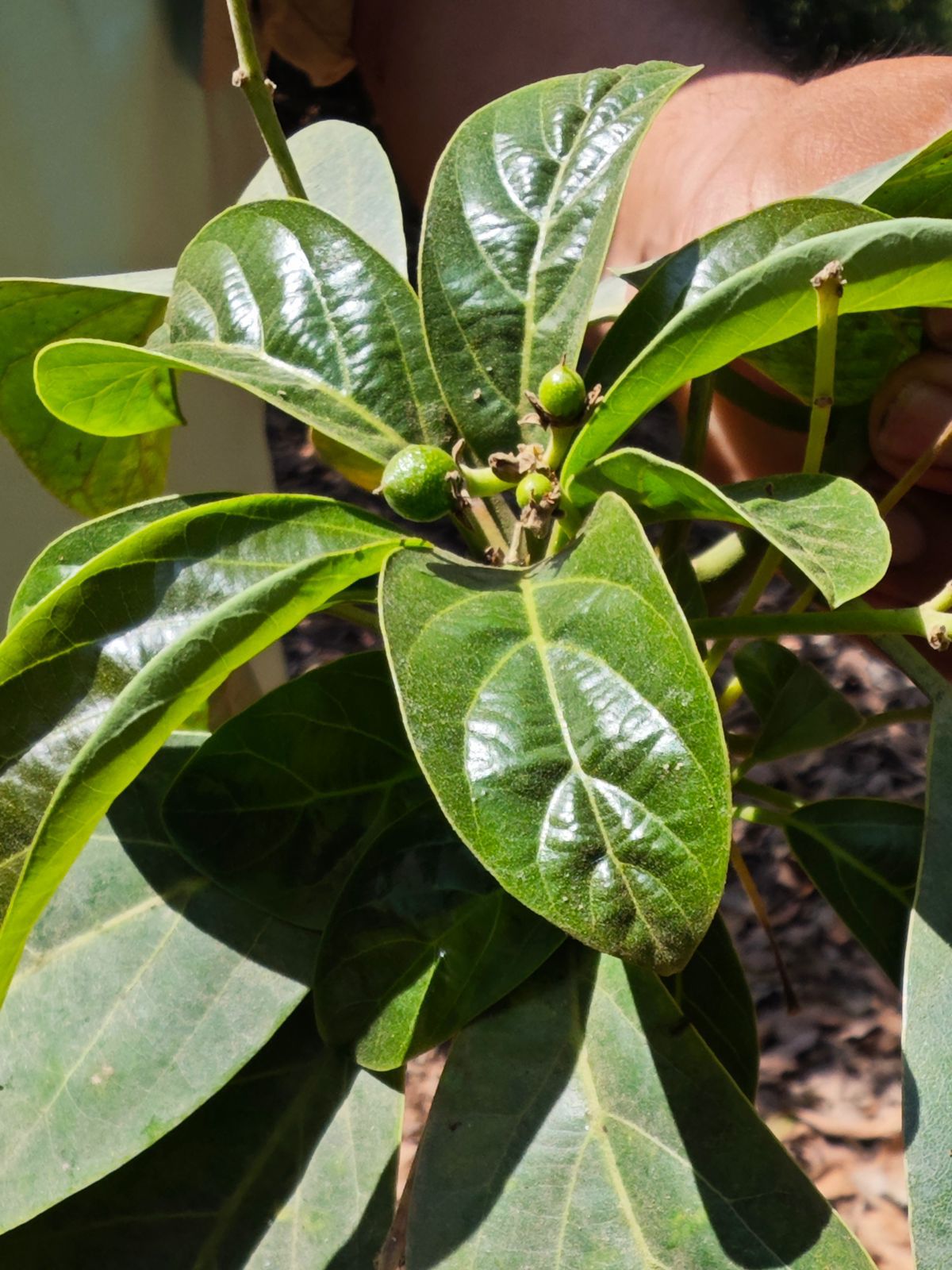
- The use of growth regulators has been observed in many farms, at low concentrations. However, for these to be effective and alter the plant's behavior to improve fruit set and temporarily slow down growth, wrinkling of the leaves of new shoots should be observed. The argument heard is that they don't want to
The photograph shows how the leaf looks after the correct use of regulators.
- There's a fear of nitrogen fertilization because it causes fruit abortion, but when you look at foliar and flowering analyses, the nitrogen level is low at flowering and fruit set. Complementing this is the need to build up nitrogen reserves in the plant between summer and winter. It's important to understand that nitrogen, when used correctly, improves fruit set and size, not the opposite. Having had the opportunity to advise in several countries, a recurring factor when there's low productivity is the reluctance to apply nitrogen and the fear surrounding its use. Ironically, amino acids are applied to promote fruit set, but not nitrogen (which is what produces amino acids).
- Personally, I don't analyze radiation as an isolated factor; it must be incorporated into orchard management. If it's said to be high, then logic dictates that more shade should be provided and less in the orchard itself, the soil should be covered with mulch in new plantings that don't yet cast shade, and irrigation should be done correctly—it's better to over-irrigate than under-irrigate.
- Fruit tree management. The most productive branch in Hass avocados is the vigorous sucker, and this is the explanation: the current season, this is why the fruit is located in the upper part of the trees. It's not the height that explains this, but rather that the suckers are vertical, and the Hass avocado's production habit is to bear fruit at the tip of the sucker. Furthermore, if we link this concept of suckers to radiation, it would be worthwhile to question whether the tree in the outer and upper part is where it is most exposed to radiation, which would be negative for production, so why is that where the greatest amount of fruit is located? Therefore, let's not blame radiation for a poor result.
We need to make the tree work for us, not the other way around. In nature, the law of least effort applies, meaning that a small stimulus produces a large result or response. I feel that avocado tree management is becoming much more complicated as we try to better understand the environment that makes the tree work from within.
It's that simple if you simulate generating the microenvironment from which the variety we're working with originates. It's important to understand that this microenvironment is the starting point, not the inhospitable environment that surrounds it.
Marco Mattar Fajardo
Colombia