Gary Clevenger
California Avocado Market Report
USA
Pre-season harvest estimate for 2026 and volume flow projections
(CAC/AMRIC survey of handlers – December 2025)
Market overview
According to the CAC/AMRIC survey of December 2025, California's avocado harvest in 2026 is estimated to reach 330 million pounds in total, distributed as follows:
- 310 million pounds of Hass
- 8 million pounds of Lamb
- £11 million from GEM
- 1 million pounds of other varieties
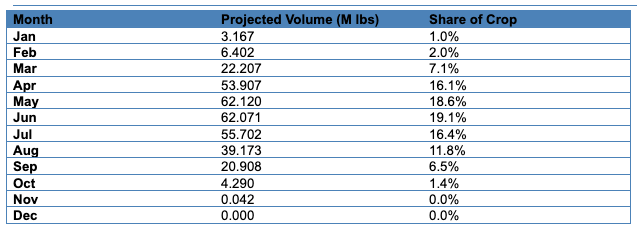
Monthly CAC volume projection (Flow, not harvest recommendation)
The CAC estimate projects when California volume is expected to move through the supply chain (handlers/shippers). It is not guidance on the “best time to harvest.” The harvest timing continues to be determined by fruit maturity, size, condition, and real-time market signals.
Projected monthly distribution (total harvest):
Highlights of the weekly curve
The report compares the historical weekly pattern of the last 4 years with the AMRIC managers' forecast for December 2025. The weeks of greatest activity are concentrated between the end of May and the end of June, and the managers' forecast shows a stronger push towards the end of summer (August) compared to the 4-year curve.
Examples of peak weeks (total volume):
-
Week ending May 24: 16.777M (managers) vs 16.597M (4 years).
-
Week ending June 28: 16.835M (managers) vs 16.453M (4 years).
Divergence at the end of summer:
-
Week ending August 9: 10.710M (managers) vs 7.236M (4 years).
-
Week ending August 16: 10.439M (managers) vs 7.095M (4 years).
Import overlap: Mexico + Peru
The calendar for Mexico and Peru is relevant when considering price risks and the "convergence window" in May/June.
-
Mexico: Exports year-round, but the USDA notes that its peak season is from December to February (over 35% of exports), with the Super Bowl being a strong driver of demand. After February, the market typically moves out of the Mexican peak window, although Mexico remains a consistent supply base throughout the year.
-
Peru: its season is concentrated in spring and summer. The USDA indicates that the peak harvest months are from May to August, and that most exports occur between March and August.
Conclusions for producers (3 key points)
-
The CAC estimate is for volume flow, not a harvest recommendation. The optimal harvest time continues to be determined by maturity, size, fruit condition, and market signals.
-
Early size can be an advantage. Last year, those who harvested before the heavy flow (when they were at the correct size) achieved better returns; waiting for the busiest window increased the risk once the channel became saturated.
-
Pay attention to the May/June convergence. The strongest flow projected by the CAC coincides with Peru's seasonal strength (May–August), while the industrial sector is moving past Mexico's peak (December–February). This overlap could quickly put pressure on the market.
Conclusions for buyers / retail
Retailers should continue planning promotions around the California Open Season (CAS) flow—April through July is the heart of California's peak season—but with flexibility. If growers achieve early sizes and harvest before the peak, volumes can be brought forward. When the convergence window arrives, repeating campaigns and maintaining strong displays is what ensures fruit movement and stabilizes the business.
The central message
The CAC indicates when California's volume is expected to enter the market, not when growers should harvest. In 2026, the harvest strategy must balance early-size opportunities with the risk of convergence in May/June, when California's strong period may overlap with Peru's peak, while Mexico emerges from its winter peak.
Gary Clevenger
Freska Produce International, LLC
gary@freskaproduce.com